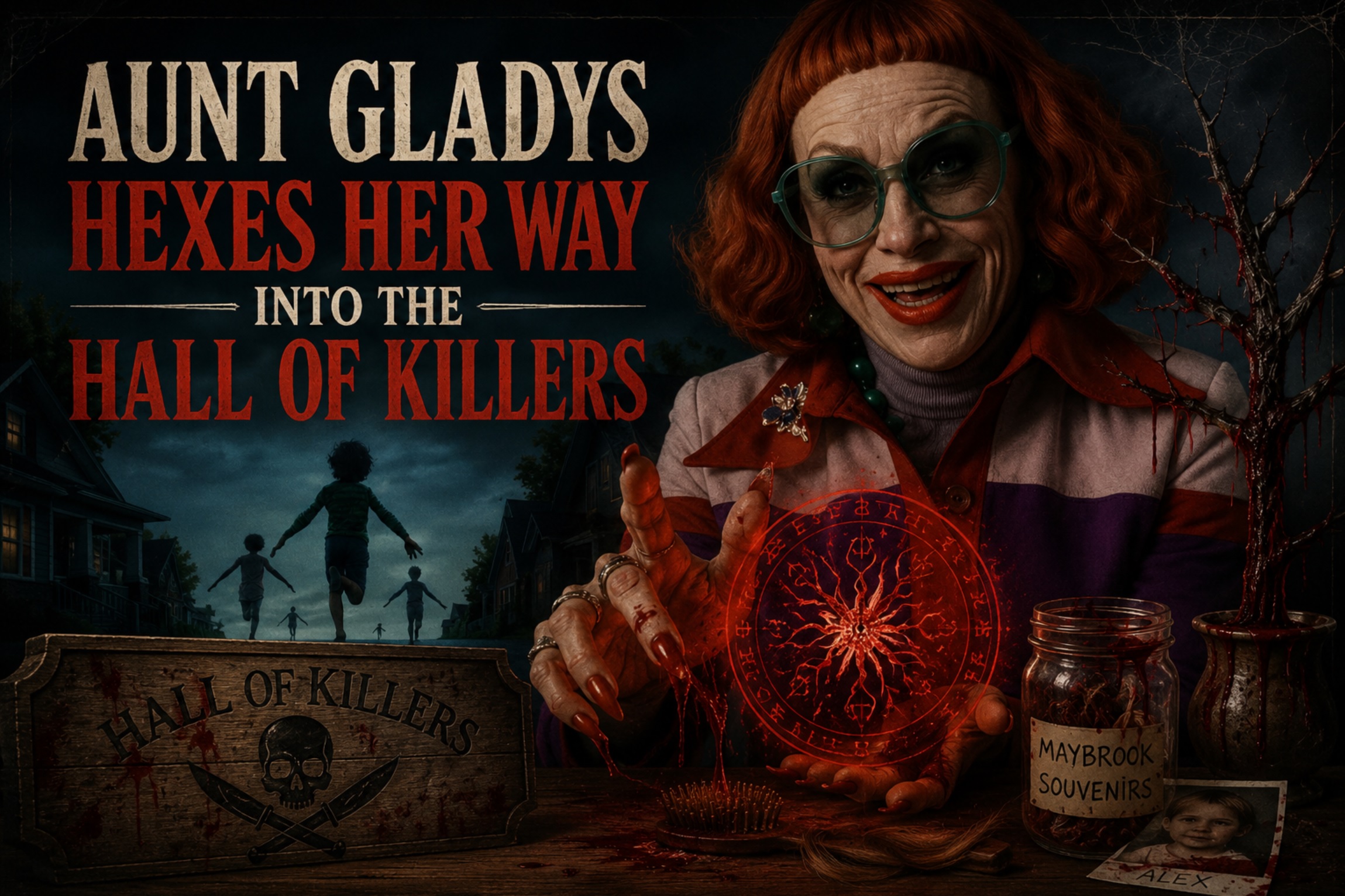
Aunt Gladys Politely Hexes Her Way into the Second Class Tier
Every now and then, a horror villain comes along who reminds us that you don’t need a chainsaw, a hockey mask or an unhealthy obsession with sharp gardening equipment to become utterly terrifying. Sometimes, all you need is a warm smile, impeccable manners and the ability to enslave an entire town through ancient witchcraft. It’s a surprisingly effective combination, and one that has earned Aunt Gladys, the unforgettable antagonist from Zach Cregger’s Weapons (2025), a well-deserved place in the Second Class Tier of the Hall of Killers.
On paper, Aunt Gladys shouldn’t work as a horror icon. She’s an elderly woman who speaks softly, never seems particularly flustered and carries herself with the sort of calm dignity you’d expect from someone who reminds you to put a jumper on because “it’s a bit chilly outside.” If she invited you in for tea and offered you a slice of Victoria sponge, you’d probably accept without a second thought. Five minutes later she’d have stolen a lock of your hair, drawn a blood sigil on the kitchen table and condemned your entire bloodline to eternal suffering. That’s the thing about Aunt Gladys. She doesn’t need to chase you. By the time you realise she’s the villain, you’ve already accepted the second biscuit.
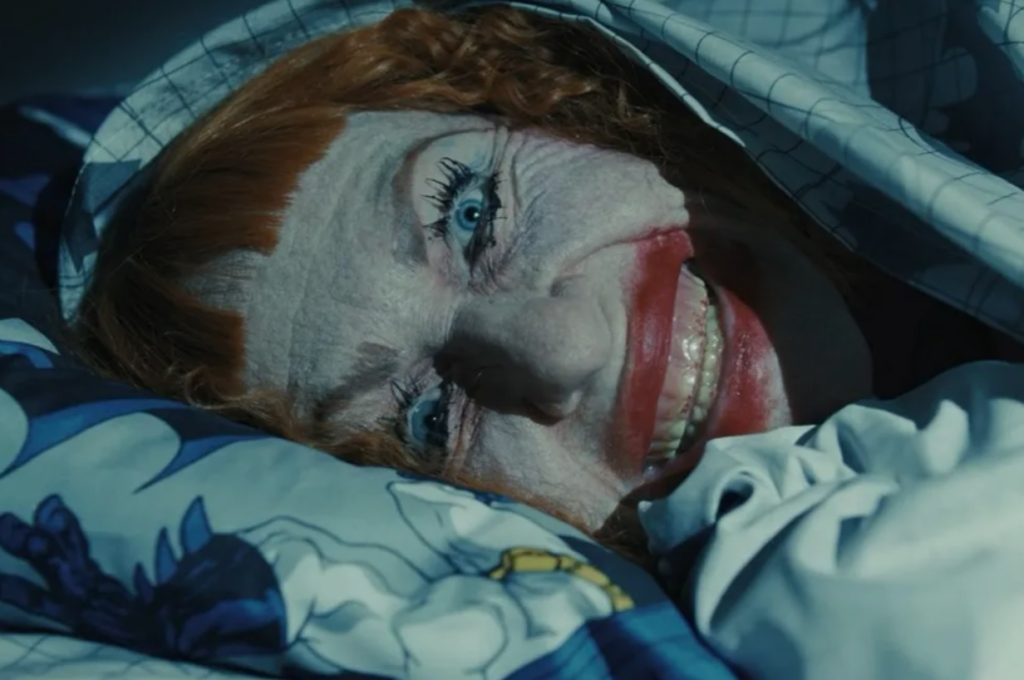
When Weapons begins, Gladys appears to be nothing more than an elderly relative looking after young Alex Lilly while his parents are supposedly ill. Considering the town is already reeling from the inexplicable disappearance of seventeen children from the same third-grade class, you might think somebody would ask a few more questions before happily leaving a vulnerable child with an elderly woman who seemingly materialised out of nowhere. Apparently not. Horror films have taught us many valuable lessons over the years. Don’t investigate strange noises. Don’t split up. Never read Latin out loud. And, perhaps most importantly after Weapons, if a previously unmentioned relative suddenly appears and introduces themselves as “Aunt Gladys”, maybe ask for some identification before handing over the house keys.
Of course, that’s exactly what makes Zach Cregger’s writing so effective. Gladys isn’t introduced with sinister music or dramatic lighting announcing her arrival. She’s simply… there. Quietly observing. Quietly listening. Quietly waiting. While everyone else desperately tries to solve the mystery surrounding the missing children, the audience slowly begins to realise that the seemingly harmless old woman sitting in the corner is actually the most dangerous person in Maybrook. It’s a brilliantly understated reveal, and one that becomes even more unsettling as the true extent of her influence begins to emerge.
Unlike many horror villains who rely on physical violence, Aunt Gladys barely needs to lift a finger. Her true strength lies in manipulation, patience and supernatural control. Through witchcraft, blood rituals, personal belongings and a disturbing thorn-covered tree, she strips people of their free will, bending children and adults alike to her command. Victims don’t simply die; they become extensions of her own sinister purpose. That’s a far more frightening prospect than somebody charging at you with a machete. At least with Jason Voorhees you know the situation. With Aunt Gladys, you’re never entirely sure whether your latest bad decision was your own idea or one she planted in your head three days earlier while complimenting your curtains.

Amy Madigan deserves enormous praise for creating such a memorable villain. It would have been easy to play Gladys as an exaggerated evil witch, cackling every few minutes while stirring an enormous bubbling cauldron somewhere beneath Alex’s house. Instead, Madigan delivers a remarkably restrained performance that never once feels theatrical. Every word is measured. Every smile feels genuine until you think about it for another five seconds. Every glance suggests she’s already worked out exactly how events are going to unfold while everyone else is still trying to figure out why things feel so wrong. It’s a performance built almost entirely on quiet confidence, and that’s precisely why it lingers in your mind long after the credits have rolled.
One of the smartest creative decisions Cregger makes is refusing to explain everything. Modern horror occasionally falls into the trap of overexplaining its monsters, usually involving a dusty library, an ancient manuscript and one poor character whose sole purpose is apparently reading exposition aloud. Weapons wisely avoids that temptation. We never learn exactly how old Aunt Gladys is, where her powers originated or whether she’s simply an accomplished practitioner of witchcraft or something far older wearing human skin. The mystery surrounding her becomes part of the horror itself. Sometimes the questions are considerably more frightening than the answers, and Aunt Gladys thrives within that uncertainty.
What makes her especially fascinating is that she almost feels like the complete opposite of a traditional slasher icon. She doesn’t rack up a body count through brute force. She isn’t physically imposing. She rarely even raises her voice. Instead, she patiently sets events in motion before allowing everyone else to destroy themselves. It’s psychological horror at its finest, where dread comes not from what the villain is doing, but from the horrifying realisation that they’ve probably been controlling the situation all along. Jason kicks doors down. Freddy invades dreams. Ghostface makes sarcastic phone calls. Aunt Gladys quietly smiles while the entire town unknowingly dances to her tune. Honestly, it’s difficult to decide which approach is more terrifying, although the polite smile somehow feels significantly worse.
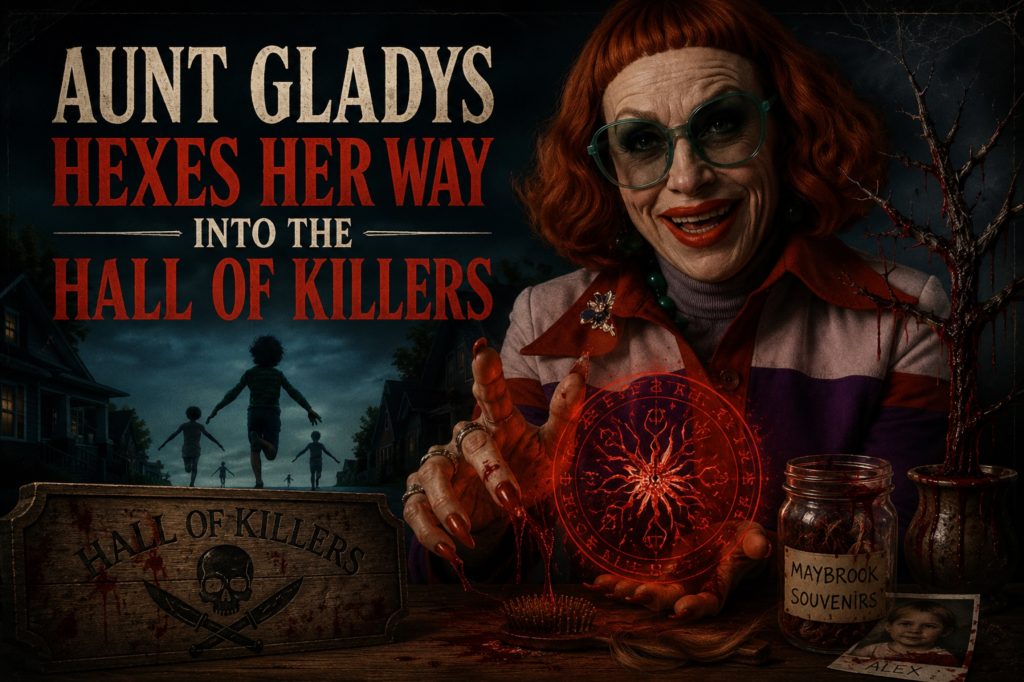
The impact Aunt Gladys made was immediate. Despite sharing the screen with an ensemble cast and appearing in only one film so far, she quickly became the defining image of Weapons. Critics repeatedly singled out Amy Madigan’s performance as one of the film’s standout achievements, praising the remarkable balance of vulnerability, intelligence and pure malevolence she brought to the character. Horror fans responded just as enthusiastically, immediately embracing Gladys as one of the genre’s strongest new supernatural antagonists. In fact, her popularity was so overwhelming that Zach Cregger confirmed development of Gladys, a dedicated prequel exploring the character’s origins, before Weapons had even completed its theatrical run. That’s an extraordinary achievement for any horror villain and speaks volumes about the impression she left on audiences.
So why does Aunt Gladys earn Second Class Tier rather than climbing even higher? Simply because greatness in horror isn’t measured by body count alone. The Hall of Killers rewards influence, memorability, originality and lasting impact, and Aunt Gladys already possesses all four in abundance. She completely dominates Weapons without dominating the screen time. She introduces one of the most compelling supernatural villains of recent years. She delivers genuine psychological terror rather than relying on spectacle. Most importantly, she reminds us that horror is often at its most effective when evil wears an ordinary face. After all, anyone can be frightened by a seven-foot killer carrying an axe. It’s much harder to defend yourself against a sweet old lady asking whether you’d like another cup of tea before casually using your hair to perform an occult ritual.
Congratulations, Aunt Gladys. You’ve quietly manipulated, psychologically dismantled and politely bewitched your way into the Second Class Tier of the Hall of Killers. We would have congratulated you in person, but if there’s one thing Weapons taught us, it’s that accepting invitations from mysterious elderly relatives is rarely the beginning of a pleasant afternoon.