Who Are the Laestrygonians in Christopher Nolan’s The Odyssey? The Myth Behind the Giant Warriors
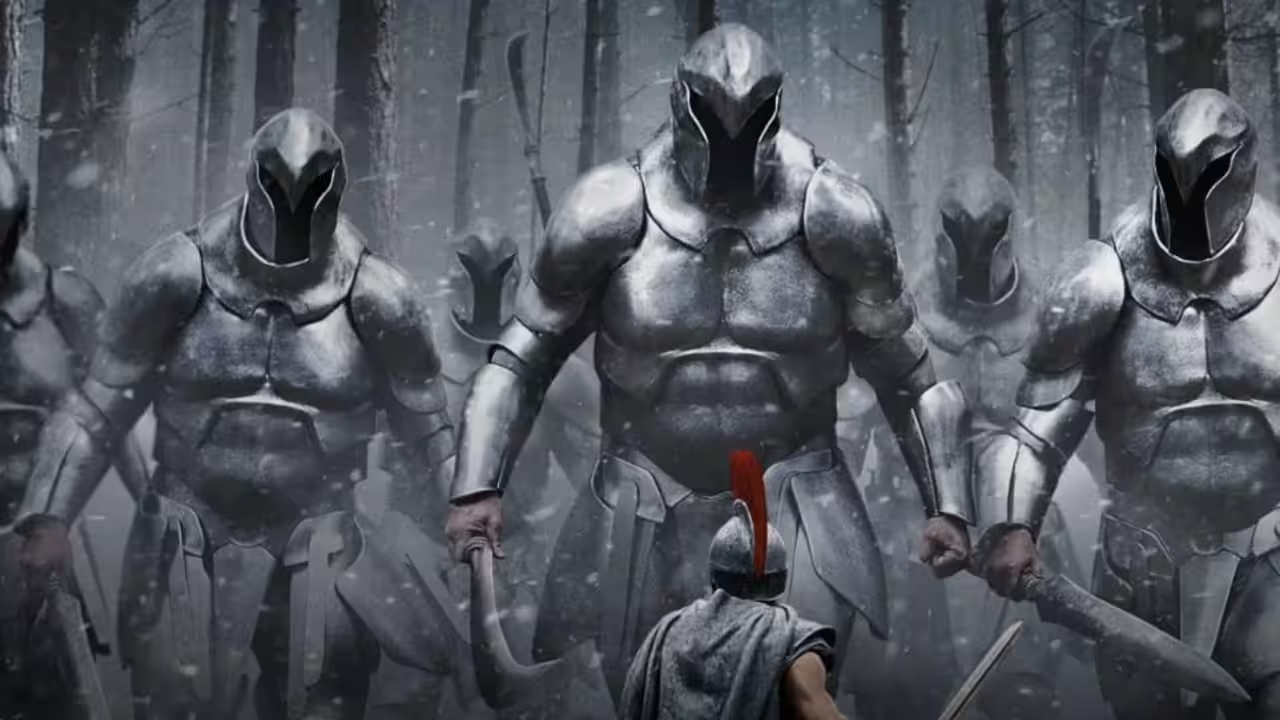
Christopher Nolan’s The Odyssey is packed with unforgettable moments, from the towering Cyclops to the haunting Sirens and the legendary Trojan Horse. Yet one sequence in particular has left cinema audiences scratching their heads long after the credits rolled. If you’ve watched the film in IMAX, you’ve probably found yourself asking exactly the same question as thousands of others: who are those enormous silver-armoured warriors that Matt Damon’s Odysseus and his men encounter deep within the forest?
The answer lies in one of the oldest and most terrifying chapters of Homer’s Odyssey. While Nolan reimagines the encounter for the screen, those gigantic warriors are not an invention of the filmmaker. They are the Laestrygonians, one of the deadliest races Odysseus ever crossed paths with during his ten-year journey home from the Trojan War. Although they receive far less attention than the Cyclops or the Sirens in popular culture, Homer’s original tale paints them as an almost unstoppable force that came closer than anyone else to wiping out Odysseus and his entire expedition. In Nolan’s adaptation, they’re transformed into something even more unsettling, proving that sometimes the lesser-known monsters are the ones that leave the biggest impression.

The sequence begins deceptively calmly. Odysseus and what remains of his exhausted crew arrive on what appears to be a peaceful, lush island after enduring unimaginable hardship at sea. Having already angered Poseidon by blinding the Cyclops, they’re battered, hungry and desperate for supplies. As they venture inland, they spot what looks like a lone soldier clad in gleaming silver armour standing silently among the trees. Believing they’ve finally found civilisation, they respectfully call out, invoking what the film refers to as Zeus’s Law, Nolan’s interpretation of the ancient Greek concept of xenia, the sacred obligation to offer hospitality to strangers. It’s one of the oldest customs in Greek mythology, where refusing shelter or kindness to travellers wasn’t simply considered rude, but an offence against Zeus himself. Unfortunately for Odysseus, the stranger isn’t quite what he appears to be.
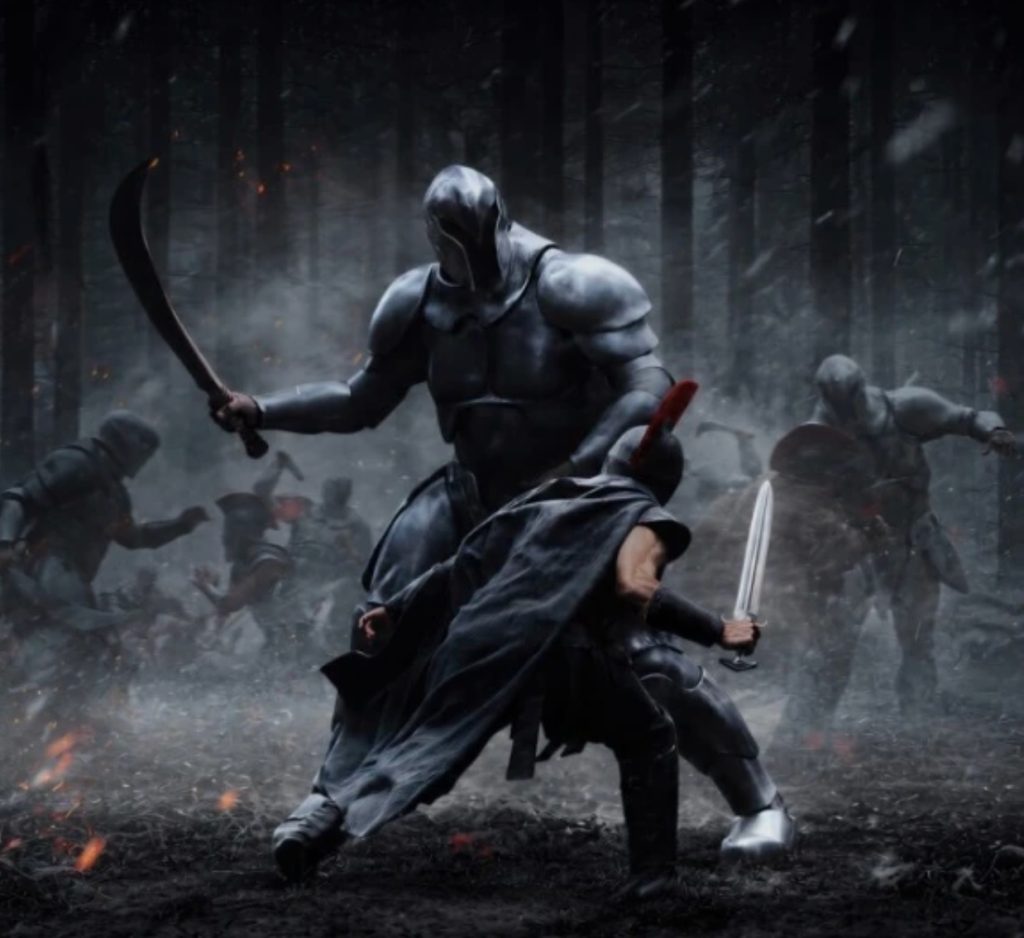
When the figure finally turns around, Nolan delivers one of the film’s most memorable reveals. The “soldier” is actually a child. Not an ordinary child, but one who towers above the Greek warriors. Moments later, the child’s scream echoes through the forest, summoning an army of equally gigantic warriors who emerge from the trees and descend upon Odysseus’s men. Rather than engaging in an honourable battle, the Greeks quickly realise they’re being hunted. Nolan intensifies the nightmare by having the forest itself appear to shift around them, the trees creating enormous natural cages that leave the invading giants free to pick off the trapped sailors one by one. It’s a terrifying sequence that feels almost like a fairy tale gone horribly wrong, and one of the most visually striking additions to the mythology in the entire film.
Although Nolan gives the encounter his own distinctive visual style, the Laestrygonians themselves come directly from Book X of Homer’s Odyssey. In the original poem, they are described as a race of man-eating giants, often said in later traditions to descend from Laestrygon, a son of Poseidon. That lineage makes Odysseus’s encounter particularly unfortunate. By this stage in his journey, Poseidon is already furious with the Greek king for blinding his Cyclops son, Polyphemus, and has sworn to make every step of Odysseus’s voyage home a living nightmare. Sailing into the territory of another race connected to the sea god was never likely to end well. Greek mythology has a habit of reminding its heroes that bad luck can always get considerably worse.
The Laestrygonians: The Man-Eating Giants of Homer’s Odyssey
In Homer’s version, Odysseus sails with twelve ships to the city of Telepylus, home of the Laestrygonians. Interestingly, he displays one of his rare moments of genuine caution by refusing to steer his own ship into the city’s enclosed harbour. While the rest of his captains happily sail through the narrow entrance and anchor together inside the calm waters, Odysseus leaves his own vessel tied to rocks outside the harbour. It’s a decision that ultimately saves his life and the lives of the men aboard his ship, proving that occasionally listening to your instincts is preferable to following everyone else. Given some of Odysseus’s previous decisions throughout the epic, this was arguably one of his finest moments.
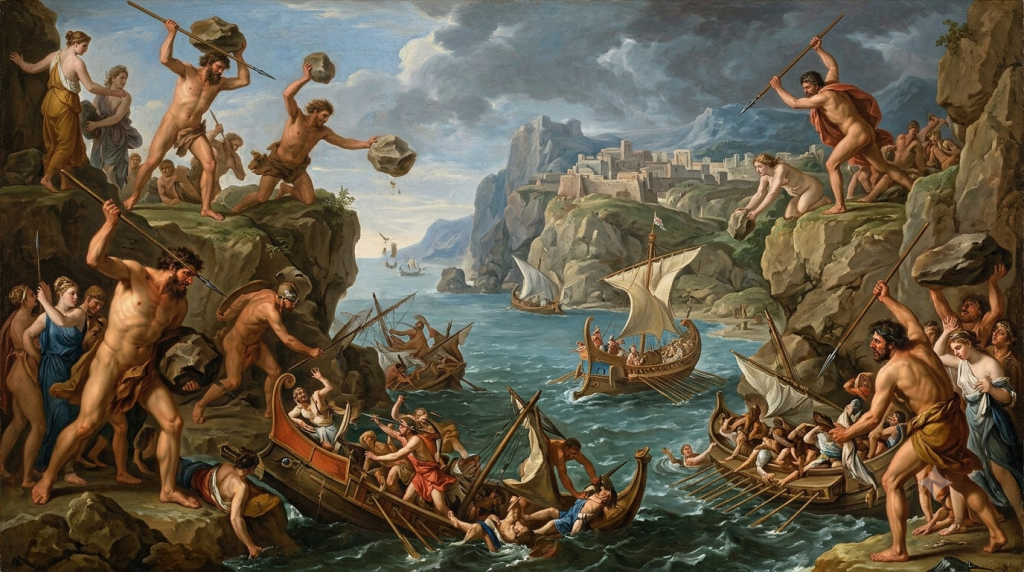
After seeing smoke rising inland, Odysseus sends a small scouting party to investigate. They eventually meet a young woman collecting water at a spring, who politely identifies herself as the daughter of King Antiphates and directs them to her family’s home. So far, everything seems perfectly normal. The scouts probably think they’ve finally found somewhere to rest, enjoy a hot meal and perhaps complain about Cyclopes for a few hours. Instead, they discover that Antiphates and his family are giants. The king immediately grabs one of the visitors, kills him and eats him where he stands before raising an alarm that summons thousands more Laestrygonians. The peaceful harbour instantly becomes a death trap as the giants rain enormous boulders down from the surrounding cliffs, smashing eleven of Odysseus’s twelve ships before spearing the surviving sailors “like fish”. It’s one of the bloodiest episodes in the entire poem and reduces Odysseus’s once-mighty fleet to a single surviving ship.
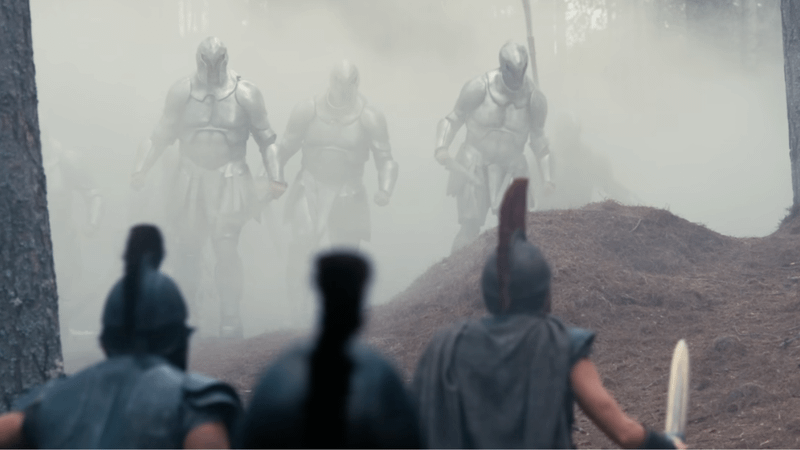
Christopher Nolan remains surprisingly faithful to the broad outline of this encounter while introducing several memorable ideas of his own. The most obvious change is the appearance of the giants. Homer simply describes enormous, man-eating beings, whereas Nolan dresses them in reflective silver armour that initially disguises their true size. It’s a wonderfully simple visual trick that allows both the audience and Odysseus to share the same moment of horrifying realisation. Likewise, the living forest that traps the Greeks has no basis in Homer’s poem, but it fits perfectly with the dreamlike atmosphere Nolan creates throughout the film. Rather than simply watching giants attack from a distance, viewers experience the sensation of being trapped inside a hunt where the environment itself appears to have turned against the heroes.
The encounter also reinforces one of Nolan’s recurring themes throughout The Odyssey. Several times during the film, Odysseus reflects on the difference between a battle and a hunt. Battles imply two sides meeting as equals, each capable of victory or defeat. A hunt is something entirely different. One side has all the power, while the other is simply trying to survive. The Laestrygonian sequence embodies that idea perfectly. There is no glorious clash of armies. No heroic last stand. No carefully choreographed duel between champions. The Greeks flee because fleeing is the only rational response. Faced with giants capable of effortlessly crushing ships and throwing rocks the size of houses, courage quickly becomes secondary to basic survival.
Like many creatures from Greek mythology, the exact origins of the Laestrygonians remain deliberately vague. Later ancient writers attempted to place them in the real world, with historians such as Thucydides and Polybius associating them with Sicily, while Pliny the Elder also linked them to Sicily and southern Italy. Other traditions connect them to Sardinia, suggesting the legends may have developed after Greek sailors encountered enormous ancient stone statues or heard stories of unusually tall local tribes. None of these theories can be proven, of course, but they demonstrate how mythology often evolved by blending genuine geography with travellers’ tales, gradually transforming ordinary places into homes for extraordinary creatures.
Ultimately, that’s what makes the Laestrygonians such fascinating figures within The Odyssey. They represent more than simply another monster for Odysseus to overcome. They embody the terrifying unpredictability of the ancient world, where every unfamiliar coastline could conceal unimaginable dangers and where hospitality, something normally considered sacred, could be replaced without warning by unimaginable violence. Christopher Nolan captures that uncertainty brilliantly, taking one of Homer’s lesser-known episodes and transforming it into one of the film’s most memorable set pieces. While audiences may arrive expecting to fear the Cyclops or the Sirens, many leave the cinema remembering the moment an innocent-looking child turned around, revealed itself to be a giant, and unleashed an army of silver-armoured hunters that proved some myths are every bit as terrifying today as they were nearly three thousand years ago.