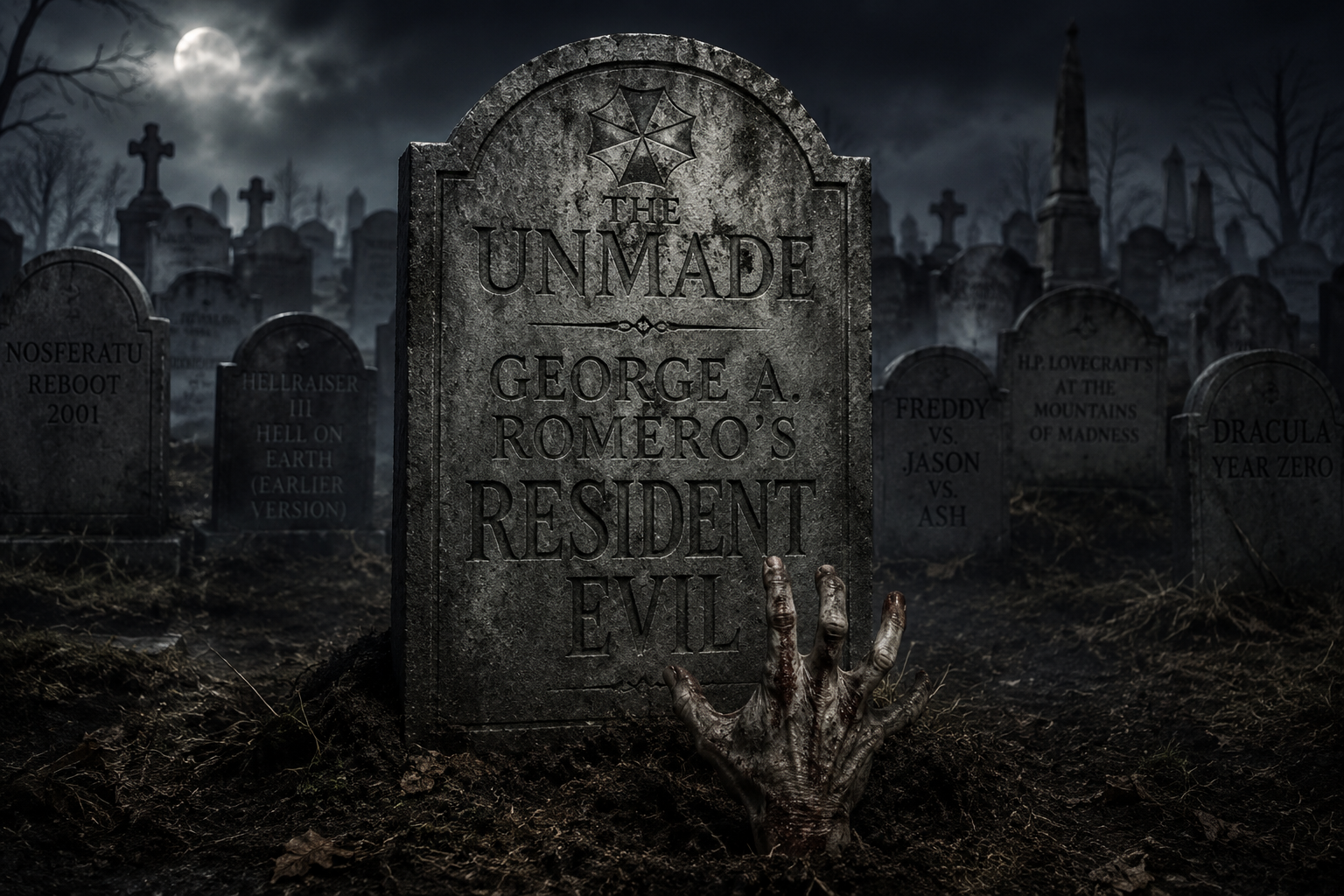
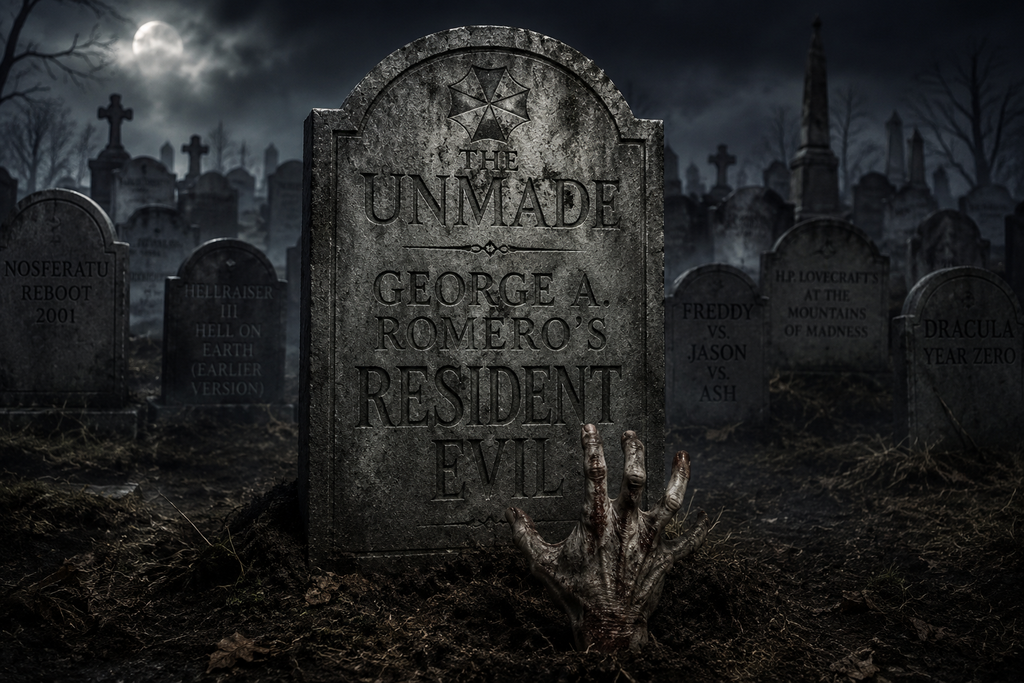
The Unmade: George A. Romero’s Resident Evil – The Zombie Movie That Should Have Been Inevitable
There are unmade movies that make perfect sense in hindsight. Somebody announced something, development dragged on for years, everyone involved wandered off to other projects and eventually the whole thing quietly disappeared. Then there is George A. Romero’s Resident Evil, a film whose failure to exist still feels faintly ridiculous. Resident Evil was a video game series enormously indebted to cinematic horror, its original director Shinji Mikami openly influenced by Romero’s zombie films, and Romero was the filmmaker whose Night of the Living Dead had fundamentally changed what the screen zombie could be. Putting the two together should have been less a production decision and more a law of nature. Instead, Romero wrote the screenplay, revised it, and was ultimately removed from the project. A few years later Resident Evil reached cinemas without him.
Welcome, then, to The Unmade, our new regular excavation of horror films that were announced, developed, written, prepared or sometimes even partially shot before disappearing into that enormous Hollywood graveyard marked Things We Nearly Got. There could hardly be a better place to begin.
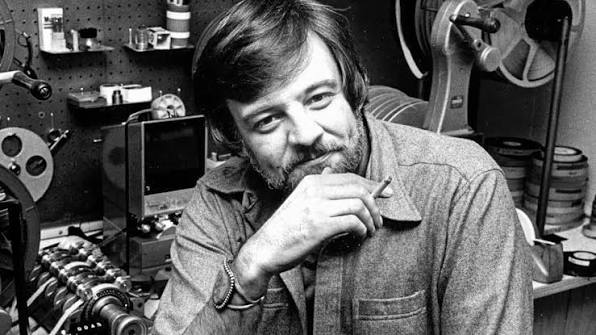
Resident Evil Owed George A. Romero a Drink
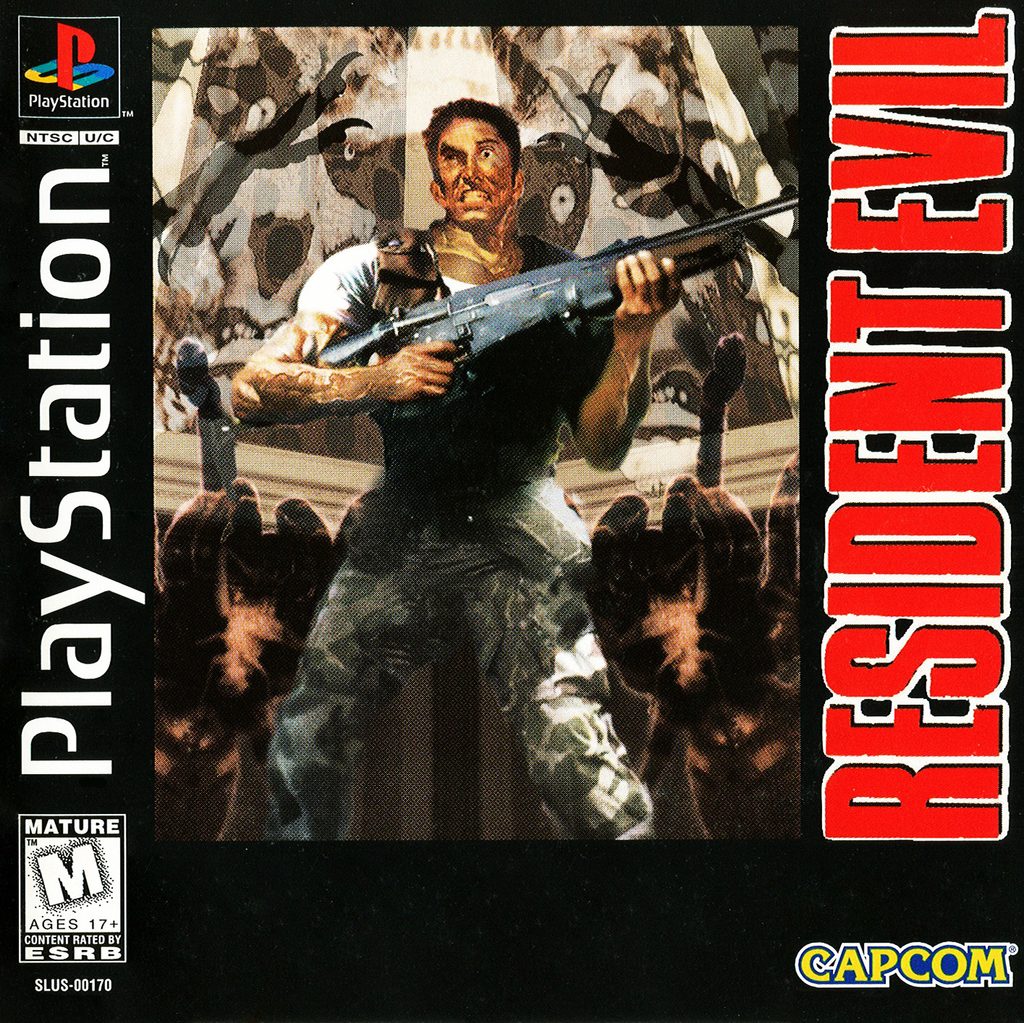
When Capcom released Biohazard, renamed Resident Evil outside Japan, for the PlayStation in 1996, Romero’s fingerprints were already all over its DNA. Mikami originally considered ghosts for the game before moving towards zombies, with Romero’s 1978 Dawn of the Dead among his inspirations. The resulting game trapped Chris Redfield and Jill Valentine inside a mansion filled with zombies, biological experiments and increasingly unpleasant evidence of the Umbrella Corporation’s activities. It helped popularise the term “survival horror” and became successful enough that a sequel was inevitable.
That sequel created the strange route by which Romero finally became directly involved with the franchise he had indirectly helped inspire. In 1998, Capcom hired him to direct a live-action Japanese commercial for Biohazard 2, known elsewhere as Resident Evil 2. Brad Renfro played Leon S. Kennedy and Adrienne Frantz played Claire Redfield in the commercial, which Romero shot in Los Angeles. It wasn’t the Resident Evil feature film, but for a brief moment audiences could see what happened when the man behind Night of the Living Dead and Dawn of the Dead was handed Capcom’s zombies.
The obvious question followed: why stop at an advert?
George Gets the Mansion
Romero was subsequently brought into the proposed feature adaptation, following an earlier screenplay by Alan B. McElroy that had not moved forward. Romero didn’t simply stick a few zombies into a generic action screenplay and write Resident Evil across the front page. He actually studied the game. One of the more wonderful details from the development is that Romero had his secretary play through Resident Evil while recording the gameplay so he could use the footage as reference. The director who had helped create modern zombie cinema was essentially doing his homework by watching somebody else negotiate the Spencer Mansion.
His first draft, dated 7 October 1998, was developed from a story by Romero and Peter Grunwald, and the screenplay remained recognisably based upon the original game. Chris Redfield and Jill Valentine were the central characters, while familiar names including Barry Burton, Rebecca Chambers, Albert Wesker and Ada Wong appeared. The mansion, Umbrella’s experiments and the game’s creatures were part of the package rather than being discarded in favour of an unrelated story carrying the Resident Evil name.
It wasn’t, however, a scene-for-scene transcription of somebody’s PlayStation save file. Romero made significant alterations. His Chris and Jill had a romantic relationship, for example, and elements of characters and backstories were changed. That distinction matters because Romero’s Resident Evil is sometimes remembered online as the completely faithful adaptation that Capcom inexplicably rejected. It was considerably closer to the first game’s characters and storyline than the film eventually released in 2002, but calling it an exact adaptation would be misleading.
Romero was also thinking cinematically about the creatures. Legendary comic-book and horror artist Bernie Wrightson was brought in to produce concept work, including designs for the Tyrant based upon the original game’s monster and Romero’s screenplay. This wasn’t therefore merely Romero mentioning Resident Evil during an interview and fans spending the next quarter-century imagining the rest. A screenplay existed. Revisions existed. Creature design work existed. This was a genuine attempt to make the film.
And then things started going wrong.
Apparently George Romero Wasn’t Quite Right for a Zombie Movie
Trying to establish precisely why an abandoned film died can become surprisingly difficult, particularly when different participants remember events differently. What is firmly established is that Romero’s screenplay wasn’t approved and that he continued revising the material before eventually leaving the project. Capcom producer Yoshiki Okamoto subsequently gave Electronic Gaming Monthly an extraordinarily economical explanation: “Romero’s script wasn’t good, so Romero was fired.”
There you have it. No twenty-part documentary required. Thanks, Yoshiki.
Romero himself understandably had a somewhat different perspective. Speaking to DGA Magazine in 2000, he said he didn’t believe the people controlling the project were interested in the spirit of the game and thought they wanted something heavier and more akin to a war movie. His conclusion was considerably simpler: they simply never liked his script.
That’s an important point when looking back at The Unmade. We can read Romero’s surviving screenplay and know what he wanted to make, but we shouldn’t pretend there is one universally agreed account explaining every decision that killed it. There were creative disagreements, Romero’s drafts failed to satisfy the people who needed to approve them, and ultimately the studio moved forward without him. The wonderfully ironic result was that one of cinema’s most influential zombie filmmakers had been hired to adapt a zombie game partly inspired by his work and was then deemed unsuitable for the job.
Hollywood occasionally achieves levels of Hollywood that should not be physically possible.
Then Along Came Paul W.S. Anderson
Resident Evil didn’t remain dead. British filmmaker Paul W.S. Anderson, who had already directed the successful 1995 adaptation of Mortal Kombat, eventually became the man who brought the property to cinemas. Crucially, Anderson took almost the opposite approach to Romero. Rather than directly retelling the first game, he developed an original story designed to exist within the Resident Evil world. Anderson has explained that he didn’t want fans who had played the games to know everything that was going to happen before the movie began.
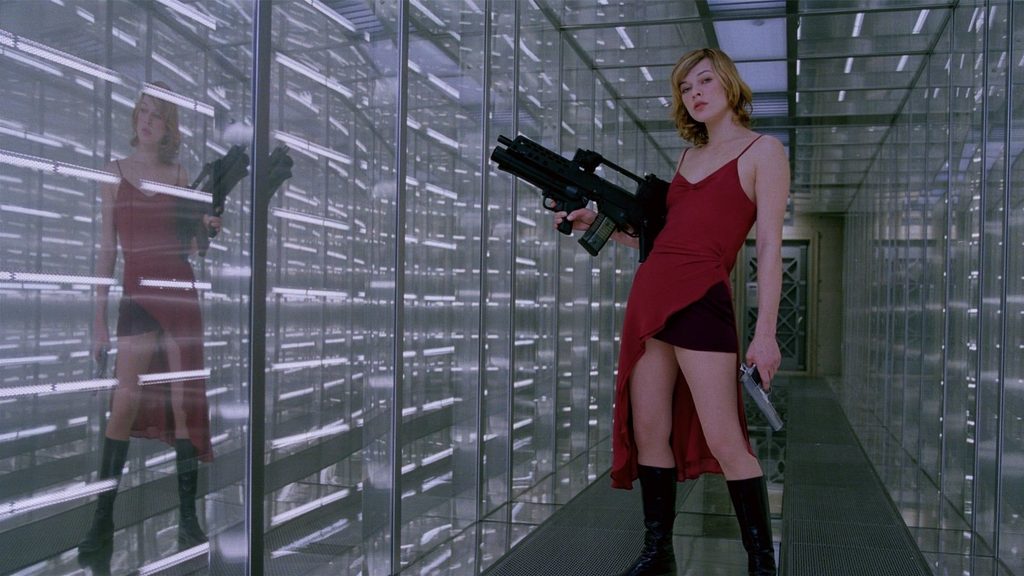
The resulting Resident Evil, released in 2002, starred Milla Jovovich as Alice, an original character rather than one of the games’ existing protagonists. It retained Umbrella, zombies, biological experiments and other recognisable ingredients while constructing its own story around an underground laboratory called the Hive. Anderson’s film ultimately launched an enormously successful movie franchise, with Jovovich returning across six instalments between 2002 and 2016.
And that creates one of the most interesting things about Romero’s abandoned version. This isn’t a story where the studio rejected a filmmaker, produced something else and immediately discovered it had made a catastrophic mistake. Whatever individual fans think of Anderson’s Resident Evil films, they became a major commercial franchise. The alternative path worked.
But it also means we lost something completely different.
What Would Romero’s Resident Evil Have Been?
This is where we’re going to establish an important rule for The Unmade: we’re not going to review films that don’t exist. Nobody can truthfully tell you that Romero’s Resident Evil would have been a masterpiece, a disaster or the greatest video-game adaptation ever made. A screenplay isn’t a finished film. Casting, performances, cinematography, editing, effects, budget restrictions and a thousand production decisions would have transformed what was on the page.
What we can say is that Romero’s surviving material points towards a much more direct cinematic interpretation of the original Resident Evil than Anderson eventually made. Chris, Jill, Barry, Rebecca and Wesker would have given game players immediately recognisable characters. The mansion would have provided the central environment. Umbrella’s experiments and familiar creatures would have connected the movie directly to the mythology Capcom had already established. And Bernie Wrightson designing monsters for a George Romero Resident Evil movie is precisely the sort of sentence that makes horror fans stare mournfully through windows on rainy afternoons.
The great frustration is that Romero wasn’t an arbitrary celebrity filmmaker being attached to a popular game. The connection ran in a circle. Romero’s films influenced Resident Evil; Resident Evil became successful; Romero was brought in to direct a Resident Evil 2 commercial; that relationship helped lead to Romero developing the movie. The grandfather was effectively being invited to meet one of his strangest grandchildren.
And then the family gathering was cancelled.
The Resident Evil Movie From Another Timeline
Interest in Romero’s lost adaptation never really disappeared. His screenplay circulated online, fans continued debating what his movie might have looked like, and the project eventually became the subject of the documentary George A. Romero’s Resident Evil, directed by Brandon Salisbury. That continued fascination tells you something about why this particular unmade film remains so compelling.
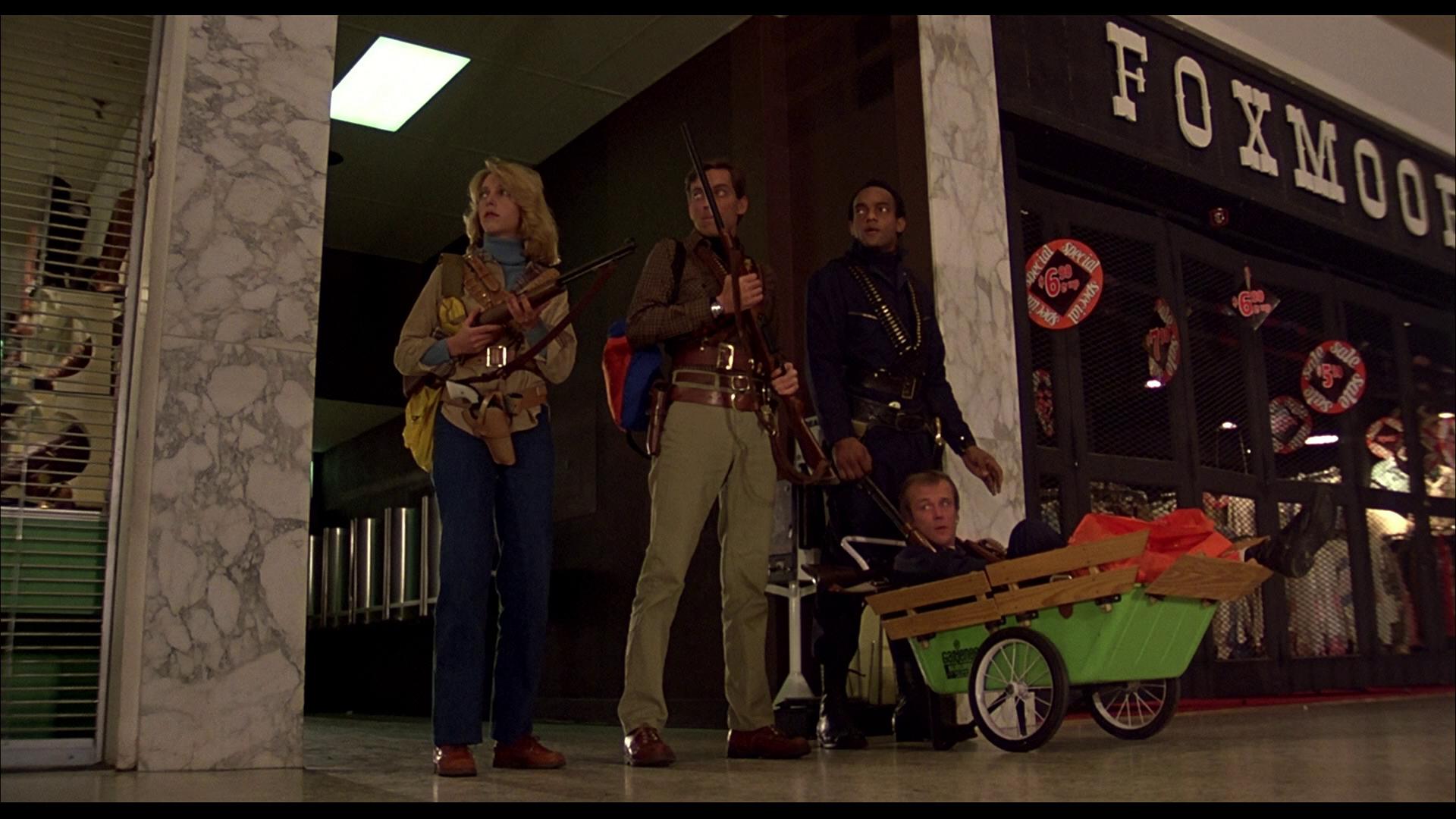
It isn’t simply the novelty of imagining a famous director attached to somebody else’s franchise. Romero fundamentally changed zombie cinema with Night of the Living Dead in 1968, expanded his vision spectacularly with Dawn of the Dead in 1978 and continued it with Day of the Dead in 1985. Resident Evil subsequently became one of gaming’s defining horror franchises while openly drawing from the cinematic tradition Romero helped establish.
The film we eventually received took Resident Evil somewhere else entirely and created its own successful identity. But sitting beside that history is another Resident Evil: Chris and Jill, Spencer Mansion, familiar monsters, Bernie Wrightson designs and George A. Romero behind the camera.
We know enough about it to see the shape of the movie.
We’ll just never know what it would have become.
And that makes George A. Romero’s Resident Evil exactly the kind of film that belongs in The Unmade.