
Sombras Chinas Review: Found Footage for the Influencer Generation
Cinema has spent well over a century working with the horizontal frame, so there is something initially strange about watching a feature film turn itself on its side. Yet that is precisely where Argentine writer and director Sebaztian Baz finds the identity of Sombras Chinas. Shot in a native 9:16 vertical format and constructed around livestreams, social media videos and the constant documentation of its central character’s life, the film takes some of the principles of found footage and asks what that language might look like for a generation that willingly films itself every day.
It is an interesting idea and, although Sombras Chinas doesn’t entirely nail the execution, Baz deserves credit for thinking outside the box. The modern equivalent of somebody discovering a mysterious videotape no longer needs to involve footage being found after an event. Today it could already be online, broadcast voluntarily by the person experiencing it while hundreds or thousands of strangers watch, comment and react in real time. Baz recognises how dramatically our relationship with cameras has changed and uses that as the foundation for a contemporary thriller.

Candela Del Zotto plays Candela Montenegro, an influencer for whom the boundary between living her life and broadcasting it has almost disappeared. Shopping trips become promotional opportunities, relationships become material for her followers and even personal disappointments can be transformed into content. Early in the film, Candela visits a clothing store looking for something to wear for her approaching second anniversary with boyfriend Ramiro. After discovering that he has cancelled her credit card, she simply uses her online reach to secure the dress through promotion instead. It is an effective introduction to a world in which an audience has effectively become another form of currency.
Her relationship with Ramiro is already falling apart, and when it finally collapses Candela responds in the way she understands best: publicly. Rather than retreating from social media, she becomes increasingly dependent upon it, following what Ramiro is doing, communicating with friends and continuing to feed an audience that has become a permanent presence in her life. Around her is El Polaco, played by Carlos Benincasa, an older taxi driver who initially appears to be an eccentric but relatively harmless fixture in Candela’s orbit. As questions surrounding her family and people from the past begin surfacing, however, Sombras Chinas gradually moves away from observing influencer culture and towards something considerably darker.
The problem is that gradually really is the important word. Baz takes his time establishing Candela’s world, and the opening portion can test the patience. We spend a lot of time watching livestreams, promotional exchanges, shopping and the everyday performance involved in being an influencer before the larger mystery starts revealing itself. There is a purpose to much of this because we need to understand how completely Candela has surrendered her private life to the camera, but some repetition could have been removed without losing that point. The film simply takes a little too long to become the thriller it eventually reveals itself to be.

Once the mystery develops, Sombras Chinas becomes considerably more compelling. Candela begins investigating her family history, while the discovery of a locked wooden box containing money and a handgun gives the story the forward momentum that its opening lacks. An increasingly mysterious older man named Horacio begins appearing among her followers, and El Polaco’s connections to the past mean the people surrounding Candela become progressively more difficult to read. It is during this section that Baz’s unusual presentation starts paying dividends.
Found footage has traditionally worked by exploiting the audience’s instinct to believe an imperfect image. A beautifully composed and perfectly lit shot immediately announces cinema, whereas badly framed handheld footage can create the fleeting impression that we are witnessing something that actually happened. Sombras Chinas updates that relationship for social media, where vertical video, livestream glitches, awkward framing and people talking directly into their phones have become completely ordinary visual experiences. Baz isn’t simply sticking a phone in front of his actors and calling it innovative; he understands that people also behave differently when they know they’re being watched.
Candela isn’t merely a character being filmed. She is frequently creating the film herself, deciding what her followers see and presenting whichever version of Candela Montenegro she wants to exist at that moment. The camera consequently becomes both our window into her life and a reason to question what we’re seeing. Her followers might know where she shops, who she dates, where she goes and how she claims to be feeling, yet that doesn’t necessarily mean they know her at all. This difference between the person and the online performance becomes one of the film’s more interesting ideas.
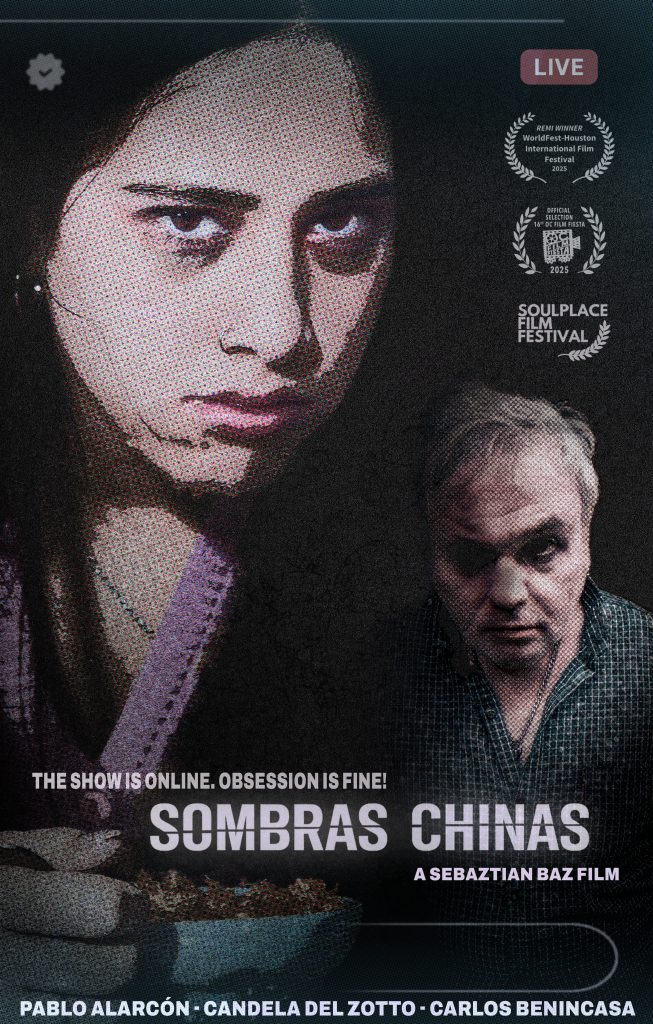
The 9:16 presentation is the boldest expression of Baz’s approach. Watching a feature film in such a narrow frame initially feels wrong, particularly on a television or cinema screen where large areas are deliberately unused, but after a while the decision starts to make sense. Rather than placing a smartphone somewhere inside a conventional cinematic image, Baz essentially makes the smartphone screen the image. Director of photography Seba Sandoval finds effective ways to work within those restrictions, and the narrowness becomes particularly useful once the story moves towards danger. Suddenly everything we cannot see beside Candela becomes considerably more important than it was when she was showing followers a new dress.
Baz is also sensible enough not to become completely imprisoned by his own rules. Nicolás Fontimpe’s electronic score occasionally appears where strict found footage logic might suggest there should be no non-diegetic music, while some images stretch the credibility of how the footage could exist. That doesn’t particularly matter. Sombras Chinas is ultimately a thriller rather than an academic exercise in following the laws of found footage, and Baz is more interested in borrowing and evolving the format’s cinematic language than obeying an imaginary rulebook.
Del Zotto carries a huge amount of the film and handles that responsibility well. She effectively has to play two versions of the same woman: Candela the person and Candela the influencer, with the distinction between them sometimes deliberately difficult to identify. It would have been easy to make her an irritating parody of online narcissism, but Del Zotto finds enough vulnerability underneath the performance to keep her human. Her dependence on followers isn’t presented simply as vanity; their attention and approval have become intertwined with her sense of self worth, particularly as her personal relationship deteriorates.
Benincasa provides a useful contrast as El Polaco. Candela exists almost entirely in the immediate present, constantly broadcasting whatever is happening right now, while he carries a history that she doesn’t fully understand. Their relationship helps bridge the two halves of the film, moving Candela away from followers, promotions and relationship problems towards events with much greater consequences.

What prevents Sombras Chinas from climbing higher is primarily its pacing. Baz trusts the concept for slightly too long before applying substantial narrative pressure, and the first half could have been tighter. Once the film begins accelerating, it demonstrates how effective its unusual format can be, which only makes you wish that urgency had arrived earlier.
Nevertheless, there is something genuinely admirable about a filmmaker attempting to move found footage forward rather than simply reproducing its familiar tricks. People no longer need a contrived reason to continue filming when something strange happens because filming has become the default state for millions of people. We document where we go, what we eat, what we’ve bought, who we’re with and how we’re feeling, often voluntarily supplying complete strangers with an extraordinary amount of information about our lives. Sombras Chinas recognises that this behaviour gives the thriller genre an entirely new collection of tools.
The film doesn’t completely fulfil the potential of its concept, and a tighter opening would have made its eventual descent into darker territory more effective. Yet there is enough originality and filmmaking intelligence here to make the experiment worthwhile. Baz has taken the basic principles of found footage and considered how social media, livestreaming and influencer culture could change them rather than simply dressing an old formula in modern technology.
Sombras Chinas is therefore an imperfect but genuinely inventive thriller. It takes a little while to get going, but when its mystery finally takes hold, the vertical frame stops feeling like a gimmick and becomes part of the suspense. Most importantly, Baz has found a different way into a format that many filmmakers have been repeating for decades. It doesn’t always work, but watching someone genuinely try to find a new cinematic language is considerably more interesting than watching another film simply speak one we already know by heart.