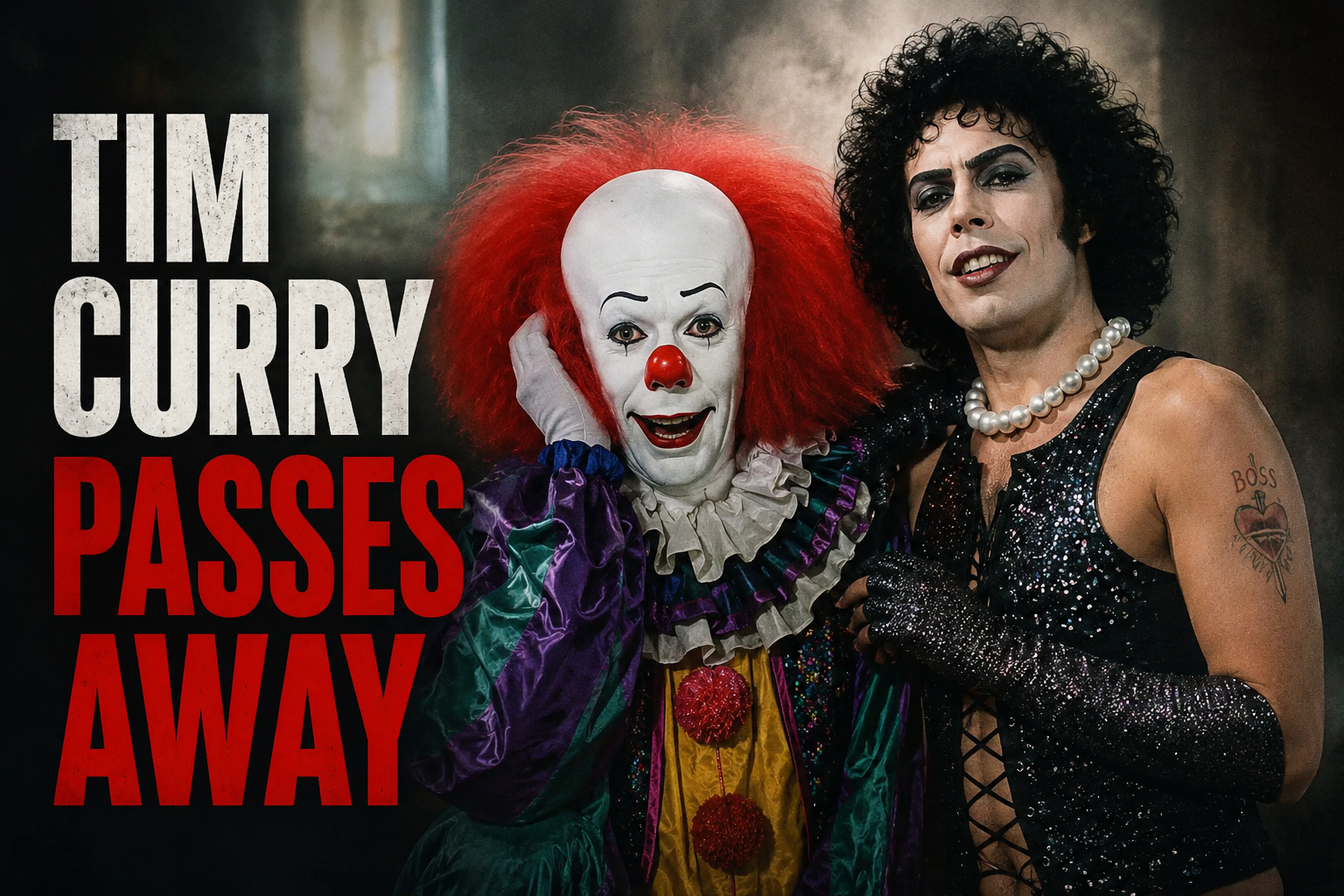
Tim Curry Dies Aged 80: Remembering a True One-of-a-Kind Screen Legend
Tim Curry, the legendary British actor whose extraordinary career gave us Dr. Frank-N-Furter, Pennywise the Dancing Clown, Darkness, Wadsworth, Long John Silver and perhaps the most suspicious hotel concierge in movie history, has died at the age of 80.
Curry died on Tuesday, 25 August 2026, at his home in Los Angeles. His death has been reported by major entertainment outlets including Variety and The Hollywood Reporter, while TMZ, which first broke the news, reported that police attended his home late on Tuesday night and that no foul play was suspected.
For horror fans in particular, Curry occupies a special place in popular culture. He wasn’t simply a respected actor who occasionally appeared in horror films; he created characters that became part of the language of the genre. Yet reducing his career to horror would barely scratch the surface. Over more than five decades, Curry worked extensively across theatre, film, television, animation, music, audiobooks and video games, becoming one of those rare performers who could appear in almost anything and somehow make it more memorable.
Born Timothy James Curry on 19 April 1946 in Grappenhall, Cheshire, he studied English and Drama at the University of Birmingham before beginning his professional career on stage. His early work included the original London production of Hair in 1968, but the role that would transform his life arrived several years later – and involved fishnets, heels and one of the most unforgettable entrances in musical history.
Rocky Horror Changed Everything

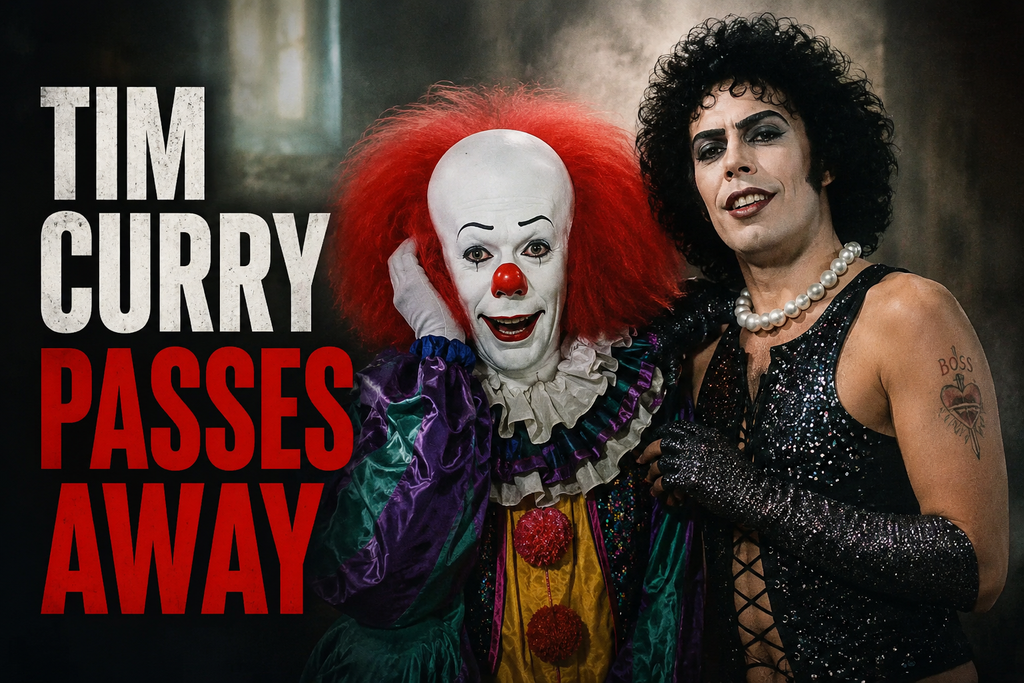
Curry originated the role of Dr. Frank-N-Furter in Richard O’Brien’s The Rocky Horror Show at London’s Royal Court Theatre in 1973. He subsequently played the character in Los Angeles and on Broadway before taking Frank to the screen in Jim Sharman’s 1975 film The Rocky Horror Picture Show.
The film was not an immediate mainstream success, but something extraordinary happened afterwards. Midnight screenings helped transform Rocky Horror into one of cinema’s great cult phenomena, developing its own traditions of costumes, audience participation, callbacks and repeat viewing. More than half a century after Curry first stepped into Frank-N-Furter’s heels, people who weren’t even born when the film was released continue discovering it.
At the centre of that phenomenon is Curry’s performance. Frank could easily have become little more than a collection of outrageous mannerisms, but Curry made him seductive, funny, threatening, arrogant, vulnerable and completely magnetic. The performance announced exactly what made Curry special: whatever else was happening around him, it was remarkably difficult to look at anybody else.
Rocky Horror could easily have defined his entire career. Instead, Curry somehow went on to create several more characters that became cult icons in their own right.
Pennywise: The Face of a Generation’s Nightmares
For an entire generation of horror fans, Tim Curry was Pennywise.

Stephen King’s enormous 1986 novel It was adapted for television as a two-part miniseries in 1990, with Curry playing the shape-shifting entity’s most famous form, Pennywise the Dancing Clown. He appeared alongside Richard Thomas, John Ritter, Annette O’Toole, Harry Anderson and Tim Reid in an adaptation that inevitably had to restrain some of the novel’s more extreme material for network television.
Curry didn’t need graphic violence. His Pennywise could switch from an almost cheerful children’s entertainer into something cruel and terrifying within seconds. That contrast became the performance’s greatest weapon. He frequently looked like the sort of clown who really might have been hired for a child’s birthday party, which made the moments when the monster underneath emerged considerably more disturbing.
Long before the modern wave of creepy clown imagery, Curry’s Pennywise had already traumatised a generation. When Andy Muschietti adapted It for cinemas in 2017, Bill Skarsgård inherited a character that had been associated with Curry for nearly three decades. Skarsgård deliberately created a very different Pennywise, but Curry’s interpretation has never disappeared. The storm drain, the balloons, that grin and Curry’s delivery remain among the most enduring images of television horror.
Darkness, Wadsworth and an Incredible 1980s
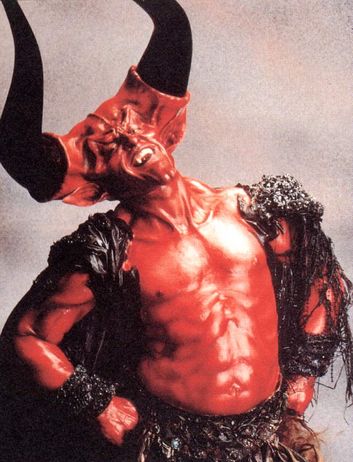
Curry’s ability to become something monstrous had already been demonstrated spectacularly in Ridley Scott’s Legend in 1985. Playing Darkness opposite Tom Cruise, Curry performed beneath extensive prosthetic makeup, huge horns and an elaborate physical transformation. With so much of the actor visually concealed, his distinctive voice and theatrical presence became crucial to the character, helping make Darkness one of fantasy cinema’s most instantly recognisable villains.
Remarkably, 1985 also gave audiences Wadsworth in Clue. The two characters could hardly be further apart. Jonathan Lynn’s murder-mystery comedy allowed Curry to unleash his gift for physical comedy, rapid-fire dialogue and controlled hysteria, culminating in the famous breathless reconstruction of the night’s events. Clue wasn’t a major box-office success on its original release, but subsequently developed an enormous cult following, with Wadsworth becoming another of Curry’s most beloved performances.
His other work around this period demonstrated the sheer range involved. Curry played Rooster Hannigan in John Huston’s Annie and continued an extensive stage career that included Mozart in Amadeus and the Pirate King in The Pirates of Penzance. Decades later, he would earn another major theatrical success as King Arthur in Monty Python’s Spamalot. Across his career, Curry received three Tony Award nominations.
Congo: Tim Curry Turns Everything Up to Eleven
Then there is Congo.
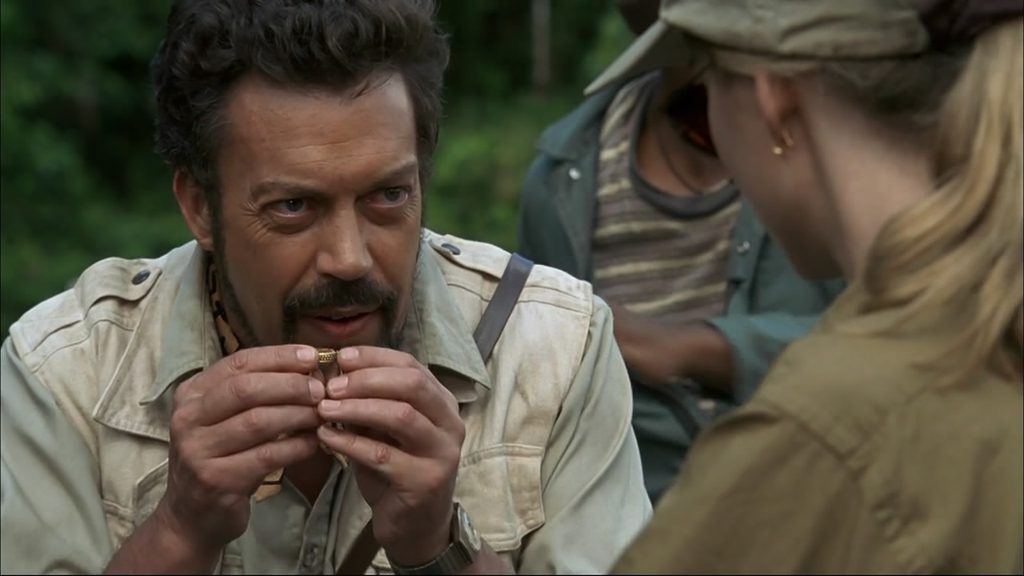
Frank Marshall’s 1995 adaptation of Michael Crichton’s novel remains one of those gloriously excessive studio adventures that seems to become more entertaining with age. Laura Linney, Dylan Walsh and Ernie Hudson head into dangerous territory in search of the Lost City of Zinj, with talking gorilla Amy, deadly grey gorillas, diamonds, lasers and volcanic destruction all eventually entering the equation.
Into this relatively restrained environment walks Tim Curry as Herkermer Homolka.
Curry’s Romanian adventurer is a huge performance: the accent, expressions, gestures and line delivery are all pitched at precisely the level required by a film in which almost nothing is understated. Yet Curry never appears embarrassed by the material or as though he’s standing outside the film making fun of it. He commits to Homolka completely.
That was one of Curry’s great strengths. He understood what kind of film he was in. Give him serious drama and he could play it seriously. Give him theatrical comedy and he could dominate it. Give him an adventure involving killer gorillas and a lost diamond mine and he would make absolutely certain you remembered Herkermer Homolka.
Home Alone 2 and the World’s Most Suspicious Concierge
Millions of people who discovered Curry as children, however, probably didn’t first know him as Frank-N-Furter, Pennywise or Darkness. They knew him as the man at the Plaza Hotel who was determined to find out exactly what Kevin McCallister was doing there.
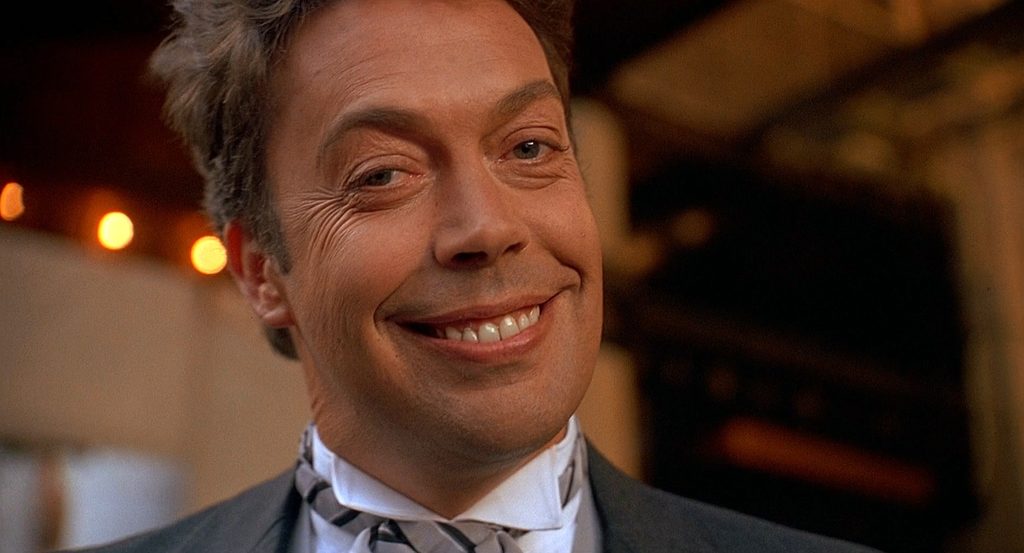
Curry played Mr. Hector, the Plaza’s concierge, in Chris Columbus’s 1992 sequel Home Alone 2: Lost in New York. After Kevin accidentally boards the wrong flight and ends up alone in Manhattan, he checks himself into the Plaza using his father’s credit card. Mr. Hector quickly becomes suspicious and begins investigating his unusually independent young guest.
It isn’t an enormous role, but Curry makes practically every moment count. His suspicious glances, exaggerated professionalism, wounded dignity and increasing determination to expose Kevin turn what could have been a straightforward supporting character into one of the sequel’s funniest elements. Curry possessed an extraordinary ability to get a laugh without saying anything at all; a raised eyebrow, narrowed eye or slowly spreading smile could become an entire joke.
Home Alone 2 subsequently became a perennial Christmas favourite, meaning Mr. Hector has effectively returned to television screens every December for more than three decades. Few supporting performances could ask for that kind of immortality.
Submarines, Musketeers, Pirates and Muppets
Looking through Curry’s complete filmography reveals just how unusual his career was. He appeared alongside Sean Connery in the 1990 Cold War thriller The Hunt for Red October as Dr. Yevgeniy Petrov, then became Cardinal Richelieu in Disney’s 1993 version of The Three Musketeers. He appeared in The Shadow with Alec Baldwin and later turned up in Charlie’s Angels and Scary Movie 2, seemingly moving between genres without ever losing the distinctive personality that audiences recognised immediately.
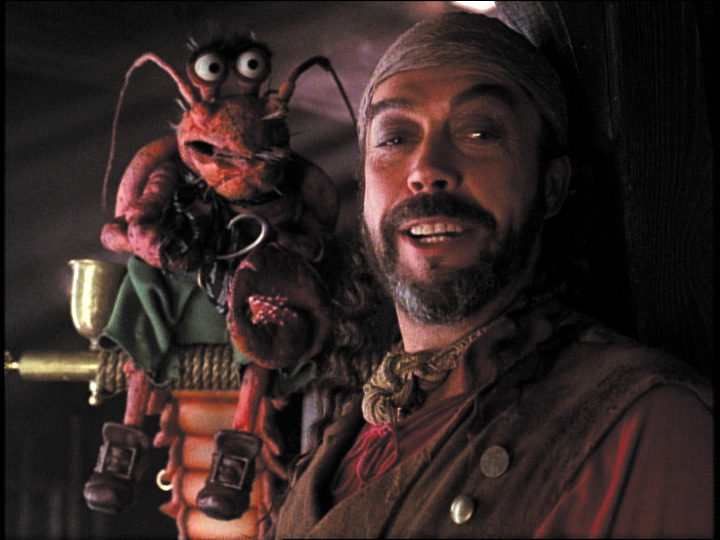
One of his most beloved later film performances came in Muppet Treasure Island in 1996, where Curry played Long John Silver opposite Kermit, Miss Piggy, Gonzo, Rizzo and the rest of the Muppet ensemble. The brilliance of his performance is that Curry doesn’t treat appearing alongside puppets as an excuse to disengage from the character. His Silver is charismatic, funny and genuinely dangerous, and Curry performs opposite the Muppets as though they are simply his fellow actors.
The result is arguably one of the finest human performances in any Muppet film. Curry’s natural theatricality fits perfectly into their world, while his ability to shift between charm and menace makes him an ideal Long John Silver.
That Voice
Even audiences who didn’t immediately recognise Tim Curry’s face often recognised his voice. He became an extraordinarily prolific voice performer, with one of his best-known roles being Nigel Thornberry in The Wild Thornberrys. He also voiced Captain Hook in Peter Pan and the Pirates, a performance that earned him a Daytime Emmy Award, and contributed his unmistakable voice to numerous animated series, films, audiobooks and video games.
That voice became increasingly important after Curry suffered a major stroke in 2012. The stroke significantly affected his mobility, and Curry subsequently used a wheelchair, but he continued working and making public appearances. In 2016, he returned to the property that had changed his life when he appeared as the Criminologist in Fox’s television production The Rocky Horror Picture Show: Let’s Do the Time Warp Again.
In 2025, Curry published his memoir Vagabond, looking back across his childhood, theatre career, screen work and the enormous changes in his life following the stroke. His career had already lasted for more than half a century, and by then several generations had their own completely different idea of what constituted a definitive Tim Curry performance.
There Was Nobody Quite Like Him
Perhaps the greatest compliment that can be paid to Tim Curry is that there has never really been another Tim Curry. Plenty of actors can play villains, plenty can perform comedy and plenty can command a theatre stage. Curry could do all of those things, sing, perform Shakespeare, carry a musical, disappear beneath prosthetics, voice animated characters and then wander into a family comedy for twenty minutes and steal half the film.
Dr. Frank-N-Furter. Pennywise. Darkness. Wadsworth. Rooster Hannigan. Cardinal Richelieu. Herkermer Homolka. Mr. Hector. Long John Silver. Nigel Thornberry. Put those characters alongside one another and they barely seem as though they could belong to the same actor, and yet each contains something unmistakably Curry.
Horror fans will continue watching Pennywise peer from the storm drain and Darkness emerge from the shadows. Rocky Horror audiences will continue doing the Time Warp. Families will continue putting Home Alone 2 on at Christmas and watching Mr. Hector slowly lose his patience with Kevin McCallister. Cult-film devotees will keep returning to Clue, Legend and Congo, while another generation will remember Curry primarily from the characters he brought to life using nothing but that extraordinary voice.
Tim Curry spent more than five decades creating characters people wanted to revisit. His greatest performances didn’t simply survive the films and programmes in which they appeared; many became pieces of popular culture in their own right.
At 80 years old, he leaves behind an extraordinary body of work and characters that will continue frightening us, making us laugh and entertaining audiences for generations.
Cinema has lost one of its true originals.