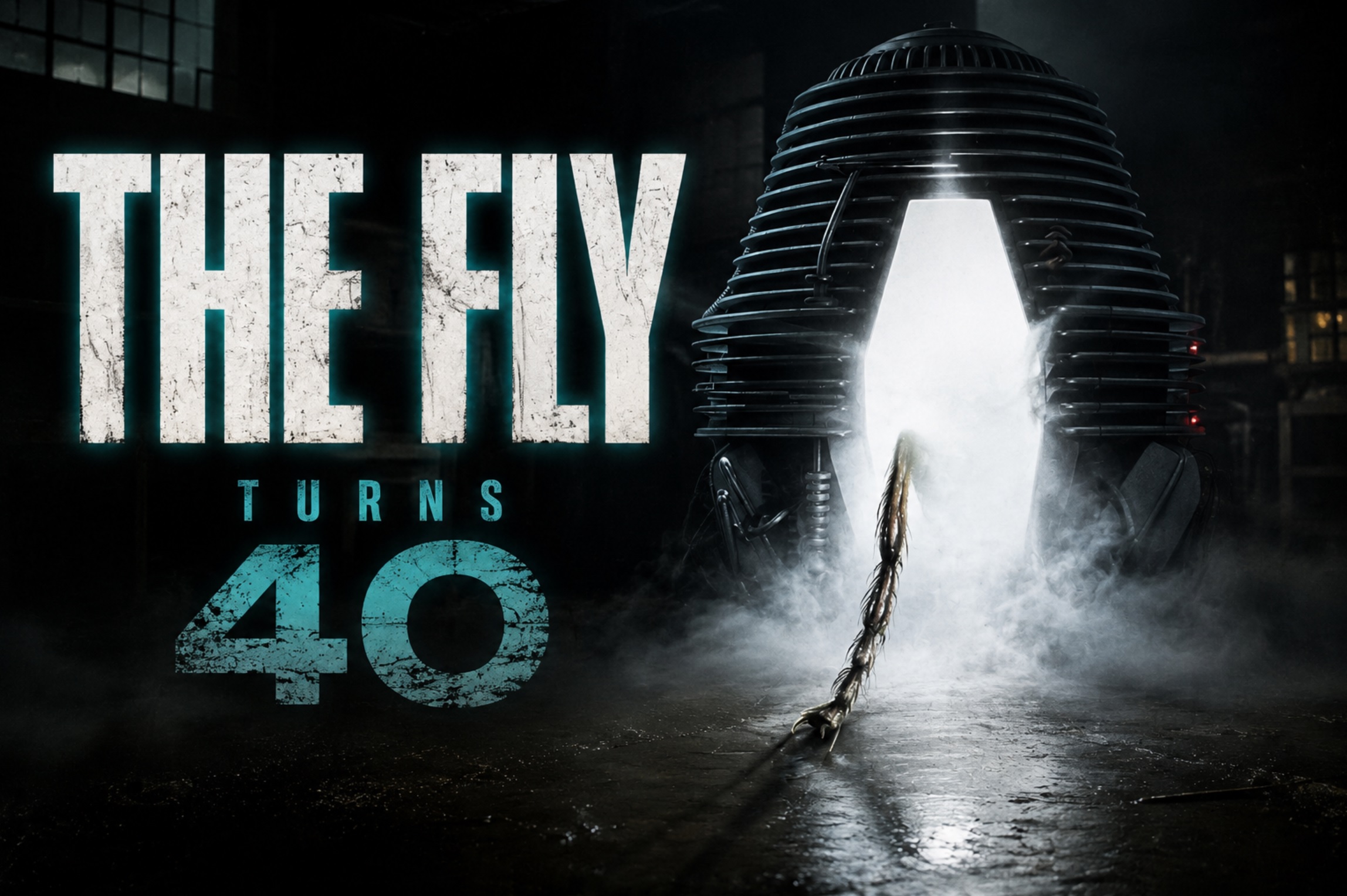
The Fly at 40: Be Afraid. Be Very Afraid… You’re Getting Old
There is something deeply unsettling happening in 2026, and for once David Cronenberg has nothing to do with it. An extraordinary number of films that still somehow feel as though they belong to our relatively recent cinematic past are celebrating their 40th birthdays. Here at Stalk & Slash, we have already marked four decades of Big Trouble in Little China, celebrated James Cameron’s magnificent Aliens and, most recently, declared our continuing love for Michael Mann’s Manhunter. Now another member of the absurdly talented Class of 1986 has reached the big four zero, and this one comes complete with teleportation pods, falling fingernails, insect politics and possibly the most revolting method of eating a doughnut ever committed to film.
David Cronenberg’s The Fly opened in American cinemas on 15 August 1986, exactly 40 years ago today. It was released by 20th Century Fox, ran for 96 minutes and opened at number one with just over $7 million before ultimately grossing more than $40 million in North America and around $60.6 million worldwide. Not bad for a romantic tragedy in which Jeff Goldblum gradually loses most of his recognisable human anatomy.
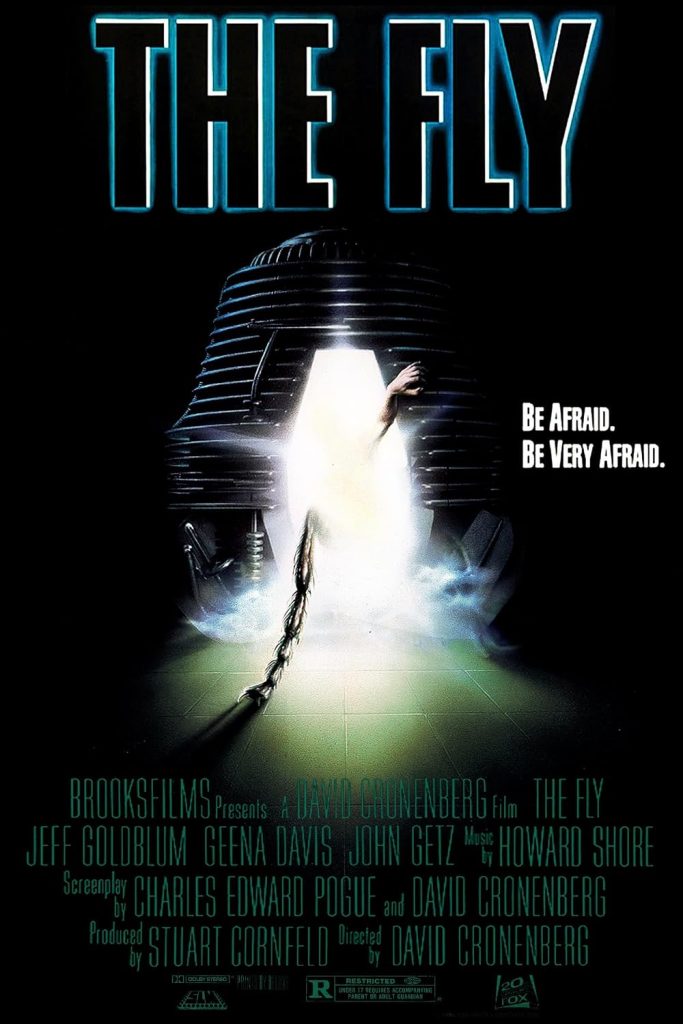
Four decades later, The Fly remains one of the greatest horror films of the 1980s, one of cinema’s finest remakes and arguably the definitive body horror movie. Yet reducing it to its spectacular makeup effects does the film a considerable disservice. Beneath all the slime, vomit, lesions and steadily disappearing body parts is a genuinely devastating story about love, disease, ageing, mortality and the horror of watching somebody you love disappear while they are still standing in front of you. It is disgusting, frightening, funny, romantic and desperately sad, sometimes within the same five minutes. Very few filmmakers could have balanced those ingredients without creating an absolute mess. Fortunately, David Cronenberg isn’t most filmmakers.
From Vincent Price to David Cronenberg
Cronenberg’s film wasn’t the first version of The Fly. The story originated with George Langelaan’s 1957 short story, which became the basis for the famous 1958 film directed by Kurt Neumann and starring David Hedison, Patricia Owens and Vincent Price. The earlier film has its own place in horror history, not least because of its unforgettable climax involving a tiny human headed fly trapped in a spider’s web, but Cronenberg and screenwriter Charles Edward Pogue took the central concept in a radically different direction. Rather than simply recreating the original, Cronenberg turned the idea of a scientific experiment gone wrong into something far more intimate and physical.
Jeff Goldblum plays Seth Brundle, an eccentric and socially awkward scientist who meets journalist Veronica “Ronnie” Quaife, played by Geena Davis, at a press event. Brundle has developed something extraordinary in his warehouse laboratory: two telepods capable of transporting matter from one place to another. Unfortunately, while the technology works perfectly well with inanimate objects, living tissue presents a rather significant problem. His first attempt at teleporting a baboon produces the sort of result that would normally lead to an immediate cancellation of funding, several visits from animal welfare officials and perhaps a gentle suggestion that Seth consider a less ambitious hobby.
Brundle eventually solves the problem, successfully teleports another baboon and decides that the obvious next stage of scientific testing is himself. Unfortunately, he enters the telepod without noticing that a housefly has joined him. The computer detects two separate lifeforms and, rather than politely asking Seth whether he would like to remove the insect and start again, decides to fuse them together at the molecular genetic level.
Computers. Always trying to help.
Jeff Goldblum Is Absolutely Magnificent
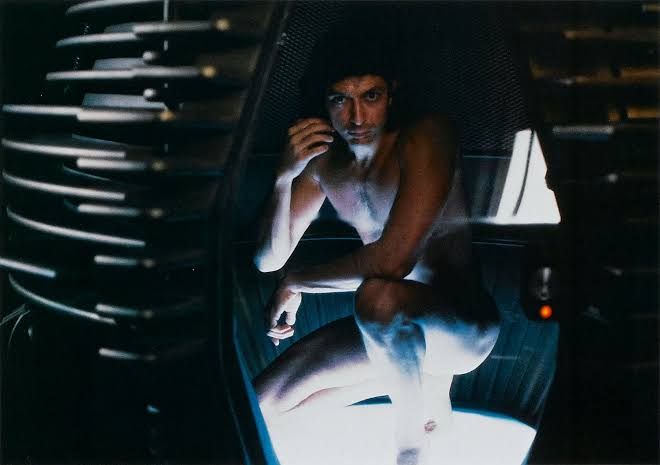
One of the reasons The Fly works so brilliantly is that Seth Brundle is enormously likeable before everything starts dropping off him. Goldblum gives one of the best performances of his career, taking all the unusual rhythms, nervous energy and eccentricity that make him such a distinctive actor and finding the perfect character for them. Brundle is brilliant without being suave, charming without really understanding that he is charming and socially awkward without becoming a caricature. You believe that this strange man could build a teleportation system in his loft while simultaneously requiring considerably more effort to understand how a date works.
Cronenberg specifically wanted Goldblum for the role, although other actors had been considered during development. The choice proved inspired because the transformation requires much more than somebody willing to sit underneath increasingly elaborate prosthetics. Goldblum effectively plays several versions of Seth. There is the shy scientist Ronnie initially meets, the exhilarated man who believes teleportation has somehow purified him, the arrogant and increasingly manic Brundle who regards ordinary humans as inferior, and finally the terrified man who understands that his humanity is being systematically erased.
That middle stage is particularly clever because, for a while, Seth thinks the accident has improved him. His strength increases dramatically. His reflexes improve. He has enormous amounts of energy and becomes increasingly confident. If the film stopped around this point, the telepod would be the greatest fitness programme ever devised. Unfortunately, the benefits package also includes coarse insect hairs growing from your back and the eventual loss of your ears.
Goldblum makes the transition from excitement to denial and finally terror completely convincing. When Seth starts documenting the changes and refers to himself as “Brundlefly”, there is something almost childlike about his attempt to intellectualise what is happening. He is a scientist observing his own destruction, desperately trying to turn catastrophe into research because research is something he understands.
Geena Davis Is the Film’s Secret Weapon
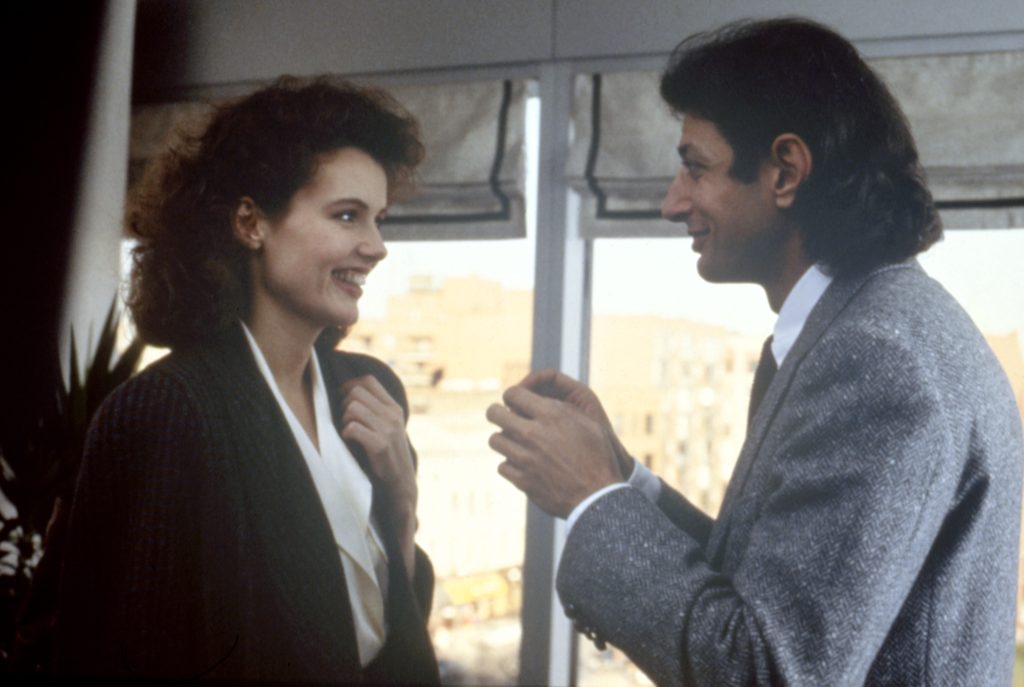
As brilliant as Goldblum is, The Fly would not have anything like the same emotional power without Geena Davis. Ronnie is not simply the horrified girlfriend standing nearby while the makeup department attacks Jeff Goldblum with increasingly unpleasant prosthetics. She is the emotional centre of the film, and Davis has the difficult job of making us understand why she remains emotionally connected to Seth long after common sense would suggest changing her telephone number, moving house and perhaps relocating to another continent.
Goldblum and Davis were a real life couple during production, and the chemistry between them gives the relationship an intimacy that becomes crucial later. Their early scenes are funny and romantic, which means we have something to lose once Seth’s condition begins deteriorating. Cronenberg allows us to spend enough time with them as a couple that the horror doesn’t merely come from seeing Brundle transform. It comes from watching Ronnie realise that the person she loves is disappearing.
This is why The Fly ultimately plays more like a tragic love story than a conventional monster movie. Ronnie isn’t trying to defeat Seth for most of the film. She wants him back. Even after his appearance has become horrifying, there are moments when we can still recognise the man she fell in love with underneath it. The tragedy is that Seth can recognise him too.
The Greatest Body Horror Transformation Ever?
Of course, we cannot celebrate The Fly without talking about the reason generations of viewers have looked suspiciously at their fingernails after watching it. The creature and makeup effects were overseen by Chris Walas, with Stephan Dupuis working on the makeup, and the transformation of Seth Brundle remains one of the supreme achievements of practical effects cinema. Their work deservedly won the Academy Award for Best Makeup, an unusually sensible decision from an organisation that historically hasn’t always been eager to embrace horror.
The brilliance is in the progression. Brundle does not simply go to bed as Jeff Goldblum and wake up the following morning looking like an enormous fly. His body deteriorates gradually through a series of increasingly extreme stages. His complexion changes, strange hairs appear, his face becomes swollen and damaged, his teeth deteriorate and various parts of his body begin deciding they have enjoyed their time with Seth but would now prefer independent careers.
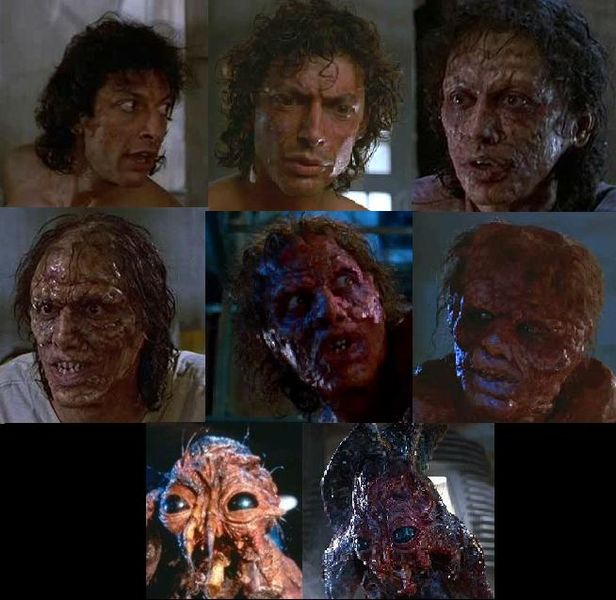
The bathroom cabinet sequence remains simultaneously horrible and very funny. Seth has started storing the pieces that have fallen from his body in jars, essentially creating a small museum dedicated to himself. There is something almost heartbreakingly methodical about it. Of course he keeps them. He is still a scientist. If your ear falls off, apparently the responsible scientific procedure is not to scream continuously for three days but to put it in a jar and label it.
Cronenberg understood something fundamental about body horror: the small things can be worse than the monsters. A gigantic creature is fantastical. A fingernail coming loose is recognisable. We know what a fingernail feels like. We know what a tooth feels like. The thought of those familiar parts suddenly ceasing to belong to us produces a much more immediate physical reaction than any number of tentacles.
Brundlefly Is Really About Us
The Fly was released during the AIDS crisis and has frequently been interpreted through that context, but Cronenberg himself has described the film’s central concerns more broadly in terms of disease, ageing and death. That distinction matters because it helps explain why the movie remains so powerful 40 years later. Brundle’s condition is fantastical, but what happens emotionally is painfully familiar: a healthy person changes, his body becomes unreliable and both he and the person who loves him are forced to confront the possibility that there is no way back.
Watching The Fly at different ages can therefore produce very different experiences. See it when you’re young and the principal concern is that Jeff Goldblum’s ear has just come off. See it when you’re older and suddenly Cronenberg appears to be making a two hour documentary about everything you have been desperately trying not to think about. The film hasn’t changed. You have, which is a particularly unpleasant trick for a movie celebrating its 40th birthday to play on the rest of us.
Seth’s greatest fear isn’t simply that he is going to look monstrous. It is that he is going to stop being Seth. As the insect DNA increasingly takes control, he becomes concerned that he is losing human qualities such as compassion. He can observe the change taking place but cannot stop it, meaning there is a terrible period in which enough of Seth remains to understand that eventually there may not be enough of Seth left to care.
That is infinitely more frightening than a giant fly chasing somebody down a corridor.
“Be Afraid. Be Very Afraid.”
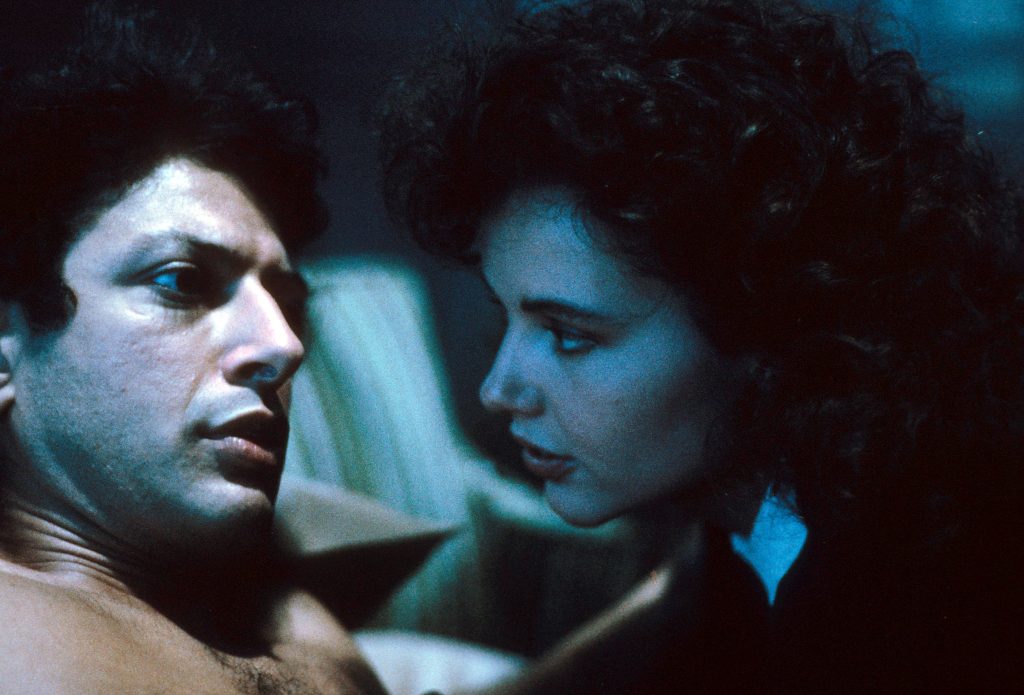
The film also gave horror cinema one of its most enduring taglines. “Be afraid. Be very afraid” became so deeply embedded in popular culture that people who have never watched The Fly have probably heard some variation of it. The line is spoken by Ronnie in the film and became central to its marketing, eventually escaping into the wider culture in a way few movie taglines manage.
The extraordinary thing is how little The Fly depends upon conventional scares. Cronenberg isn’t particularly interested in somebody walking slowly towards a cupboard while the music stops so something can leap out. The fear comes from inevitability. Once we understand what has happened to Brundle, the suspense is no longer about whether he will transform but how far the transformation will go and how much of him will remain when it is complete.
Cronenberg occasionally allows black humour into that nightmare, particularly as Brundle begins exploring the practicalities of being part insect. His method of eating becomes one of the film’s most memorably revolting ideas. Brundle explains the process to Ronnie with almost cheerful scientific enthusiasm before demonstrating it, and suddenly everyone watching discovers that they weren’t particularly hungry after all.
Howard Shore Makes a Monster Movie Feel Like Tragedy
Another enormous part of the film’s power comes from Howard Shore’s score, performed by the London Philharmonic Orchestra. Shore had already established a significant creative relationship with Cronenberg, and his music for The Fly gives the film an almost operatic scale. Instead of treating the material like a trashy creature feature, the score approaches Seth’s fate as genuine tragedy.
That decision is crucial. The images become progressively more outrageous, but the film itself never starts laughing at Seth. Even when Cronenberg finds grotesque humour in what is happening, the emotional reality remains serious. Shore’s music helps hold those competing tones together, particularly during the final stages when the physical transformation reaches its most extreme form.
The result is something surprisingly beautiful for a film containing quite this much bodily fluid. Cronenberg gives us all the physical horror we could possibly want, but he never allows the effects to become the entire point. The creature matters because we remember the man who used to be inside it.
The Pregnancy Makes Everything Worse
As though Ronnie’s situation weren’t already complicated enough, she discovers that she is pregnant and has no way of knowing whether the child was conceived before or after Seth’s fusion with the fly. Cronenberg turns pregnancy anxiety into one of the film’s most infamous sequences when Ronnie dreams that she gives birth to an enormous maggot. Cronenberg himself appears in the film as the gynaecologist, proving that if you’re going to direct one of cinema’s most revolting nightmare birth sequences, you might as well give yourself a front row seat.
The pregnancy also drives Seth towards his final, desperate plan. By now almost completely transformed, he decides that the solution to his deteriorating condition is to use the telepods to fuse himself with Ronnie and their unborn child, creating a single new organism. It is simultaneously horrifying and desperately sad because there is a warped logic behind it. Seth knows he is disappearing and believes combining himself with two human beings might restore the humanity he is losing.
It is probably safe to say that Ronnie does not consider this a viable relationship counselling exercise.
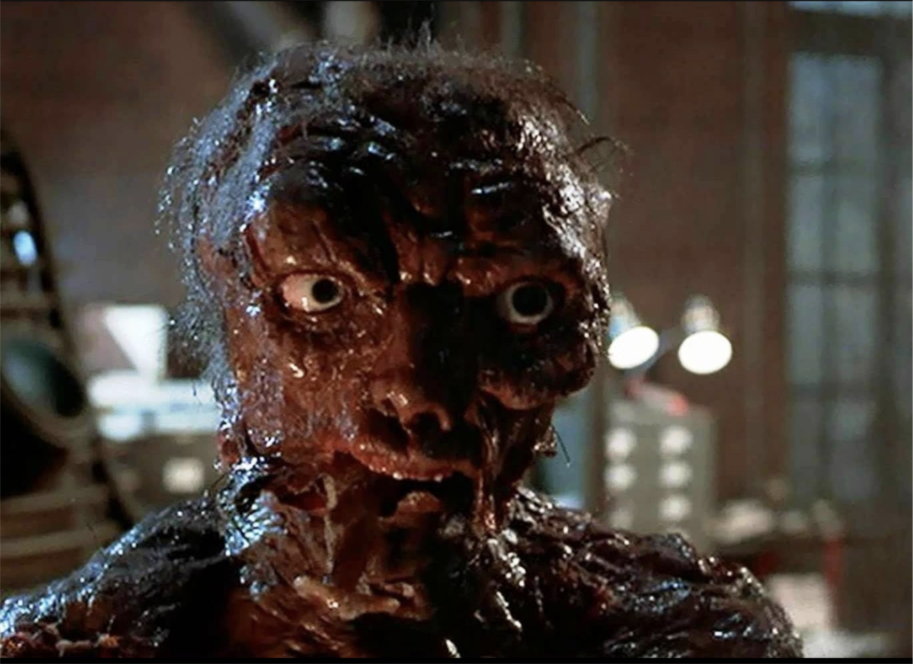
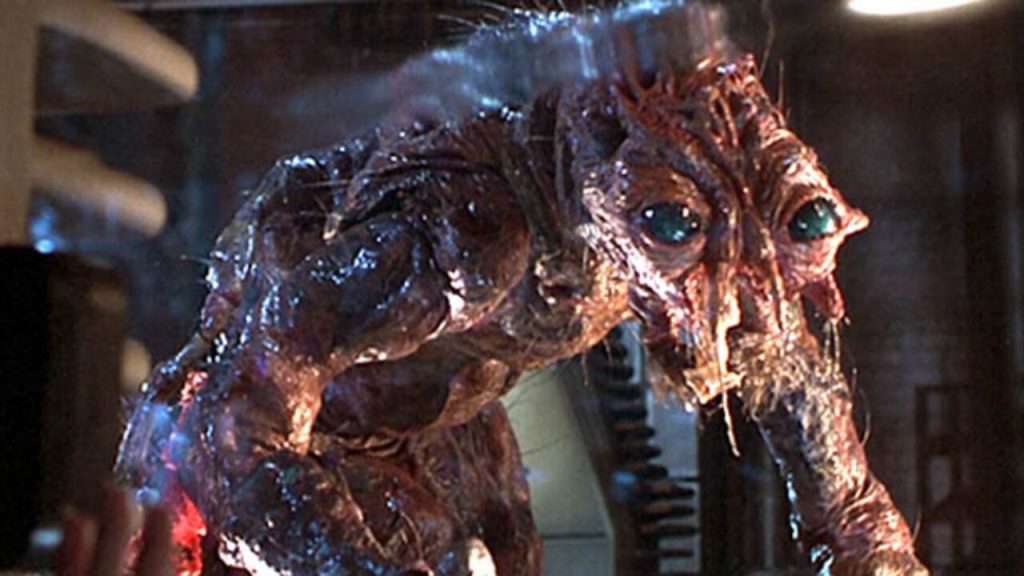
The climax pushes the effects work to its limit as Seth’s remaining human exterior finally peels away to reveal the creature beneath. His plan fails catastrophically, and the resulting Brundlefly becomes fused with part of the telepod itself. Yet Cronenberg’s final masterstroke is not making the creature frightening. It is making it pathetic. The ruined Brundlefly crawls towards Ronnie and guides the barrel of the shotgun towards its own head. Enough of Seth remains to understand what he has become, and enough remains to ask the woman he loves to end it.
That is why The Fly hurts in a way most monster movies don’t. We aren’t relieved when the monster dies. We mourn Seth Brundle.
Cronenberg Knew What to Leave Out
The production generated material that never made it into the finished film, including the notorious sequence in which Brundle experiments with fusing a baboon and a cat. The resulting creature is attacked and killed by Brundle, who then experiences another disturbing physical development. Preview audiences reportedly found the material damaging to their sympathy for Seth, and Cronenberg removed it. Other material involving an alternative ending was also abandoned, leaving the finished film with the stark conclusion we know today.
That restraint matters. There is no lengthy epilogue explaining what happened afterwards and no last minute shot of a fly buzzing around Ronnie’s apartment to tell us Brundle might return in The Fly 2: Still Buzzing. The story has reached its conclusion. Ronnie has lost him, and Cronenberg allows the weight of that moment to remain.
Hollywood, naturally, eventually made a sequel anyway.
The Fly II
The Fly II arrived in 1989 and was directed by Chris Walas, who had overseen the creature effects on Cronenberg’s film. It follows Seth Brundle’s son Martin and continues the story of the telepods and the Bartok corporation. John Getz returned as Stathis Borans, while Geena Davis declined to reprise Ronnie and Jeff Goldblum appears only through archival footage. Cronenberg was not involved.
The sequel has its admirers and contains some excellent effects work of its own, but it was never likely to escape comparison with its predecessor. The Fly works because so many elements came together at exactly the right moment: Cronenberg’s particular obsessions, Goldblum and Davis’s performances, Walas and Dupuis’s effects, Shore’s music and a screenplay that understands the monster is considerably less important than the man becoming it.
That combination is extraordinarily difficult to reproduce.
A Horror Film That Actually Won an Oscar
It is worth returning to the Academy Award because horror has historically had an awkward relationship with major awards organisations. Walas and Dupuis winning Best Makeup was entirely deserved, but Goldblum’s absence from the acting nominations remains one of those decisions horror fans have been grumbling about for four decades. His performance requires comedy, romance, physicality, menace and heartbreaking vulnerability, often while buried underneath prosthetics that would make simply remembering your dialogue an achievement.
The film itself was a significant commercial success as well. Its opening weekend brought in just over $7 million from 1,195 cinemas, enough to take the number one position at the US box office, and it remained number one the following weekend. Its worldwide total eventually reached approximately $60.6 million.
More importantly, its reputation has endured. Cronenberg had already made Shivers, Rabid, The Brood, Scanners, Videodrome and The Dead Zone, establishing himself as one of genre cinema’s most distinctive filmmakers. The Fly took the ideas that had fascinated him throughout those films – bodies changing, technology invading flesh, disease, sexuality and identity – and placed them inside a surprisingly accessible Hollywood production.
He made a mainstream hit without making a mainstream David Cronenberg film.
That’s quite an achievement.
Forty Years Later, We’re Still Afraid
Perhaps the greatest testament to The Fly is how little its emotional impact depends upon nostalgia. Yes, there are computers and technology that immediately place it in the 1980s, but none of that matters. The telepods remain convincing because the film isn’t really about whether teleportation could work. It is about what happens when the body that has carried you through your entire life suddenly becomes something you can no longer trust.
That idea doesn’t age. If anything, it becomes more frightening as the audience does.
It is also why the practical effects remain so powerful. Modern visual effects could undoubtedly create an extraordinarily detailed Brundlefly, but detail isn’t the same thing as impact. Goldblum is physically present underneath much of the transformation, interacting with Davis and occupying the same space. The makeup progressively changes a face we have spent the film learning to love. By the time Seth is almost unrecognisable, we can still see traces of him.
That is the horror. Not simply becoming a monster, but remaining conscious long enough to watch yourself become one.
So yes, The Fly is 40 years old today, joining Aliens, Big Trouble in Little China and Manhunter among the extraordinary films from 1986 that we are celebrating this year. Looking back at that release calendar is frankly ridiculous. Apparently filmmakers in 1986 collectively decided future generations deserved enough classics to keep boutique Blu-ray labels in business indefinitely.
The Fly deserves its place near the very top of that remarkable year. It is gruesome without being empty, romantic without becoming sentimental, funny without undermining its horror and tragic without ever becoming pretentious. Jeff Goldblum gives arguably the performance of his career, Geena Davis gives the film its heart, Howard Shore makes the tragedy soar, Chris Walas and Stephan Dupuis created some of the finest transformation effects ever put on screen, and David Cronenberg somehow turns a story about a man accidentally merging with a housefly into something profound about what it means to be human.
Forty years later, we still wince when the fingernails come off. We still feel sick when Brundle demonstrates how he eats. We still hope, despite knowing perfectly well what is coming, that somehow Seth can be saved. And when that ruined creature finally places the shotgun against its own head, the film still manages to make us feel desperately sorry for something that barely looks human anymore.
That is why The Fly isn’t simply one of the great body horror movies. It is one of the great horror movies, full stop. Forty years have done absolutely nothing to diminish it, although they have unfortunately done quite a lot to the rest of us.
Happy 40th birthday, The Fly. We remain afraid. We remain very afraid.
And if any of our fingernails fall off tonight, we’re blaming Cronenberg.