Cujo Bites His Way Into The Hall Of Killers As The First Class Canine Of Carnage
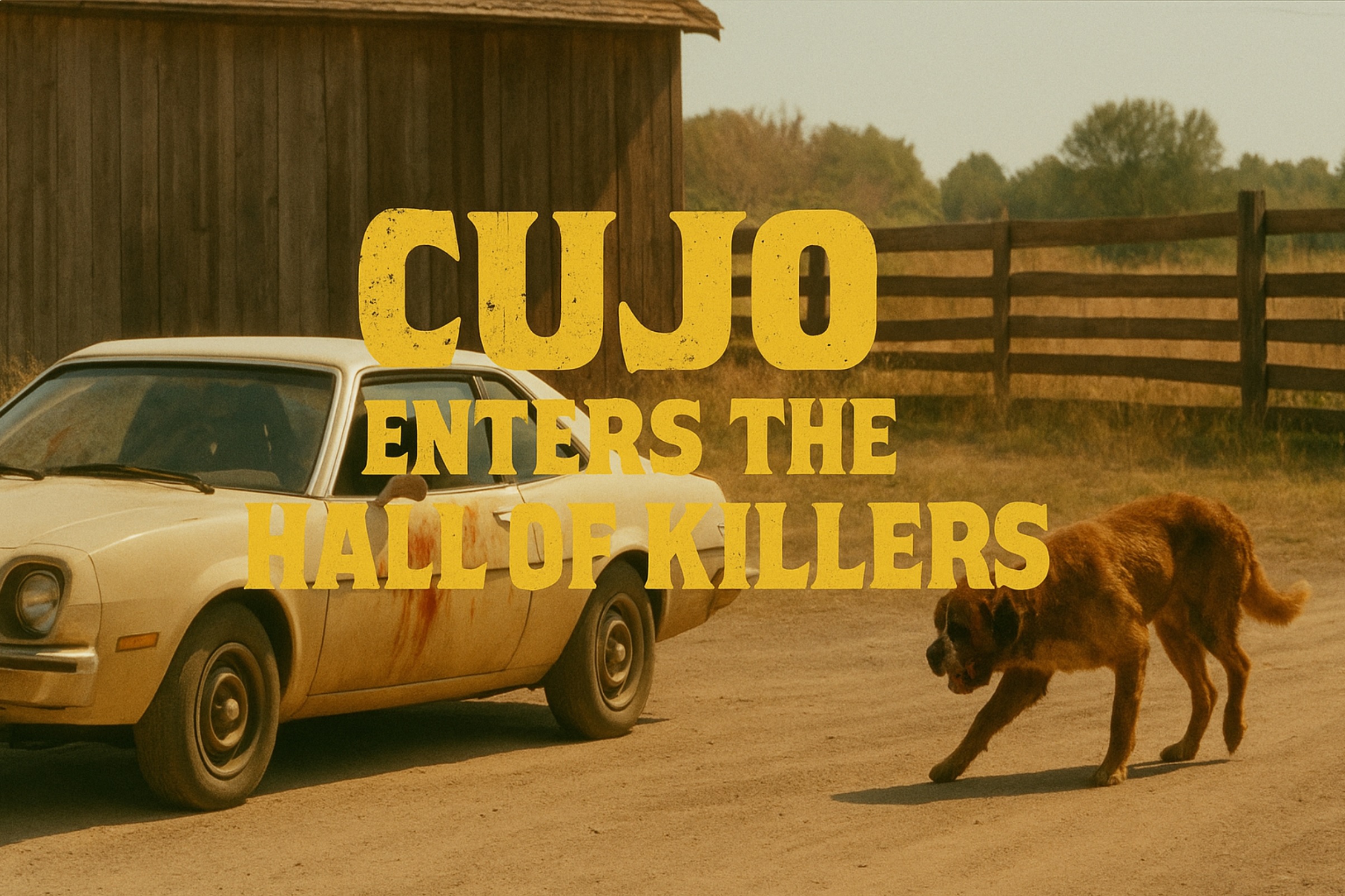
Every so often, horror gives us a monster that stays with us forever. Not a vampire, not a ghost, and not a masked maniac — but a big, slobbering Saint Bernard who just wanted a quiet life until rabies turned him into an unstoppable killing machine. Stephen King’s Cujo remains one of the most terrifying and tragic creatures ever to grace the genre, and it is only fitting that he has now been inducted into the Hall Of Killers in the First Class tier. Good boy? Not quite. Great horror icon? Absolutely.

When Cujo bounded into cinemas in 1983, audiences were not ready. Directed by Lewis Teague and adapted from King’s 1981 novel, it turned the humble family dog into a source of unrelenting terror. The film’s brilliance lies in its simplicity. There is no supernatural curse, no evil spell, just a beloved pet who takes one wrong bite at the wrong time and becomes the stuff of nightmares.
The story follows Donna Trenton, played with heart-stopping intensity by Dee Wallace, and her son Tad, trapped in their car while Cujo, now foaming at the mouth and out of his mind, prowls outside. The summer heat builds, the air becomes suffocating, and the dog’s low growls echo like thunder. There are few horror scenes as tense as that moment when Wallace dares to open the car door. It is sweaty, primal fear at its finest.
Stephen King’s novel, written during a period he later admitted he barely remembered, cuts right to the bone. It is a story about bad luck, motherhood, and how fragile safety really is. There is no ghost in the machine, no villain twirling a moustache. Just a virus, a dog, and the sheer chaos of nature gone wrong.
The movie toned down some of the novel’s darker turns but still delivered one of the most nerve-shredding creature features of the 1980s. Wallace’s performance is legendary — she manages to make you feel every ounce of exhaustion, desperation, and terror. Watching her go head-to-head with Cujo is less like watching an actress perform and more like witnessing someone genuinely fighting for their life with a very angry dog.

Now, while The Howling had already shown us that animalistic horror could be smart, stylish, and full of fur, Cujo did something entirely different. Joe Dante’s The Howling (1981) gave us transformation and howling at the moon. Lewis Teague’s Cujo gave us claustrophobia, heat, and the horrifying sound of claws on metal. Later films such as Silver Bullet and Dog Soldiers would follow suit, each putting their own spin on toothy terror, but none captured the suffocating panic of Cujo.
Even four decades later, it stands out because it feels so real. The practical effects — a mix of trained Saint Bernards, animatronics, and one poor bloke in a dog suit — create a visceral sense of danger that modern CGI still struggles to match. There is something about real drool, real fur, and real teeth that just gets under your skin. You can keep your digital monsters. Give us a sweaty summer day, a broken-down car, and one very cross dog any time.

Pop culture, of course, has never forgotten Cujo. He has been referenced in The Simpsons, Family Guy, and countless other shows. Even people who have never read the book or seen the film know the name. It has become shorthand for any out-of-control animal. “Careful, he’s turning into Cujo,” has probably been said in every vet’s office at least once.
So why the First Class tier in the Hall Of Killers? Because Cujo represents a kind of horror that is rare — raw, human, and heartbreakingly believable. He is not a villain in the traditional sense. He is a victim of chance, of bad timing, of a universe that does not care about your plans or your car battery. He is tragedy wrapped in fur, with a growl that echoes across forty years of horror history.
Cujo taught us that terror can come from anywhere, even from the family pet. He made us fear the ordinary, and that is why he still stands tall (and slobbering) among the legends. So here’s to Cujo, the canine king of chaos. May his place in the Hall Of Killers be as secure as a locked car door — which, as it turns out, might not be very secure at all.