Horror Shorts In Focus: Pariah
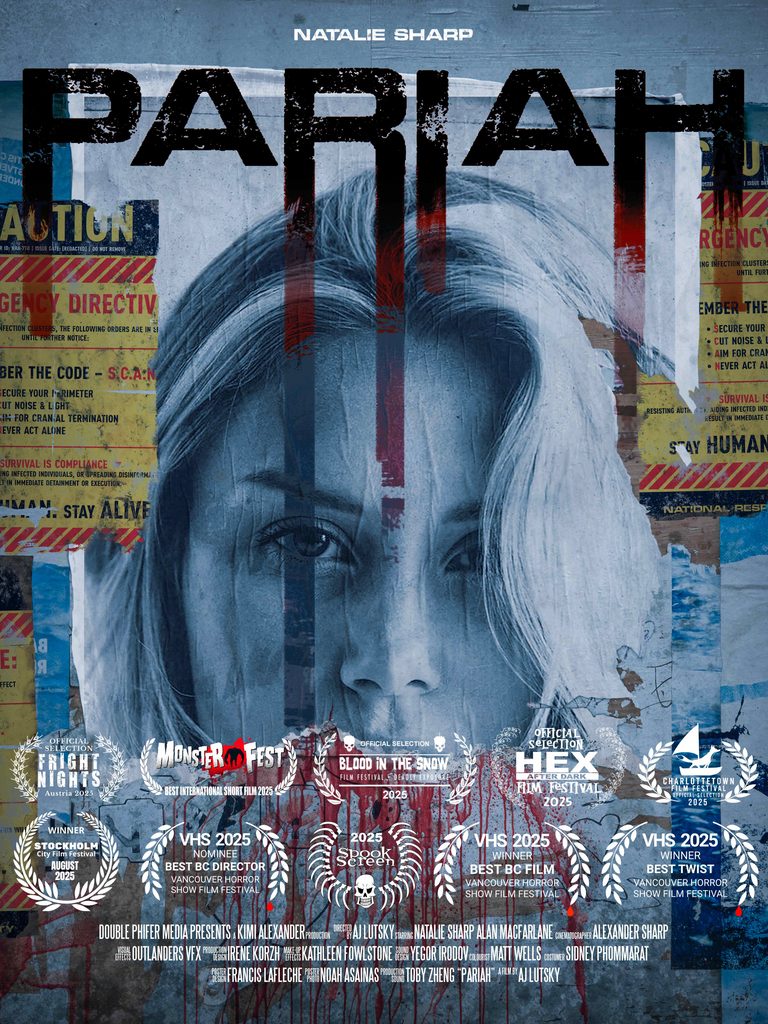
It takes some feature films two hours and a budget capable of bankrupting a small country to convince us that civilisation has ended. Pariah manages it in little more than five minutes, a rifle, some snow, a few abandoned vehicles and the deeply unpleasant feeling that whatever happened here, humanity didn’t come out of it particularly well.
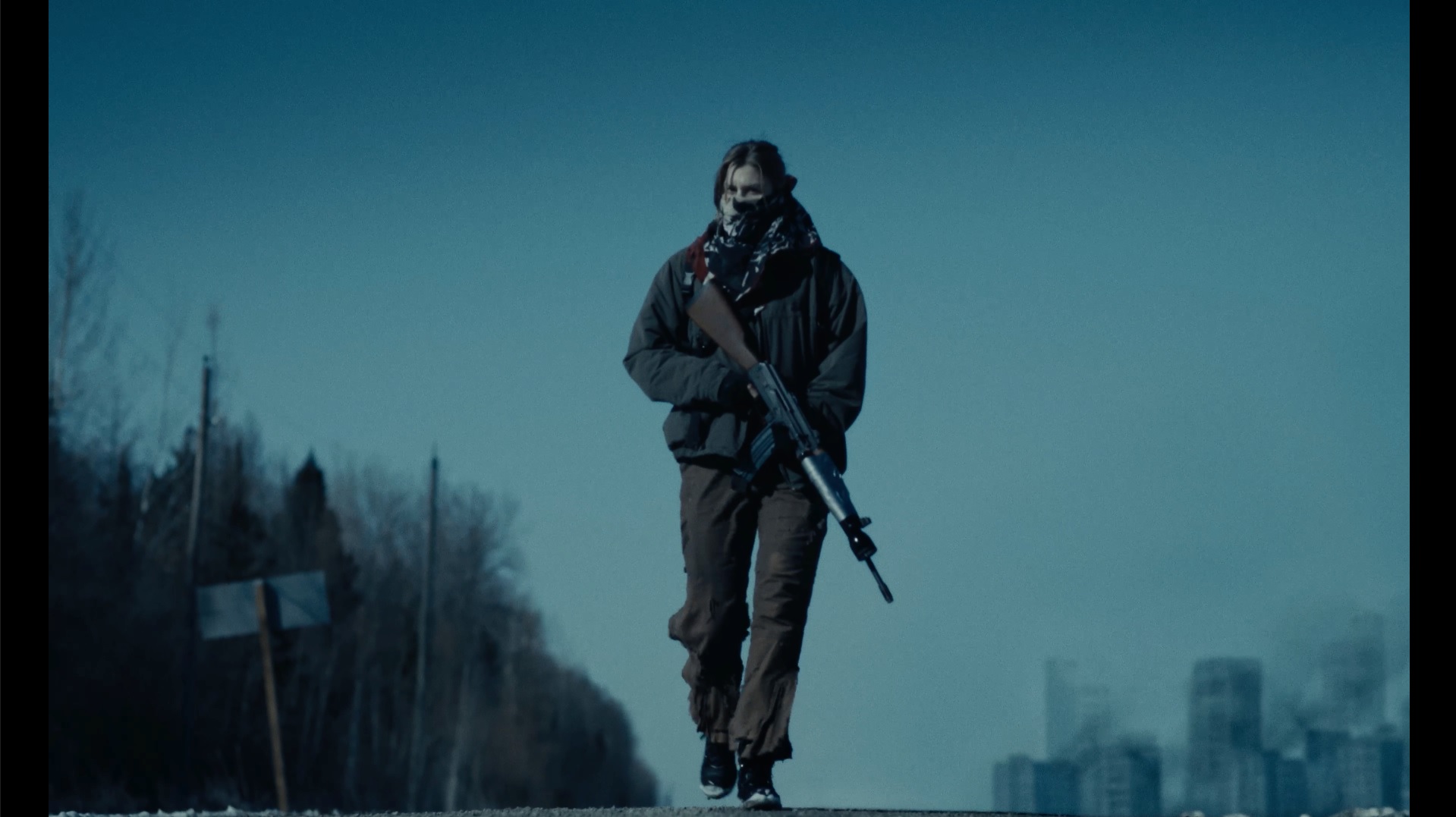
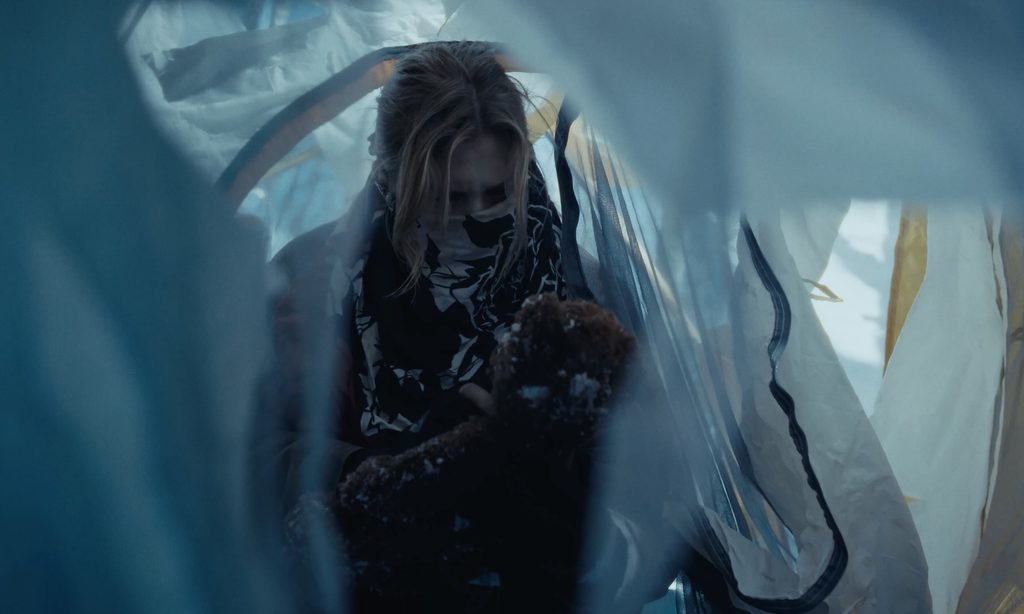
Directed by AJ Lutsky, Pariah drops us into a frozen post-apocalyptic landscape alongside a solitary woman travelling through what appears to be the remains of civilisation. Played by Natalie Sharp, she initially looks exactly like the sort of hardened survivor these stories have taught us to follow. A bandana covers the lower half of her face, a rifle remains close at hand and every abandoned building potentially contains either something useful or something waiting to kill her.
The film opens particularly well. Screeching strings rise towards a crescendo before the woman enters frame and approaches an abandoned house with the word “INFECTED” painted across an exterior wall. Inside, buzzing flies lead her towards the body of a young man with a gruesome head wound. There is almost no exposition because none is necessary. Within moments, Pariah has established disease, death and isolation without anybody having to conveniently explain the end of the world to somebody else.
Her journey continues through a wintry landscape beautifully captured by cinematographer Alexander Sharp. She discovers a damaged tent containing a wind-up radio repeating an emergency warning to quarantine and remain indoors, alongside a small teddy bear that she places in her rucksack. Later, abandoned cars clog a road and another search produces a wristwatch. These little discoveries initially encourage us to see her as resourceful rather than threatening. In a world where everything has apparently collapsed, useful objects have become more important than whatever purpose they once served.
That is where Pariah becomes clever. Lutsky understands the visual language of post-apocalyptic storytelling and uses our familiarity with it against us. We have watched countless survivors search abandoned homes, vehicles and campsites for supplies, so we instinctively assign this woman the role of protagonist. We don’t know who she is or where she is going, but the film quietly encourages us to hope she finds food, shelter and perhaps another living person.
As darkness approaches, she discovers a cabin glowing warmly from within. For the first time, this seemingly dead world contains recognisable domestic life. A young boy sits reading by lamplight while his mother and father sleep nearby, and the contrast with everything outside is immediate. After several minutes of corpses, abandoned possessions and empty roads, Pariah has finally shown us people surviving together. The woman enters the cabin, the frightened boy calls for his father, and what happens next completely changes our understanding of the person we have spent the film following. It is best left there because the less you know about the final moments of Pariah, the better.
The reversal works precisely because the film hasn’t spent its running time announcing that something is coming. Instead, it allows us to make assumptions about its central character based largely on the familiar language of survival horror. We have followed her, watched her scavenge and interpreted her behaviour through decades of post-apocalyptic storytelling, only for the film to suddenly ask whether we should ever have trusted our own interpretation. For something running barely five and a half minutes including its credits, that is an impressively efficient piece of storytelling.
What makes the short particularly impressive is the scale it achieves with very little. This doesn’t feel like several people finding an empty road and hoping nobody notices the houses behind the camera. The locations, production design, snow-covered landscape, abandoned vehicles and careful framing create the convincing impression of a much larger catastrophe. At times it has the visual texture of a big-budget post-apocalyptic television series, something resembling The Walking Dead transplanted into a frozen wilderness, only without needing hordes of zombies wandering through every shot to remind us that society has collapsed.
Alexander Sharp’s cinematography deserves considerable credit for that illusion. The bare trees, cold landscape and washed-out remnants of civilisation make the world feel genuinely exhausted, while the warm cabin initially appears almost impossibly inviting after everything that has preceded it. That contrast becomes crucial to the film’s final moments, transforming what initially looks like sanctuary into something far more uncomfortable. Production designer Irene Korzh also helps sell a world in which human life has become scarce and every surviving possession seems capable of telling a story about whoever left it behind.
The sound is just as important. Yegor Irodov’s sound design gives the empty environments an uncomfortable physical presence, from the flies surrounding the corpse to the mechanical repetition of the emergency broadcast. The final stretch is especially effective because some of its most disturbing material doesn’t need to be shown at all. What we hear is enough, and arguably worse than anything the filmmakers could have placed directly in front of the camera. Sometimes the audience’s imagination remains the cheapest special effect available and, inconveniently for us, one of the best.
The music works alongside that soundscape rather than overwhelming it, beginning with those aggressive strings and helping maintain tension throughout an extremely economical runtime. There is no room here for lengthy character development or elaborate explanations, so Pariah relies on image, sound and audience expectation to do the heavy lifting. It understands that a ruined campsite, an abandoned road or a discarded possession can tell us considerably more about this world than several minutes of dialogue explaining how everything went wrong.
That economy is ultimately the film’s greatest strength. Pariah is only around five and a half minutes including its end credits, yet it establishes a convincing world, creates a central character we think we understand and then overturns that assumption. It knows exactly how much information to give us and, more importantly, how much to withhold. There is enough here to make the world feel considerably larger than the tiny glimpse we’re actually given.
For filmmakers working with limited resources, that is worth paying attention to. Lutsky and his team don’t try to compete with studio apocalypse movies through scale. They create the suggestion of scale through locations, cinematography, production design and sound, then concentrate the actual story on one person and one deeply uncomfortable encounter. The result feels much larger than the production presumably had any right to feel, and that illusion is maintained right through to its unsettling conclusion.
Pariah is bleak, beautifully shot and impressively confident for something so brief. More importantly, it demonstrates that AJ Lutsky and the filmmakers around him understand how to use the audience’s expectations rather than simply satisfy them. Five minutes isn’t much time to build a world, establish a character and then pull our assumptions out from underneath us, but Pariah manages all three. It is certainly recommended, and AJ Lutsky, Alexander Sharp and the rest of the team behind it are names worth keeping an eye on.