The Unmade: Jaws 3, People 0
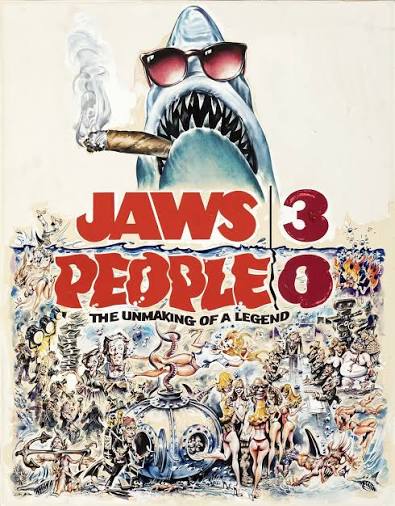
There are plenty of abandoned sequels that sound ridiculous when described decades later. Jaws 3, People 0 is different. Universal really did spend part of 1979 developing a third Jaws movie that would have turned one of the biggest franchises in cinema into a full-blown National Lampoon comedy, with Joe Dante lined up to direct and a young John Hughes co-writing the screenplay. It wasn’t merely a joke tossed around a studio office either. Scripts were written and revised, pre-production began, storyboards were created and principal photography was at one point expected to begin in October 1979. Then Universal pulled the plug, leaving behind one of the strangest roads the Jaws franchise could have travelled.
To understand how anyone reached the point of considering an official Jaws spoof, you have to go back to just how enormous the original movie had become. Steven Spielberg’s Jaws opened in 1975 and transformed Peter Benchley’s bestselling novel into a cultural phenomenon. Roy Scheider’s police chief Martin Brody, Richard Dreyfuss’ oceanographer Matt Hooper and Robert Shaw’s unforgettable shark hunter Quint headed onto the waters surrounding Amity Island to hunt the great white responsible for a series of attacks, while John Williams provided one of the most instantly recognisable scores in film history. The troubled production, including the notoriously unreliable mechanical sharks, became part of Hollywood folklore, but none of those difficulties mattered once audiences saw the finished film.
Jaws became a landmark blockbuster and inevitably made the prospect of a sequel irresistible. Spielberg didn’t return for Jaws 2, released in 1978, although Scheider was back as Brody alongside Lorraine Gary as Ellen. The premise was essentially the nightmare beginning again as another great white shark arrived around Amity, with Brody struggling to convince people that the danger was real before eventually finding himself trying to save a group of teenagers stranded at sea. It couldn’t recreate the lightning-in-a-bottle combination of Spielberg, Scheider, Dreyfuss and Shaw, but commercially it proved there was still plenty of money swimming around Amity Island.
The obvious Hollywood response would have been to make Jaws 3 and find another excuse for an enormous shark to start eating people. Instead, producers Richard D. Zanuck and David Brown, who had produced the first two films, became involved with an idea that would effectively make fun of the entire phenomenon. The person at the centre of that idea was Matty Simmons, publisher of National Lampoon and producer of National Lampoon’s Animal House, which had become a huge hit in 1978.
Simmons later recalled that Zanuck and Brown expressed an interest in making something with him. Rather than pitching a conventional movie, Simmons jokingly suggested “Jaws 3, People Nothing”, imagining Jaws author Peter Benchley walking out of his house, jumping into his swimming pool and promptly disappearing as a shark fin appeared. What began as Simmons messing around suddenly became considerably more serious when the producers liked the idea.
Universal did too. In April 1979, the trade press reported plans for a joint Universal and National Lampoon production titled Jaws 3, People 0. Zanuck and Brown were going to executive produce, while Simmons developed the story. Instead of bringing in established Hollywood screenwriters, Simmons turned to two people working within National Lampoon: Tod Carroll and John Hughes.
Yes, that John Hughes.
This was years before Hughes directed Sixteen Candles, The Breakfast Club, Weird Science and Ferris Bueller’s Day Off, and before his screenplays for movies including Mr. Mom and the enormously successful Home Alone. Hughes was already an accomplished advertising writer and National Lampoon contributor, but Jaws 3, People 0 came at the very beginning of his screenwriting career. Simmons would later credit the abandoned project as an important step in getting Hughes into the movie business, with their professional relationship continuing through projects including National Lampoon’s Vacation.
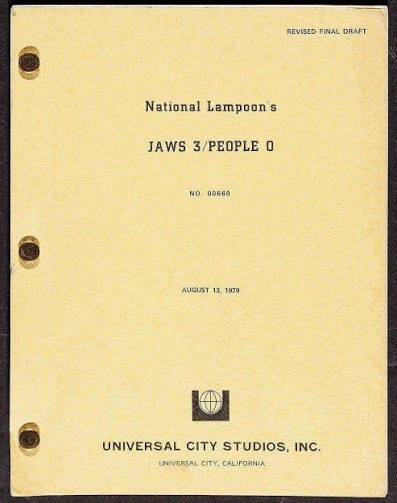
Hughes and Carroll didn’t simply produce a treatment that disappeared into somebody’s filing cabinet. A complete screenplay was written and repeatedly revised. Surviving copies include a second revised final draft dated August 24, 1979 with revision pages continuing into September, while another surviving version is dated September 10. A 47-page continuity and storyboard folder from the production has also survived. Those materials are important because they demonstrate just how seriously Universal explored making a movie that, on paper, sounds like the sort of thing horror fans might invent after several drinks.
The basic premise was gloriously self-aware. Rather than pretending another shark had conveniently arrived to terrorise Brody and Amity for the third time, Jaws 3, People 0 would take place around the production of another Jaws movie. Hollywood was attempting to continue exploiting the killer-shark phenomenon while an actual shark began causing trouble for the people making it. The franchise would essentially turn around and bite the industry that had been feeding from it.
Simmons’ Peter Benchley gag survived into the screenplay, with the author of Jaws becoming an early victim of a shark in his own swimming pool. The script then expanded the joke into a broader attack on Hollywood, sequels, executives and the flood of killer-animal movies that followed the original Jaws. It wasn’t simply going to parody individual scenes from Spielberg’s film. The very existence of an unnecessary third instalment was part of the joke.
That approach made Joe Dante an inspired choice to direct. Dante had recently made Piranha for producer Roger Corman, a low-budget 1978 horror film about genetically altered piranhas escaping into public waterways. Nobody could miss the debt to Jaws, particularly as Piranha arrived during the same year as Jaws 2, but Dante and screenwriter John Sayles gave their movie enough humour and self-awareness to make it considerably more than a lifeless imitation.
There is also a wonderful irony connecting Spielberg to Dante’s career. Universal had been unhappy about Piranha and considered taking action against its release, but Spielberg reportedly saw the film and regarded it favourably, helping defuse the situation. Dante then found himself being considered to direct an official parody of the franchise that had inspired Piranha. Had Jaws 3, People 0 happened, it would have become Dante’s first movie outside the Roger Corman production world. Instead, after the project collapsed, he went on to direct The Howling and eventually reunited with Spielberg as director of Gremlins.
The cast being discussed was similarly interesting. Contemporary reporting identified Roger Bumpass for a role, while Simmons later remembered Bo Derek and Richard Dreyfuss as being involved in the plans. Dreyfuss had, of course, played Matt Hooper in the original Jaws but declined to return for Jaws 2. Accounts of Jaws 3, People 0 indicate that the film was interested in using real people and personalities associated with the Jaws phenomenon rather than simply pretending it existed in isolation. Contemporary reports even described a planned appearance by MCA president Sid Sheinberg, further blurring the boundary between Universal making the joke and Universal being the joke.
The surviving screenplay demonstrates just how determined the writers were to tear apart the machinery of Hollywood filmmaking. The shark movie being produced within the story gives the screenplay an excuse to recreate and distort imagery associated with Jaws, while the characters and situations mock producers, filmmakers and the increasingly desperate business of turning successful movies into franchises. Other killer-animal films were also part of the satirical target. By 1979, Jaws had already helped inspire everything from Orca and Grizzly to Dante’s own Piranha, making the entire creature-feature industry ripe for ridicule.
It is easy to look at the title today and imagine something resembling Scary Movie, but Jaws 3, People 0 was being developed before the great explosion of movie spoofs that defined the early 1980s. Airplane! wouldn’t arrive until 1980. The idea of a major studio deliberately turning its prestigious blockbuster franchise into an anarchic parody of itself was a considerably stranger proposition in 1979 than it might sound now.
That also appears to have been one of the project’s fundamental problems.
Dante later recalled a creative tug-of-war between the National Lampoon side and Zanuck and Brown. According to Dante, the Lampoon contingent wanted the movie to become increasingly outrageous, while the producers wanted parts of it played straight. Dante was caught somewhere between the two approaches and later summed up the contradiction perfectly: a film called Jaws 3, People 0 couldn’t really be expected to play things straight.
This wasn’t a minor disagreement about the number of jokes in a scene. It went to the heart of what the movie actually was. Was Universal making a legitimate third Jaws movie that happened to be funny, or was National Lampoon being allowed to tear Jaws apart using Universal’s own money? Those are two very different films, and the further development progressed, the harder that difference seems to have been to ignore.
Nevertheless, the project got remarkably close to becoming real. Trade reporting from June 1979 described the movie as being about the production of a fictional Jaws sequel and listed October 7, 1979 as the expected beginning of principal photography. Storyboards and continuity material were prepared, and Simmons later claimed that Universal had already spent around $2 million on pre-production before everything stopped.
By October, it was over.
Contemporary reporting stated that Zanuck, Brown and Universal executives had rejected the completed screenplay. Dante’s later recollections support the idea that serious creative disagreements had developed over the film’s tone. Simmons, however, subsequently told a much more dramatic story about why Jaws 3, People 0 died.
According to Simmons, Steven Spielberg intervened.
Simmons claimed that Spielberg objected to the proposed movie ridiculing Jaws and its director and threatened to leave Universal if the studio went ahead with it. In Simmons’ telling, that ultimatum resulted in the production being cancelled despite the money Universal had already spent preparing it. It is a terrific Hollywood story, particularly because Spielberg’s earlier support had helped Dante’s Piranha avoid trouble with Universal, but it needs to be treated carefully. Simmons’ account is his recollection of what happened, rather than something we can state as the single proven explanation for the cancellation.
The contemporary record establishes that Universal, Zanuck and Brown rejected the screenplay, while Dante himself remembered substantial disagreements between National Lampoon and the producers over what kind of movie they were making. Spielberg’s alleged intervention may have been another factor, and Simmons clearly believed it was decisive, but reducing the entire collapse to Spielberg marching into an office and killing the movie would ignore the documented creative problems already surrounding the production.
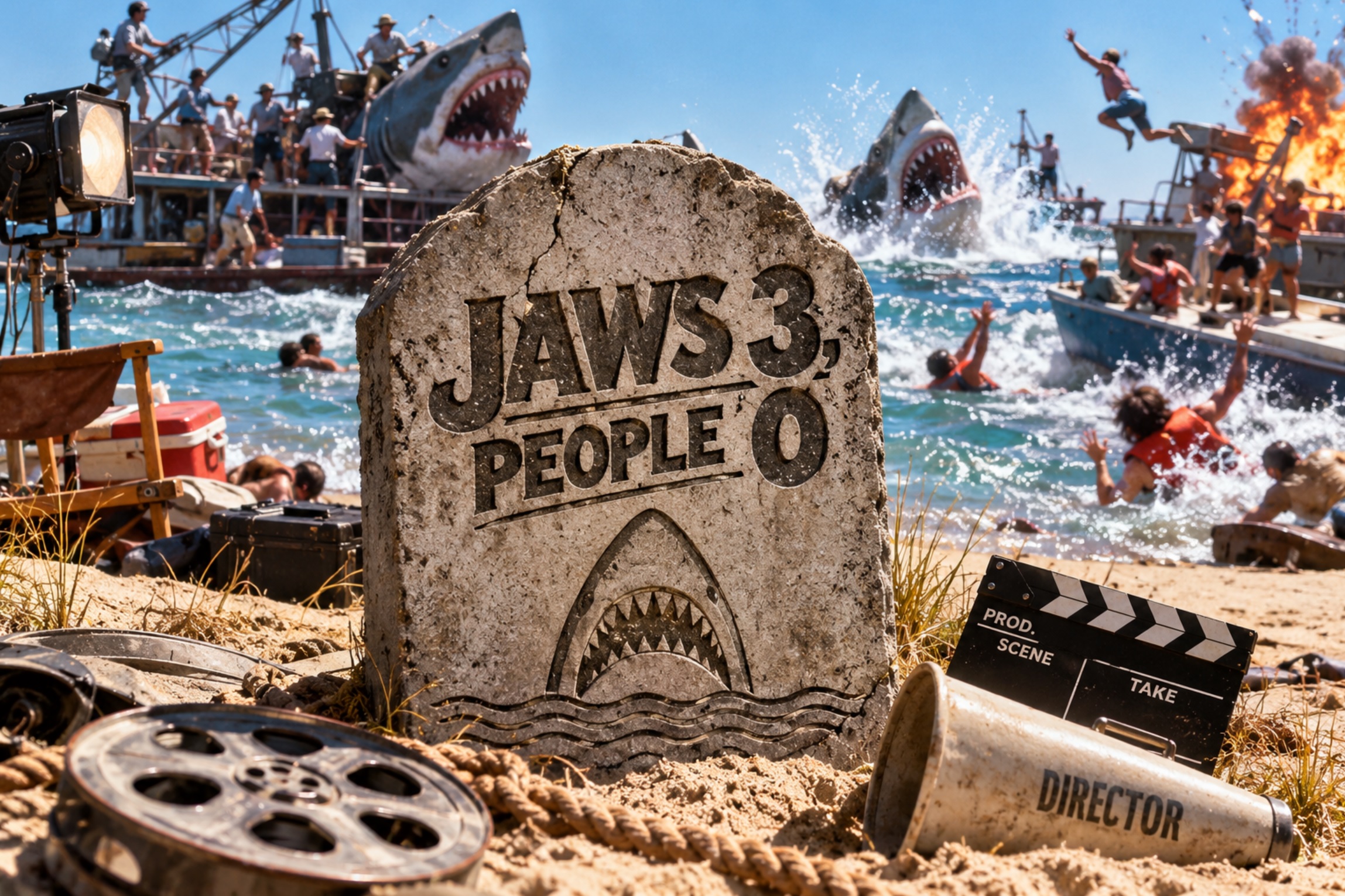
Whatever finally delivered the fatal bite, Jaws 3, People 0 was dead before cameras rolled.
Universal didn’t abandon the idea of a third Jaws film, of course. It simply abandoned the idea of laughing at one.
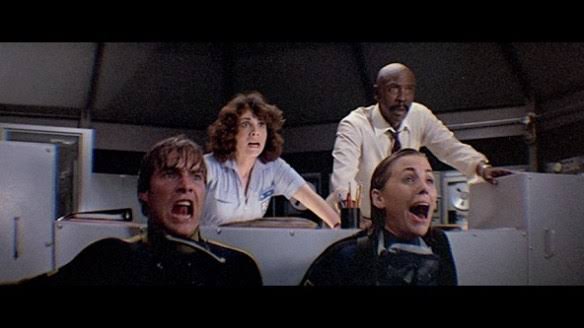
Four years later, audiences received Jaws 3-D. Directed by Joe Alves, production designer on the first Jaws and second-unit director on Jaws 2, the 1983 sequel moved away from Amity Island and followed the grown-up Brody sons. Dennis Quaid played Michael Brody, now working at SeaWorld in Florida, with John Putch as Sean, Bess Armstrong as Kathryn Morgan and Louis Gossett Jr. as park manager Calvin Bouchard. A great white enters the park’s lagoon system, and it eventually becomes apparent that an even larger shark is lurking inside the complex.
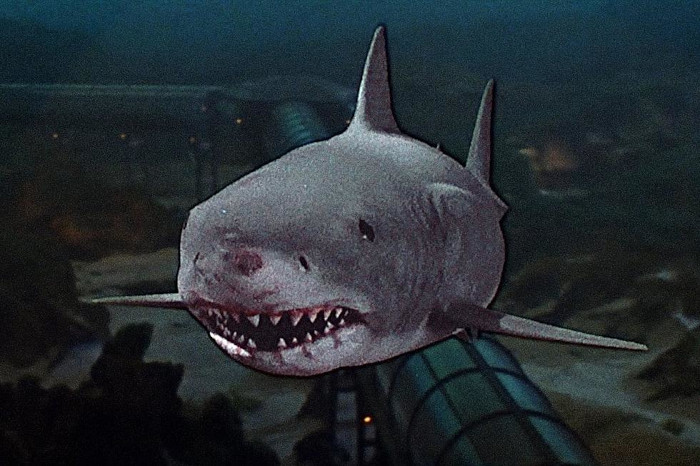
The movie embraced the early 1980s revival of stereoscopic cinema, resulting in objects repeatedly flying towards the audience and, most famously, a shark approaching the underwater control room in an effects shot that has enjoyed a remarkably long life on lists celebrating questionable movie special effects. It is difficult not to wonder what might have happened if Universal had gone with Dante, Hughes, Carroll and National Lampoon instead. Jaws 3-D certainly isn’t lacking entertainment value, but Jaws 3, People 0 would have taken the franchise somewhere completely unexpected.
There is another reason the abandoned project remains fascinating. Look at the people involved with the benefit of hindsight. Joe Dante went on to make The Howling, Gremlins, Explorers, Innerspace, The ‘Burbs and Matinee. John Hughes became one of the defining voices of American comedy during the 1980s and subsequently wrote some of the biggest family films of the following decade. Matty Simmons had just helped turn Animal House into a phenomenon. Put those sensibilities together and allow them to attack Hollywood’s obsession with sequels from inside one of Hollywood’s biggest franchises, and there is at least the possibility that Jaws 3, People 0 could have been something genuinely special.
Dante himself has been much less romantic about the lost opportunity. Looking back, he has said that although he liked the screenplay and thought it contained funny material, he isn’t convinced the finished movie would necessarily have been good. He also remembered the corporate restrictions surrounding the project and the constant disagreement over tone. Years later, when asked whether he would consider returning to the idea, Dante dismissed the possibility because he regarded it as too specifically a product of its time.
He’s probably right. Jaws 3, People 0 belongs to a very particular moment when Jaws had changed Hollywood, Animal House had demonstrated the commercial potential of National Lampoon’s brand of comedy, killer-animal imitations were everywhere and studios were beginning to realise that successful movies could be stretched into continuing franchises. The joke worked precisely because everyone knew what Jaws was and everyone could see Hollywood preparing to squeeze it again.
Instead, the movie became another resident of development hell. The screenplay survives, production paperwork survives and enough contemporary reporting exists to show that this was far more than one of those imaginary sequels that grew larger with every retelling. For a few months in 1979, Universal genuinely considered allowing National Lampoon, John Hughes and Joe Dante to turn its prized killer shark into a joke about Hollywood greed, endless sequels and the absurdity of trying to keep a franchise alive simply because the previous one made money.
Then Universal cancelled it and, four years later, made a third Jaws movie in 3-D.
Sometimes the punchline writes itself.