The Bad Seed Has Arrived: Rhoda Penmark Enters the Hall of Killers
The doors to the Hall of Killers have opened again, and this time you can forget the hockey masks, chainsaws and enormous men inexplicably capable of catching sprinting teenagers while walking at a leisurely pace. Our latest inductee is eight years old, beautifully dressed, exceptionally polite and would probably make a wonderful first impression on your grandmother. Unfortunately, if your grandmother owns something Rhoda Penmark wants, we strongly recommend changing the locks.
Yes, Rhoda Penmark has officially entered the Stalk & Slash Hall of Killers, taking her place in Second Class, and anyone questioning whether an eight-year-old belongs alongside some of horror’s most notorious murderers clearly hasn’t watched The Bad Seed. Rhoda doesn’t need supernatural powers, an intimidating mask or a signature weapon. She has immaculate manners, blonde pigtails and the deeply inconvenient belief that if somebody has something she wants, removing that person from the equation is a perfectly reasonable solution.
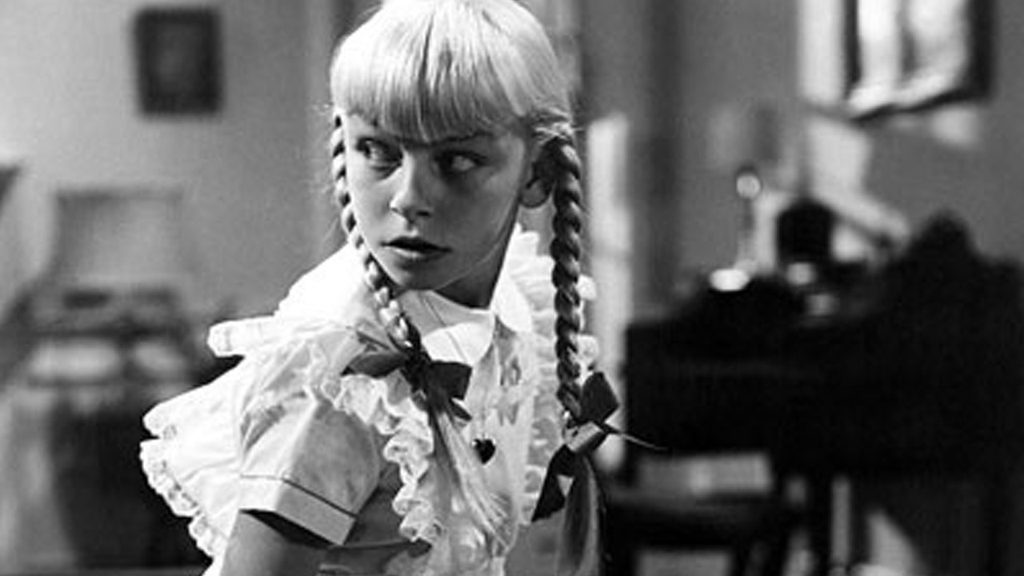
Created by William March for his 1954 novel The Bad Seed, Rhoda subsequently appeared in Maxwell Anderson’s stage adaptation before making the leap to cinema in Mervyn LeRoy’s 1956 film. Patty McCormack had already played Rhoda on Broadway and reprised the role for the movie, earning an Academy Award nomination for Best Supporting Actress. McCormack’s performance remains the defining screen version of the character, largely because she makes Rhoda’s outward sweetness almost as unnerving as the murders themselves.
Somebody Just Give Rhoda the Bloody Medal
If there’s one lesson to take away from The Bad Seed, it’s that schools should really have a contingency plan for disputes involving penmanship awards. Rhoda believes she deserves a medal given to her classmate Claude Daigle, and she is not somebody who handles disappointment by going home, sulking for twenty minutes and forgetting about it when dinner arrives. Claude subsequently drowns during a school picnic, and Rhoda’s fixation on the missing medal begins raising some extremely uncomfortable questions.
Christine Penmark, Rhoda’s mother, eventually discovers the medal among her daughter’s possessions and learns the terrible truth: Rhoda killed Claude and took it. That’s quite an escalation over a handwriting competition. Most children might complain to the teacher. Rhoda apparently considers murder an acceptable appeals process.
And this is where Rhoda becomes considerably more disturbing than simply “creepy child kills classmate”. There is no frightened confession followed by tears and remorse. Rhoda can discuss what happened with an emotional detachment that forces Christine to confront the possibility that her daughter doesn’t understand guilt in anything approaching the way she does. Worse still, Christine begins reconsidering an earlier suspicious death involving an elderly neighbour and something Rhoda coveted, raising the possibility that Claude wasn’t her first victim at all.
At this point we’d strongly recommend a new family policy: Rhoda gets whatever Rhoda wants. Medal? Certainly. Doll? Buy two. Pony? Find somewhere to put it. She wants the house? Congratulations, Rhoda, you’re now on the deeds. It isn’t ideal parenting, admittedly, but the alternative appears to involve funerals.
Leroy Makes an Absolutely Terrible Decision
Then we come to Leroy Jessup, the Penmarks’ maintenance man and possibly one of the worst judges of personal risk in 1950s cinema. Leroy is unusual because he isn’t completely fooled by Rhoda’s perfect-child routine. He recognises that something is wrong, antagonises her and begins investigating what happened to Claude. Eventually he discovers evidence that could expose her.
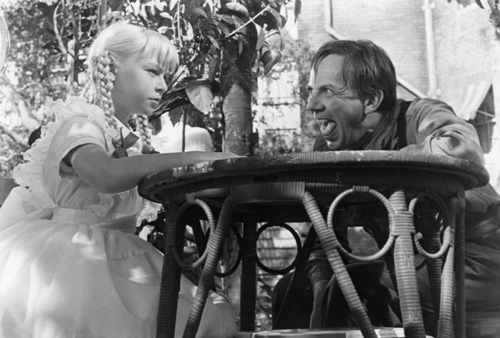
Now imagine yourself in Leroy’s position. You suspect that an eight-year-old child has murdered another child. You’ve discovered evidence suggesting your suspicions are correct. Do you alert somebody immediately? Get as far away from her as possible? Perhaps reconsider the wisdom of deliberately annoying the tiny suspected murderer?
Leroy continues annoying her.
Rhoda responds by setting fire to his bedding in the basement and locking him inside, killing him. More importantly, the murder demonstrates that Claude wasn’t simply the result of a momentary explosion of childhood rage. When somebody threatens to expose her, Rhoda is capable of deliberately removing that threat.
There’s something particularly horrifying about a child who can commit murder and then simply resume being the beautifully behaved little girl everyone expects her to be. Michael Myers at least has the decency to stand ominously at the end of the street afterwards. Rhoda can return to domestic life and continue presenting herself as somebody you’d happily trust to look after the biscuits.
The Most Terrifying Part Is That There Is No Monster
The Bad Seed also explores Christine’s discovery that she was adopted and that her biological mother was Bessie Denker, a notorious murderess. Within the heredity ideas explored by March’s story, Christine becomes terrified that a capacity for criminal behaviour has somehow travelled through her and emerged in Rhoda. Importantly, those ideas about inherited criminality belong to the story’s exploration of nature versus nurture and shouldn’t be mistaken for modern scientific fact.
What matters dramatically is the nightmare this creates for Christine. Rhoda hasn’t been raised in cruelty or deprivation. She’s been loved and provided with a secure home, yet Christine increasingly believes that none of it has prevented her daughter from becoming capable of calculated murder. After Leroy’s death, Christine reaches the horrifying conclusion that Rhoda may simply continue killing whenever somebody becomes inconvenient.
There is no demon to exorcise, curse to break or ancient book to throw into a fireplace. Rhoda doesn’t transform when the moon is full. The monster is simply sitting at the dinner table looking adorable.
And that’s precisely why she works.
Even Hollywood Didn’t Know What to Do With Her
William March’s original novel provides a particularly bleak conclusion. Christine attempts to stop Rhoda by giving her a dangerous quantity of sleeping pills before trying to take her own life. Christine dies, but Rhoda is revived, leaving the murderous child alive while those around her remain unaware of the full truth. The bad seed survives.
The 1956 film couldn’t leave things there. Hollywood’s Production Code created difficulties for an ending in which a murderer escaped punishment, so the movie dramatically altered Rhoda’s fate. Christine survives, while Rhoda later returns to the lake during a thunderstorm to retrieve the incriminating penmanship medal her mother had thrown into the water. While standing on the pier, Rhoda is struck by lightning and killed.
Yes, after spending an entire film demonstrating that she can outmanoeuvre practically every adult around her, Rhoda Penmark is finally defeated by the weather.
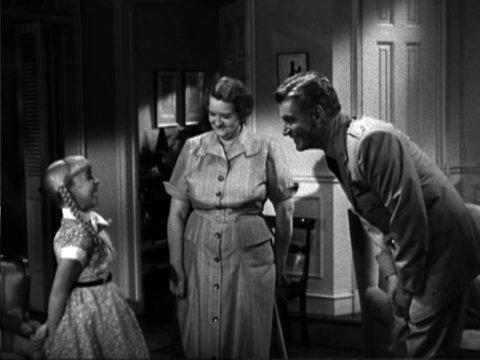
The film then performs one of the greatest tonal handbrake turns imaginable. After everything audiences have witnessed, the cast is presented again and Nancy Kelly puts Patty McCormack over her knee and spanks her. It’s an intentionally playful curtain-call-style coda following a story involving murdered children, attempted murder-suicide and a man being burned alive, and it remains one of the strangest curiosities attached to the film.
Second Class Welcomes Its Youngest Nightmare
Rhoda’s importance to horror extends far beyond her body count. The character predates many of cinema’s most famous sinister children, with The Bad Seed arriving before Village of the Damned, The Omen and the decades of demonic, supernatural and murderous youngsters that followed. March’s novel appeared in 1954, and McCormack had already established Rhoda on stage before bringing her to cinema screens two years later.
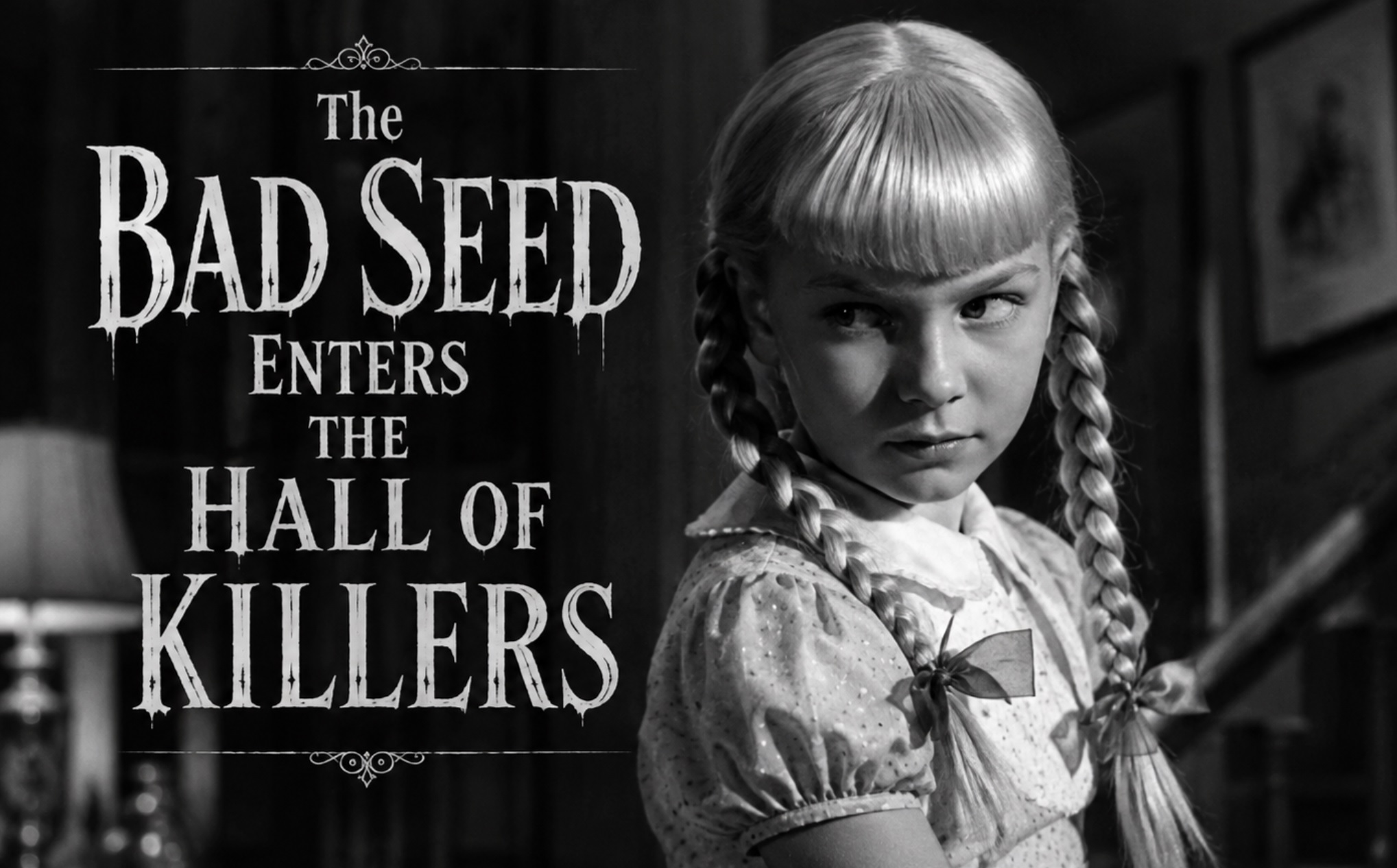
Her greatest weapon has always been the assumption that she cannot possibly be dangerous. Adults look at Rhoda and see a well-mannered little girl. Rhoda understands that expectation and uses it. Her physical harmlessness becomes a disguise more effective than any mask because accepting the truth requires the adults around her to overcome one of their strongest instincts: believing that a child couldn’t possibly be capable of calculated murder.
That’s also why we’re placing her in Second Class rather than pretending she’s suddenly competing with the supernatural heavyweights at the very top of the Hall. Rhoda isn’t going to win a fist fight with Jason Voorhees, and we’re fairly confident Michael Myers isn’t particularly interested in penmanship medals. What earns her position is what she represents, what she accomplished and how enormously influential the basic idea behind her character became.
More than seventy years after William March created her, Rhoda Penmark remains one of horror’s great reminders that monsters don’t necessarily announce themselves with masks, knives or ominous music. Sometimes they’re beautifully dressed, extremely polite and sitting quietly at the piano while everyone around them insists they couldn’t possibly have done anything wrong.
So welcome to the Hall of Killers – Second Class, Rhoda Penmark. You’ve earned your place.