Bleed the Night Will Take Us Back to 1994 for a Teenage Vampire Crime Spree
Vampires have always been remarkably good at changing with the times. Hammer gave us Christopher Lee stalking through Gothic castles, the 1980s put bloodsuckers in leather jackets and sunglasses, the 1990s found room for everything from lavish Gothic romance to broad comedy, and the 2000s eventually made them sparkle. Now another vampire movie is preparing to sink its teeth into a very particular period, with Fox Entertainment Studios acquiring Bleed the Night, a new horror spec script set during the summer of 1994.
The screenplay comes from Keith Cooper and Zoe Cooper, from a story by Keith Cooper and filmmaker Justin G. Dyck. There is currently no director attached, although the search is underway with the project reportedly being positioned for a possible production start in early 2027. That means there is still plenty we don’t know, including who will play its teenage leads, where it will shoot and when we might actually see it. What has been revealed, however, is a premise that sounds less interested in castles and ancient aristocrats than teenage loneliness, friendship and what happens when the first person who truly seems to understand you also happens to drink blood.

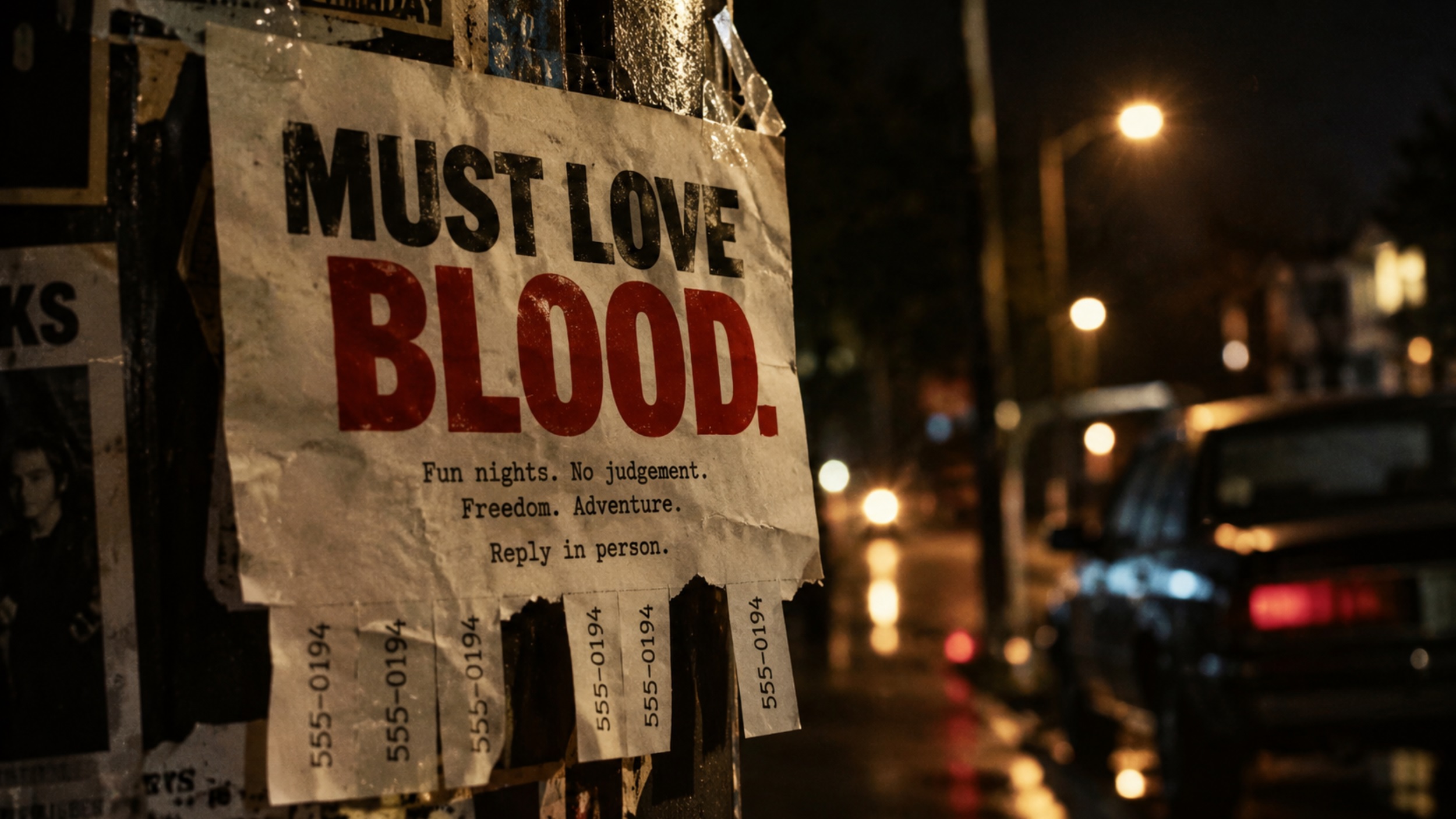
Must Love Blood
Bleed the Night centres on a lonely teenager who responds to a mysterious advertisement carrying the wonderfully reassuring words “MUST LOVE BLOOD.” She subsequently encounters a charismatic young vampire who appears to offer everything missing from her life, particularly companionship and freedom. Their new friendship turns a single summer night in 1994 into a bloody crime spree, with the teenager ultimately forced to discover just how far she is prepared to go for her first genuine friend.
It’s a simple hook, but potentially a very effective one. Vampire stories have always been fertile ground for exploring seduction, belonging, loneliness and the temptation of abandoning ordinary life for something dangerous. Making the central relationship a friendship rather than immediately presenting it as a conventional vampire romance gives Bleed the Night another angle to play with. The question isn’t simply whether this vampire will corrupt the teenager, but why someone starved of connection might willingly follow a new friend somewhere she knows she shouldn’t go.
Setting everything in 1994 could also prove important beyond giving the costume department an excuse to raid the decade for flannel shirts and questionable fashion decisions. A lonely teenager looking for connection in 1994 occupies a very different world from one doing the same thing in 2026. There are no smartphones quietly connecting her to thousands of potential friends, no social media and no instant ability to investigate the mysterious stranger who has suddenly entered her life. Answering an advertisement and meeting someone unknown carries an entirely different quality when the internet hasn’t yet become the background noise of everyday existence.
Exactly how extensively the film will exploit its period setting remains unknown. Nothing announced so far tells us whether 1994 is fundamental to the mythology or simply the backdrop to the story, so it would be premature to start imagining what the filmmakers intend to do with it. What we do know is that Bleed the Night isn’t being described as a story bouncing between different eras. This appears to be a contemporary production deliberately planting itself three decades in the past.

The Decade When Vampires Were Everywhere
It is a particularly appropriate period to revisit because the late 1980s and 1990s were already fascinating years for vampire cinema. Earlier screen vampires had frequently been associated with Gothic settings and old-world monsters, particularly through the enormously influential Universal and Hammer interpretations of Dracula. By the 1980s, however, filmmakers were increasingly dragging the vampire into contemporary America.
Joel Schumacher’s The Lost Boys arrived in 1987 with teenage vampires, motorcycles, music and the California coast, while Kathryn Bigelow’s Near Dark, released the same year, imagined its bloodsuckers as a nomadic family travelling through America’s back roads. Tom Holland’s Fright Night had already brought a vampire into suburbia in 1985. These films didn’t discard the traditional vampire so much as demonstrate how easily it could survive without the cape, castle and Transylvanian property portfolio.
The 1990s then went in almost every possible direction. Francis Ford Coppola embraced extravagant Gothic romance with Bram Stoker’s Dracula in 1992, while Buffy the Vampire Slayer brought teenage comedy into the equation that same year. Mel Brooks turned Dracula into outright parody with Dracula: Dead and Loving It in 1995. Robert Rodriguez and Quentin Tarantino would soon throw criminals into a bar full of vampires with From Dusk Till Dawn in 1996.
And sitting right in the middle of the decade was Neil Jordan’s 1994 adaptation of Anne Rice’s Interview with the Vampire, starring Tom Cruise, Brad Pitt, Kirsten Dunst and Antonio Banderas. Its release year now happens to be the precise year in which Bleed the Night takes place. Jordan’s film moved between historical periods as Louis recounted his life to a present-day interviewer, making the vampire simultaneously an ancient Gothic figure and a creature capable of existing in the modern world.

There is currently nothing to suggest Bleed the Night will attempt anything structurally similar, and comparisons shouldn’t be pushed too far. Its premise sounds much smaller and more immediate: two young people, one of whom happens to be a vampire, tearing through one summer night.
From Anything for Jackson to Bleed the Night
The involvement of Keith Cooper and Justin G. Dyck makes the project particularly interesting. The pair previously collaborated on 2020’s Anything for Jackson, with Cooper writing and Dyck directing. The supernatural horror film follows an elderly couple who kidnap a pregnant woman as part of an attempt to use a reverse exorcism to bring their dead grandson back. Its increasingly nightmarish results helped the film earn a strong reputation among genre audiences.
Cooper and Dyck have also worked on the upcoming vampire horror film Casket Girls. That project is directed by Dyck and stars Gabrielle Union and Mike Colter, with Union playing Detective Shay Williams and Colter playing her partner Galpin. The pair investigate a supernatural incident at a historic New Orleans church and inadvertently unleash the legendary Casket Girls. Keith Cooper and Dyck performed revisions on the screenplay originally written by Thomas Lennon and Robert Ben Garant. Production has already wrapped, with Aura Entertainment acquiring US rights in September 2026.
That also means Bleed the Night isn’t Cooper and Dyck’s first recent encounter with vampires, although the two projects appear very different. Casket Girls is built around New Orleans mythology, trapped characters and predatory supernatural creatures, while Bleed the Night appears to be approaching vampirism through the relationship between two teenagers and the intoxicating freedom of a dangerous new friendship.
For now, Fox Entertainment Studios has the screenplay, the hunt for a director is underway, and early 2027 is being eyed as a potential production window. There are no casting announcements or release date yet, so Bleed the Night remains at an early stage.
Still, “lonely teenager answers an advert and spends a night on a crime spree with her new vampire friend” is a pretty efficient way of getting our attention.
If the filmmakers can make 1994 more than window dressing and capture some of the danger, freedom and seductive cool that made earlier youth-driven vampire movies so memorable, Bleed the Night could have plenty to sink its teeth into.