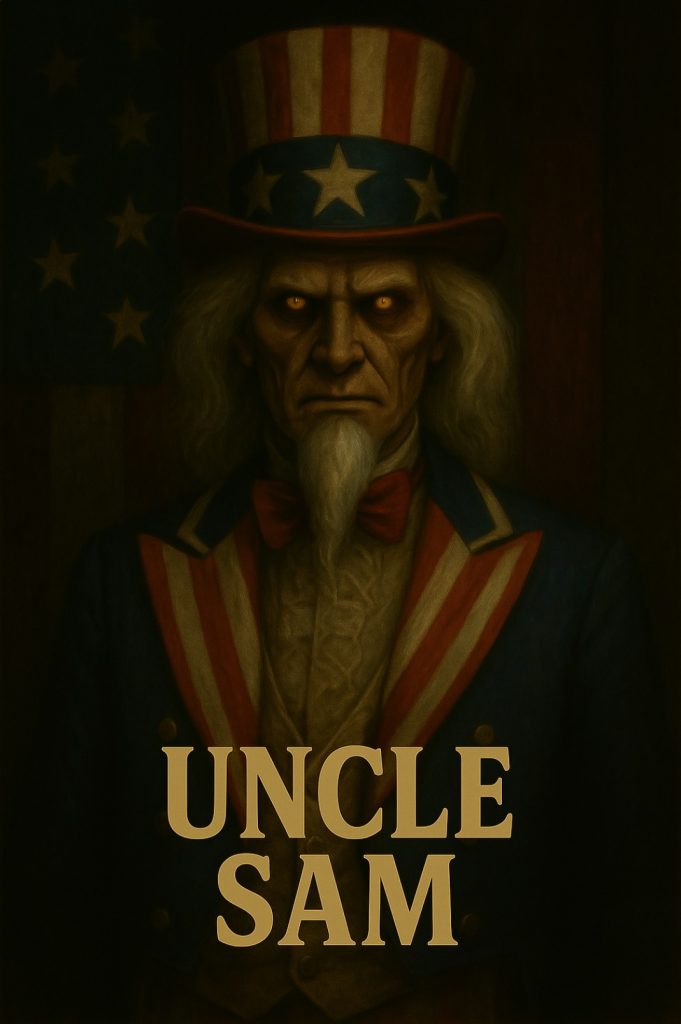
Real Name: Uncle Sam – Master Sergeant Sam Harper
First Appearance: Uncle Sam (1996)
Most Iconic Form: A reanimated soldier in an Uncle Sam costume carrying out patriotic executions
Kill Count: Multiple on screen victims during Independence Day massacre
Portrayed by: David Fralick
Tier: Third Class Tier
Uncle Sam (1996)
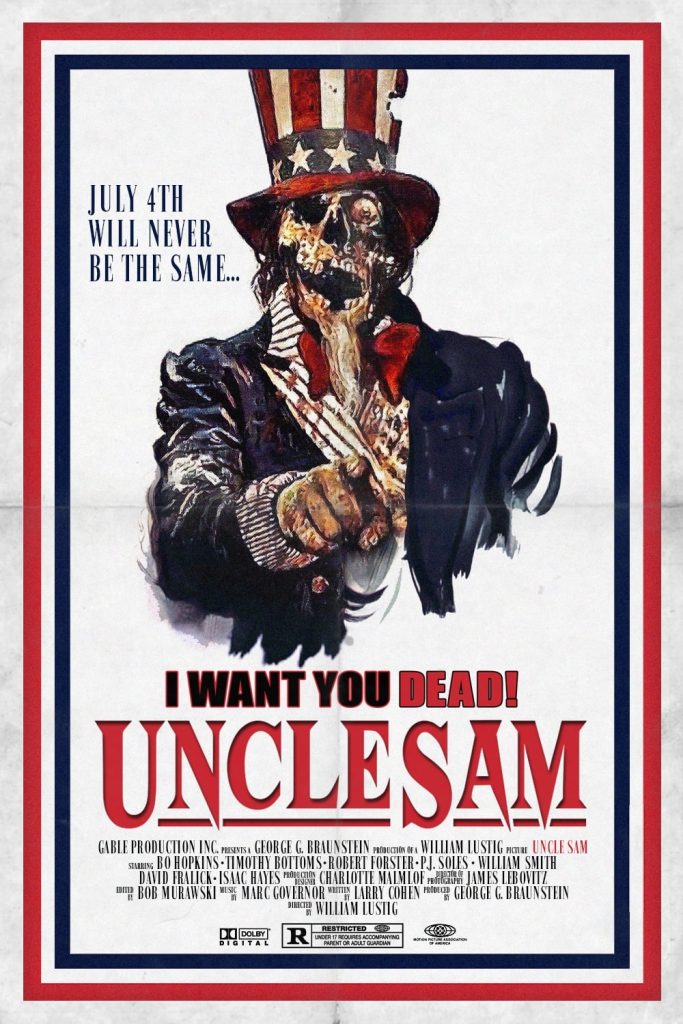
Directed by William Lustig and written by Larry Cohen, Uncle Sam is a black comedy slasher that blends political satire with small town horror. The film centres on Master Sergeant Sam Harper, a soldier killed by friendly fire during a military operation in Kuwait. His charred body is returned to his hometown of Twin Rivers just as preparations for Independence Day celebrations begin.
Before his death, Harper was already deeply unstable. Though regarded publicly as a war hero, his widow Louise and his sister Sally know the truth. Sam was an alcoholic, a violent psychopath, and a serial abuser who used patriotism as a mask for cruelty. He joined the military not out of duty, but because it allowed him to legitimise his desire to kill.
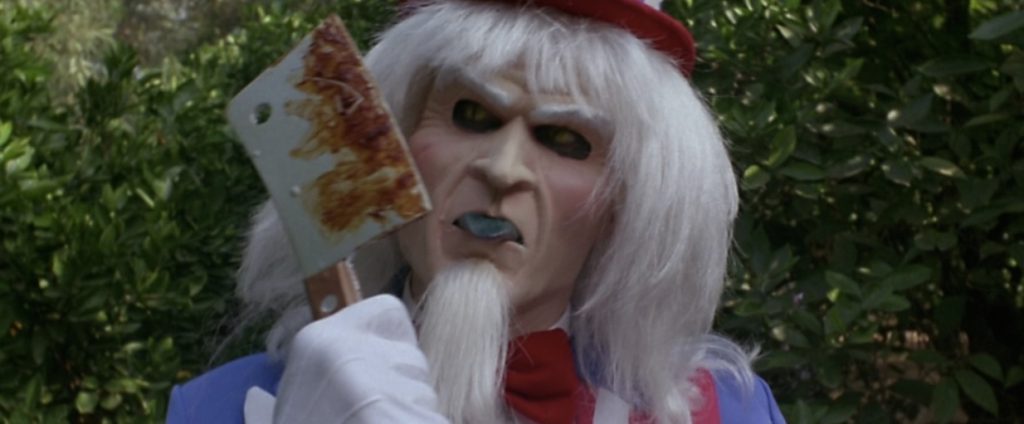
After being laid to rest, Sam reanimates as a revenant in the early hours of the Fourth of July. Emerging from his coffin, he murders a local degenerate dressed as Uncle Sam and steals the costume, transforming into a grotesque embodiment of American iconography. From that point onward, his killing spree becomes a warped patriotic crusade.
Sam targets those he sees as morally corrupt or unworthy of the nation. He kills juvenile delinquents who vandalise graves and desecrate the flag. He murders a teacher who opposed the Vietnam War. He shoots an unscrupulous lawyer and burns a teenage girl’s face on a barbecue grill after she discovers a severed head. During the town’s celebration, he escalates the carnage by blowing up visiting Congressman Alvin Cummings with fireworks and impaling Deputy Phil Burke with an American flag.
The horror unfolds against a backdrop of parades, fireworks, and red white and blue celebration, giving the violence a satirical edge. Sam claims patriotic righteousness, yet his actions reveal hypocrisy and bloodlust rather than honour.
The film’s emotional centre lies with his young nephew Jody Baker, who idolises his uncle as a war hero. As the truth about Sam’s abusive past is revealed, Jody must confront the collapse of his patriotic fantasy. Sam himself claims that Jody is the reason he returned, suggesting a twisted desire to pass on his ideology.
The final confrontation takes place at Louise’s house. Sam blames his old mentor Sergeant Jed Crowley, played by Isaac Hayes, for filling his head with glorified tales of combat. Jed counters that Sam never fought for his country, only for his own appetite for killing. Conventional weapons fail to stop him. Ultimately, Jed uses a ceremonial cannon to destroy Sam in a fiery explosion, reducing both the revenant and the house to rubble.
The following day, Jody burns his war themed toys, symbolically rejecting the myth of heroic violence.
Character and Themes
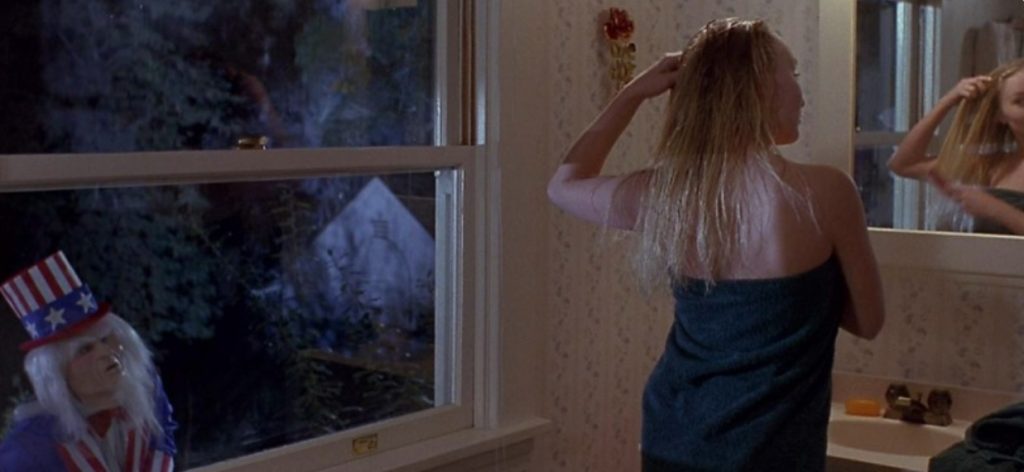
Uncle Sam is less a supernatural monster than a physical manifestation of corrupted patriotism. His return from the grave is driven not by vengeance alone but by ideological delusion. He believes himself to be punishing moral weakness, yet his victims are often chosen through warped personal judgement.
The film uses Sam to critique blind nationalism and the romanticising of war. His costume, taken from a pervert in a cheap Uncle Sam outfit, becomes a grotesque uniform. Red white and blue is drenched in blood.
Sam’s supernatural resilience reinforces the idea that myth is difficult to kill. Even after death, the ideology lingers until confronted directly.
Legacy
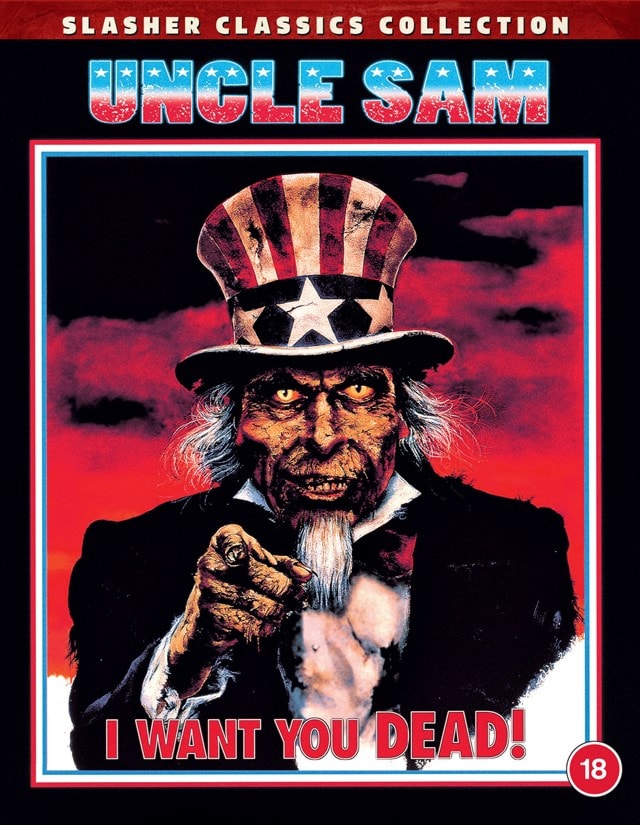
Uncle Sam has developed a cult following over time. While critics were divided upon release, some praising its satire and others criticising its uneven tone, it remains a distinctive entry in the nineteen nineties slasher landscape. Its blend of political commentary and seasonal horror makes it a unique Fourth of July counterpart to more traditional holiday themed slashers.
David Fralick’s physical performance under the costume gives the character imposing stature, while Larry Cohen’s script ensures the violence is framed through dark irony rather than straightforward exploitation.
Uncle Sam stands as a rare example of a slasher villain tied directly to national symbolism rather than personal trauma alone.
Uncle Sam was released on Blu-ray in 2025 via 88 Films as a part of their Slasher Collection. You can read our review of that HERE.
League Placement
Uncle Sam belongs in the Third Class Tier. He is a cult favourite and thematically rich villain, but functions within a contained narrative rather than as a mythic or franchise defining icon.