
Full Name: Henry (surname never confirmed)
Based on: Real-life serial killer Henry Lee Lucas
First Appearance: Henry: Portrait of a Serial Killer (1986)
Most Iconic Form: Plain clothes, emotionless stare, constantly drifting between jobs, lives, and victims
Kill Count: 11+ confirmed in-film; dozens implied
Portrayed by: Michael Rooker
Henry: Portrait of a Serial Killer (1986) – Cold, Quiet Evil
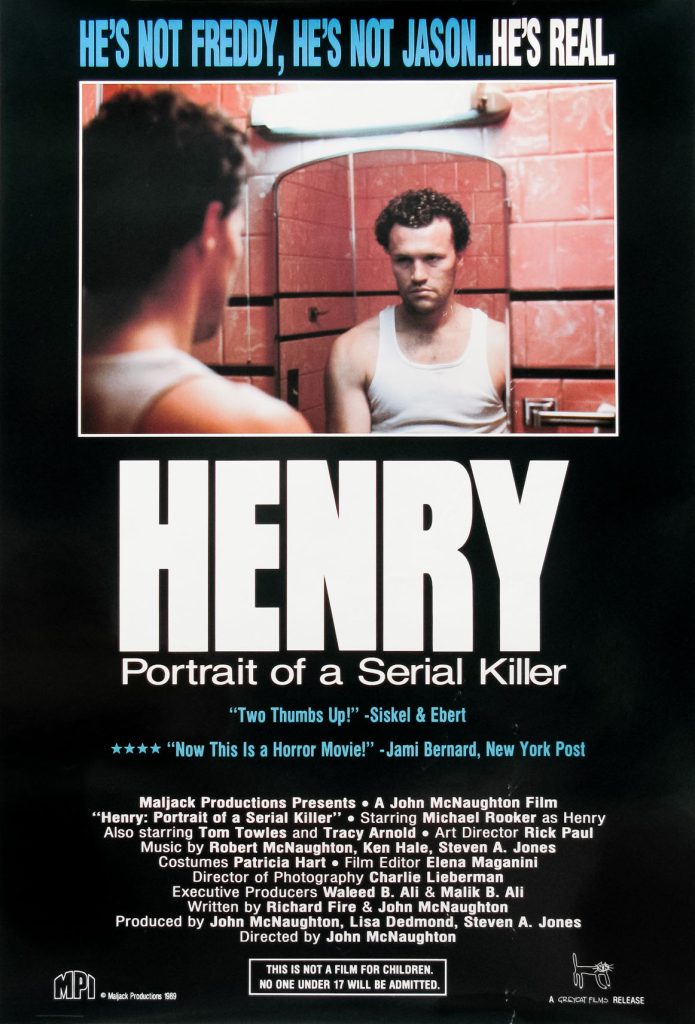
Directed by John McNaughton, this low-budget indie horror film emerged as one of the most disturbing portraits of a serial killer ever committed to film. Based loosely on the confessions of Henry Lee Lucas, the film focuses not on gore or spectacle, but on psychological detachment and moral decay.
Henry is a drifter, moving from job to job and victim to victim with no consistent pattern. His crimes include:
- Strangulation
- Bludgeoning
- Stabbing
- Drowning
- Sexual assault and necrophilia (implied)
He kills alone, but soon draws in his volatile roommate Otis and Otis’s sister Becky, forming a twisted triangle of manipulation, control, and looming violence. Henry trains Otis in his methods — cold, calculated, and seemingly indifferent to motive or remorse. Their spree includes:
- Random shootings
- Home invasions
- The infamous camcorder murder scene, where Henry and Otis record themselves killing a family, then casually rewind and rewatch it
Despite Becky’s romantic interest and emotional vulnerability, Henry remains distant. When she opens up about her abusive past, he shows a flicker of empathy — but never vulnerability. In the end, he kills her offscreen, stuffs her body in a suitcase, and leaves it on the side of the road.
He walks away without a second glance.
Physiology & Psychology
- Human male, late 20s to 30s
- Physically unremarkable: short, wiry, with a soft voice and restrained energy
- Appears non-threatening, often calm and polite — his anonymity is his weapon
- No consistent MO — he kills men, women, strangers, acquaintances, in different methods and contexts
- Displays:
- Anti-social personality traits
- Severe emotional detachment
- Lack of empathy, remorse, or identity
- Inability to form or sustain real emotional connections
- Does not enjoy killing in a sadistic sense — it’s a ritual of control, survival, or expression
- Deeply opposed to forming attachments; detachment is self-preservation
- Often described as a “murder machine in slow motion”
Cultural Impact
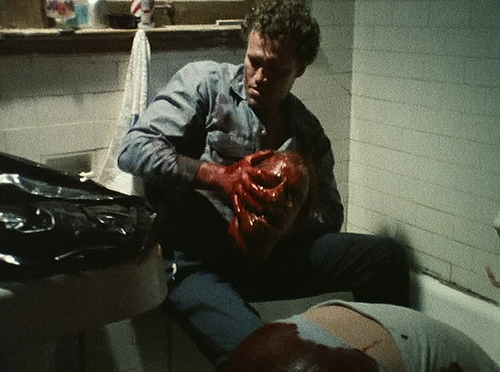
- Considered one of the grimmest and most realistic horror films ever made
- Cited frequently in academic works on serial killers, moral ambiguity, and true crime cinema
- Michael Rooker’s debut performance launched his career — praised for its realism and cold intensity
- Controversially rated X upon release; banned in several countries
- Became a cult classic, influencing:
- Man Bites Dog
- Funny Games
- The House That Jack Built
- The camcorder scene is still discussed as one of the most unsettling moments in horror history
- Henry is often referenced alongside Patrick Bateman, Joe from You, and Arthur Fleck — killers defined by detachment, not theatricality
League Placement
Henry belongs in the Second Class Tier — not supernatural, not iconic by costume or mythology, but horrifying in how ordinary he is. He doesn’t want power, revenge, or even pleasure. He kills because it’s what he does, and when it’s over… he simply moves on.