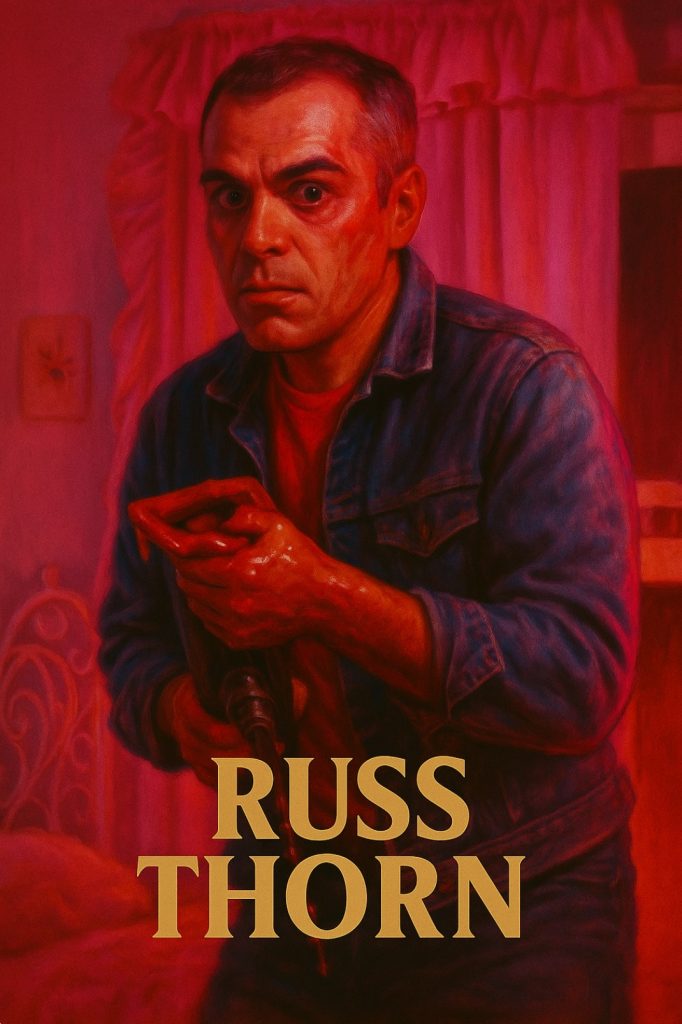
Also Known As: Russ Thorn, The Driller Killer of Venice, The Slumber Party Murderer
First Appearance: The Slumber Party Massacre (1982)
Most Iconic Form: A tall, silent man in denim, wielding a long power drill with unnerving calm and obsession
Kill Count: Eleven confirmed victims (original), five in remake
Portrayed by: Michael Villella (1982), Rob van Vuuren (2021)
Tier: Third Class Tier
The Slumber Party Massacre (1982)
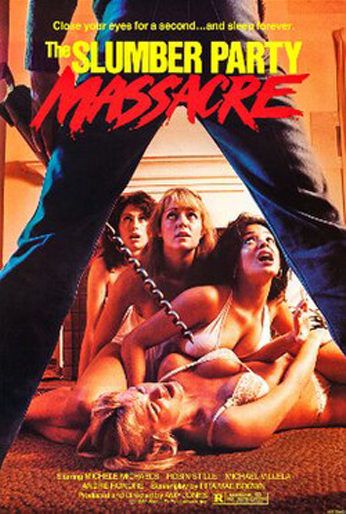
Directed by Amy Holden Jones and written by Rita Mae Brown, The Slumber Party Massacre began life as a parody of slasher conventions but evolved into something far stranger and smarter. On the surface, it is a straightforward killer-on-the-loose story, yet beneath the gore lies biting commentary on gender and violence.
The plot centres on Russ Thorn, an escaped mental patient who returns to the Los Angeles suburb where he murdered several young women years earlier. As a group of high-school girls gather for a weekend party, Thorn silently infiltrates their neighbourhood, stalking them with a power drill — a weapon that quickly became one of the most iconic images in slasher cinema.
Thorn’s killings are methodical and voyeuristic. He hides in cupboards and garages, watching his victims before striking. His apparent lack of motive makes him both terrifying and hollow. The film refrains from giving him a detailed backstory, allowing him to exist as pure aggression. Yet when he murmurs “I love you” to one victim, a flicker of twisted longing surfaces — a trace of humanity buried beneath compulsion.
The film’s final act sees Thorn defeated by the women he tormented. Survivors Trish Devereaux and Valerie Bates turn his weapon against him, leaving the drill broken and his body lifeless on the lawn. The ending reclaims power from the killer, turning his tool of dominance into a symbol of resistance.
Slumber Party Massacre (2021 Remake)
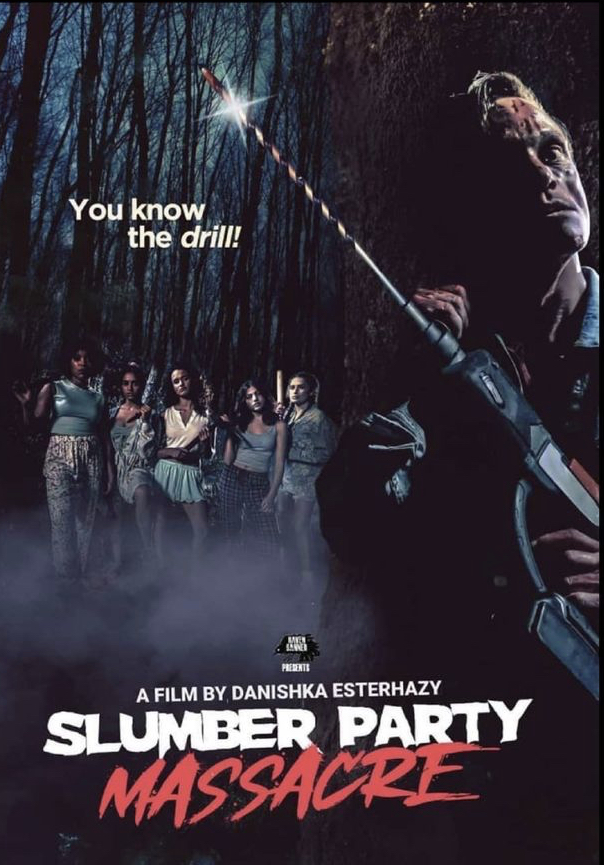
Nearly four decades later, director Danishka Esterhazy revived the property for a new generation. Rather than simply remake the original, she and screenwriter Suzanne Keilly constructed a sly inversion — a film that begins as a familiar slasher and transforms into a subversion of the entire genre.
This new version reintroduces Russ Thorn, portrayed by Rob van Vuuren, as the same infamous murderer who terrorised women years earlier. When a group of friends rent a lakeside cabin for a weekend, they find themselves targeted by the drill-wielding killer once again. The early scenes mirror the 1982 film — voyeuristic angles, creeping shadows, and the hum of the drill in the dark.
But halfway through, the film flips the formula. The young women are not helpless victims; they are bait. Their trip is a trap designed to lure Thorn out of hiding so that they can kill him once and for all. The hunters become the hunted, and the film’s tone shifts from fear to empowerment.
Esterhazy retains the gore and intensity of the original but frames Thorn’s violence through a lens of satire and reclamation. His drill, once a symbol of male aggression, becomes a parody of itself — a relic of a genre that thrived on objectifying women. Rob van Vuuren’s portrayal captures this perfectly. His version of Russ is wild-eyed, manic, and strangely pathetic — a broken remnant of slasher masculinity past its prime.
The film’s second twist arrives when the supposedly safe space becomes another trap, this time for the women, revealing a second set of killers inspired by Thorn’s legend. It becomes a story not just of survival, but of how violence replicates itself across generations and gender lines.
In the end, Thorn is decapitated, finally ending his decades-long reign. Yet the film’s tone — half tribute, half mockery — leaves him oddly pitiable. He is no longer the nightmare stalking suburbia, but the fossil of an outdated fantasy.
Psychology and Motive
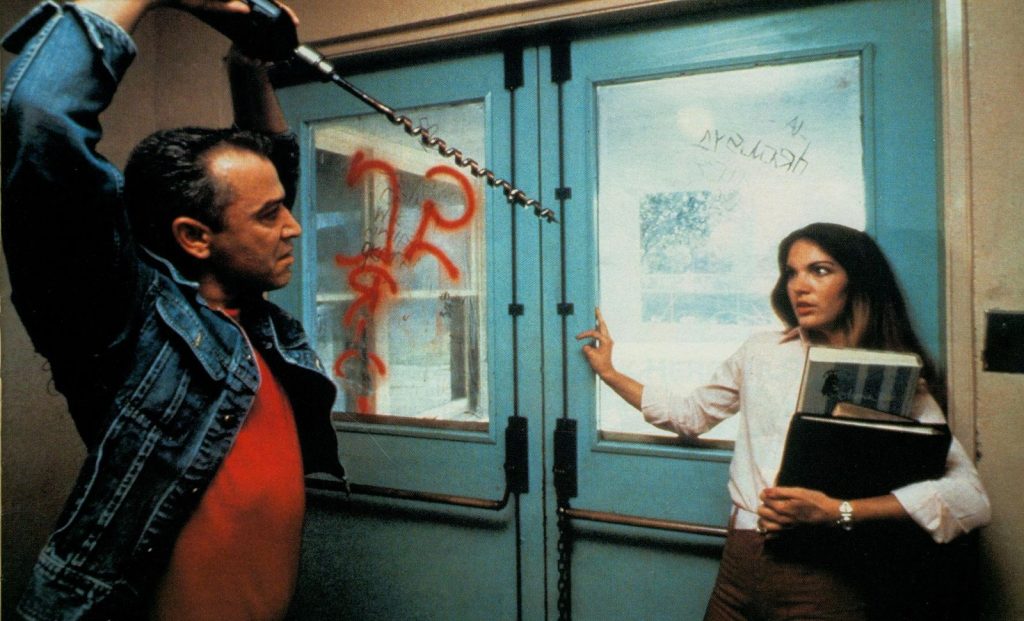
Russ Thorn’s psychology is a reflection of the genre that birthed him. In 1982, he represented the faceless male predator — a force of repression, voyeurism, and control. In 2021, that same figure becomes an object of ridicule, a dying echo of horror’s past obsessions.
Both incarnations share traits of obsession and delusion, but where Michael Villella’s original Thorn is eerily calm and detached, Rob van Vuuren’s version borders on grotesque caricature. His behaviour swings between pathetic and frenzied, reinforcing the remake’s feminist reading — that the monster’s power lies not in strength, but in the illusion of dominance.
Symbolism and Legacy
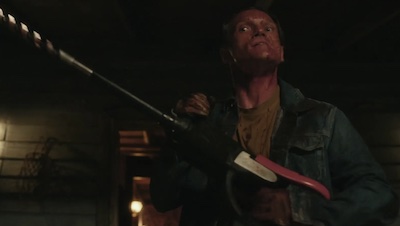
Across both versions, the drill remains Thorn’s defining image. In the original, it symbolised the invasive violence of the slasher era — a weapon of sexualised horror. In the remake, it becomes parody, its absurd size and noise stripped of menace, transformed into commentary.
The remake also honours Slumber Party Massacre’s subversive legacy. What began as satire has come full circle, reclaiming the female gaze entirely. Thorn’s existence across forty years of horror cinema mirrors the genre’s evolution: from exploitation to empowerment, from victimisation to reclamation.
Cultural Impact
Russ Thorn may not enjoy the pop-culture fame of Freddy Krueger or Jason Voorhees, but his image — the denim, the drill, the quiet persistence — remains iconic within cult horror circles. His presence across two vastly different eras of filmmaking demonstrates the adaptability of the slasher archetype.
The 2021 remake was praised for its clever reinvention and its affection for the original. By recontextualising Thorn as both threat and relic, the film paid tribute to its roots while commenting on the genre’s need to evolve.
101 Films released a double boxset of The Slumber Party Massace and The Slumber Party Massacre 2 on UHD in 2024.
League Placement
Russ Thorn belongs in the Third Class Tier. A killer born from the anxieties of 1980s suburbia and reborn as satire in 2021, he stands as both relic and reflection — proof that even the most basic monsters can become mirrors for the times that create them.