
First Appearance: Creature from the Black Lagoon (1954)
Played By: Ben Chapman (land), Ricou Browning (underwater)
Kill Count: Approx. 8–10 (across the trilogy)
Creature from the Black Lagoon (1954)

First emerging from the misty rivers of the Amazon in 1954, the Gill-man — known commonly as the Creature — became the final addition to Universal’s original monster pantheon. A hybrid of man and aquatic beast, the Creature represents primal nature, untouched by evolution or humanity. His film debut, Creature from the Black Lagoon, directed by Jack Arnold, is both a creature feature and a tragic tale of intrusion and misunderstanding.
Discovered by scientists on an expedition, the Gill-man becomes both feared and fascinated over. He is drawn to Kay Lawrence, the lone female scientist on the trip, and stalks her in what is now one of the most iconic underwater sequences in horror history — a haunting ballet of beauty and the beast beneath the surface.
Though monstrous in appearance, the Creature is not evil — he is territorial, defensive, and curious. The humans’ invasion of his lagoon sparks the violence. Armed with claws, crushing strength, and amphibious stealth, he attacks when threatened, dragging victims into murky depths. By the end, he is wounded and sinks beneath the water, leaving viewers unsure of his fate.
The film was originally shot in 3D, capitalizing on the 1950s craze, and has remained a cult classic ever since.
Revenge of the Creature (1955)
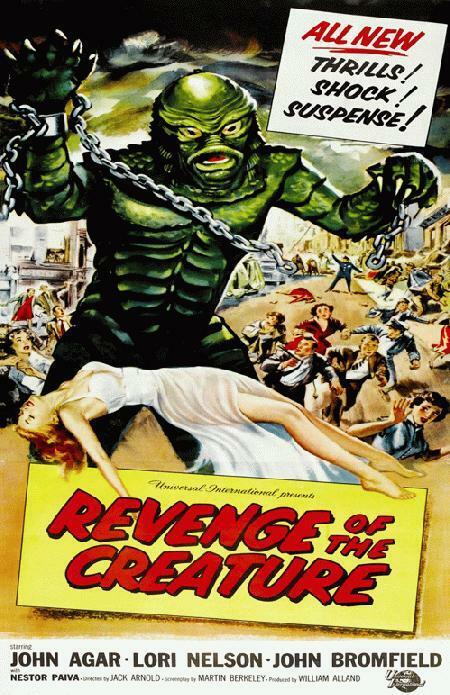
In this sequel, the Gill-man is captured and brought to Florida, where he is placed on display at a marine park — a thinly veiled critique of animal exploitation. Played again by Ricou Browning (underwater) and Tom Hennesy (land scenes), the Creature is shackled, shocked, and studied.
Of course, he breaks free.
The Creature becomes obsessed with another woman, Helen Dobson, and leaves a trail of destruction as he escapes captivity. This film leaned more into monster-on-the-loose tropes, but retained sympathy for the Gill-man. His attacks are rooted in confusion and fear, not malice.
Notably, Revenge of the Creature marks the film debut of Clint Eastwood in a brief lab technician cameo.
The Creature Walks Among Us (1956)
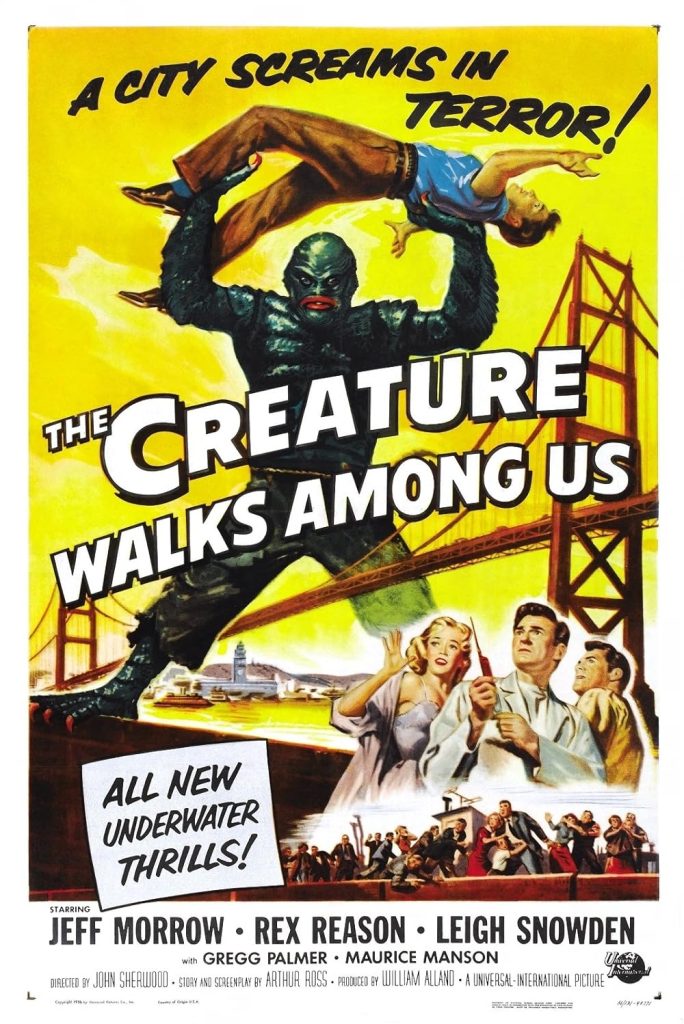
The final installment takes the darkest turn. After being severely burned during a capture attempt, the Gill-man undergoes surgery and is “humanized” — his gills are destroyed and lungs exposed, forcing him to live on land. Now walking, wearing clothes, and stripped of his aquatic identity, he becomes a symbol of lost nature, an animal mutilated by science.
This version of the Creature is quieter, more subdued, and tragic. He becomes a bystander to the humans’ cruelty and emotional dysfunction. In the end, he walks slowly into the ocean — knowing he can no longer breathe in the water — in one of horror cinema’s most melancholic endings.
Though less action-heavy, this film sealed the Creature’s legacy as not just a monster, but a victim of mankind’s need to control and destroy the unknown.
Unmade Remakes & Cultural Presence
Over the decades, remakes and reboots have been attempted repeatedly:
- John Carpenter wanted to remake the film in the 1980s with Rick Baker on effects.
- Guillermo del Toro pitched a romantic reimagining told from the Creature’s point of view. Universal rejected it — so he made The Shape of Water (2017), which won the Oscar for Best Picture and is seen as a spiritual successor.
- Universal’s “Dark Universe” teased a reboot, but the project never surfaced.
Despite no modern remake, the Creature’s look and themes have been endlessly referenced, including in:
- Monster Squad (1987)
- The Simpsons, Robot Chicken, Scooby-Doo, and Hotel Transylvania
- Countless toys, masks, models, pins, and NECA figures
- Tattoos, t-shirts, fan films, and tribute posters
His image — wide gills, black fish eyes, and clawed webbed hands — remains one of horror’s most recognizable silhouettes.
League Placement
The Creature from the Black Lagoon rests in the Infamous Class Tier — the last of the Universal Monsters, and the most tragic: a relic of nature, hunted and destroyed by the world he never chose.