
Film: Hellraiser (1987)
Character: Frank Cotton
Portrayed By: Sean Chapman, Oliver Smith and Andrew Robinson in different forms
Creator: Clive Barker
Classification: Human / Resurrected Human
Tier: Second Class
Film Directed By: Clive Barker
Based On: The Hellbound Heart by Clive Barker
Frank Cotton
Pinhead may have become the face of the Hellraiser franchise, but the principal human monster at the centre of the original film is Frank Cotton. Hedonistic, selfish and utterly without remorse, Frank spends his life searching for increasingly extreme sensations before discovering something capable of taking that pursuit far beyond anything he imagined.
Frank’s desire for ultimate pleasure leads him to the mysterious puzzle box known as the Lament Configuration. Solving it summons the Cenobites, beings offering experiences in which pleasure and pain have become indistinguishable. Frank discovers too late that what he has been searching for is considerably more terrible than he anticipated, and the Cenobites tear his body apart and take him into their realm.
That would normally be the end of a horror villain. For Frank, it is merely the beginning. His accidental resurrection and desperate attempt to rebuild his body provide the gruesome foundation of Clive Barker’s 1987 Hellraiser, making him one of the film’s most important and disturbing characters.

Opening the Box
When Hellraiser begins, Frank has already exhausted many of the conventional pleasures available to him. His pursuit of increasingly extreme experiences eventually brings him into possession of the Lament Configuration, a puzzle box he believes can open the door to unimaginable pleasure.
Frank returns to the Cotton family house and solves the box alone in the attic. Instead of the experience he expects, hooks and chains tear into his flesh and rip his body apart. The Cenobites arrive to collect what remains, taking Frank with them and restoring the room so completely that there is almost no evidence of what occurred.
The sequence establishes one of the central ideas running through Barker’s story. Frank is not an innocent person unfortunate enough to stumble upon something supernatural. He actively seeks the box because ordinary experience is no longer enough for him. His damnation begins with his own appetite.
Frank Returns
Some time later, Frank’s brother Larry moves into the house with his wife Julia. While carrying furniture upstairs, Larry cuts his hand on a nail and spills blood onto the floor of the room where Frank was taken.
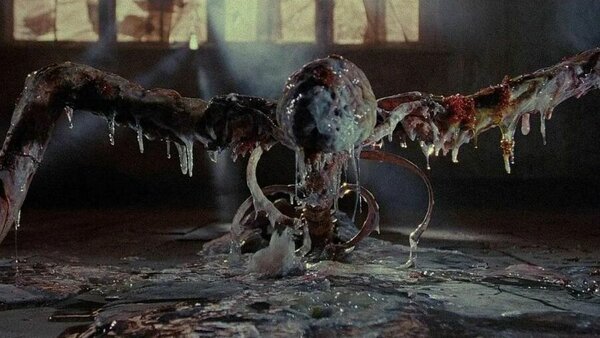
The blood causes something extraordinary and grotesque to happen beneath the floorboards. Frank begins physically reconstructing himself, returning from the Cenobites’ realm as an incomplete, skinless creature. He has escaped, but his body needs considerably more blood before it can become whole again.
Julia discovers him and learns that the hideous creature in the house is the man with whom she once had an affair. Before marrying Larry, Julia had been seduced by Frank, and her memories of their encounter have remained powerful enough for him to manipulate her even in his horrific new form.
Frank needs victims to restore himself, and Julia agrees to provide them.
Julia and the Murders
Julia begins bringing unsuspecting men back to the house under the pretence of sex. Once they are vulnerable, she attacks them and delivers them to Frank, who uses their bodies to continue his regeneration.

Each victim allows Frank to become progressively more human. Muscle, tissue and other parts of his physical form return, although he remains a grotesque approximation of the man he once was. The process gives Hellraiser some of its most memorable body-horror imagery and makes Frank’s resurrection every bit as important to the film’s visual identity as the Cenobites themselves.
Frank’s relationship with Julia also demonstrates how manipulative he is. Julia is committing murder for him, yet there is little indication that Frank possesses anything resembling genuine love or loyalty towards her. She is useful because she can provide what he needs. His later treatment of her confirms just how disposable she ultimately is to him.
Kirsty Discovers Frank
Larry’s daughter Kirsty becomes suspicious of Julia’s behaviour and eventually discovers what is happening inside the house. She encounters Frank in his partially regenerated state and manages to escape with the puzzle box.
While recovering in hospital, Kirsty solves the Lament Configuration herself and encounters the Cenobites. Faced with the prospect of being taken by them, she tells them that Frank escaped and offers to lead them back to him. The Cenobites are interested because Frank has effectively escaped a punishment they consider unfinished.
Frank therefore finds himself trapped between two threats. Kirsty knows what he is, while the Cenobites now know that the man they claimed has returned to the human world.
His solution is characteristically brutal.

Wearing His Brother’s Skin
Frank murders Larry and takes his brother’s skin, using it as a disguise. Andrew Robinson therefore effectively portrays Frank during this section of the film, as the killer attempts to convince Kirsty that the man standing before her is still her father.
It is one of the most disturbing ideas in Hellraiser. Frank has already betrayed his brother by sleeping with Julia, but he ultimately goes much further, murdering Larry and literally wearing him in an attempt to complete his escape.
Kirsty eventually realises the truth, and Frank’s disguise begins to fail. During the confrontation, Frank accidentally stabs Julia while attempting to kill Kirsty. His reaction perfectly summarises his character. The woman who murdered repeatedly to restore him receives no meaningful compassion once she becomes another obstacle.
Frank then consumes what he can from Julia and continues pursuing Kirsty.
By this point, however, Kirsty has delivered exactly what she promised.
The Cenobites have come for him.
Frank’s Second Death
The final confrontation returns Frank to the supernatural forces he believed he had escaped. The Cenobites catch him with their hooked chains and prepare to take him back.
Frank is torn apart once again, bringing his attempted resurrection to a spectacularly gruesome conclusion. His escape from Hell has cost numerous lives, including that of his own brother, yet ultimately achieves nothing. The same beings who destroyed him at the beginning of the film reclaim him at the end.

It creates a satisfying circular structure for the character. Frank spends his life pursuing experiences beyond ordinary human limits, discovers something far beyond his ability to endure, escapes it through chance and then sacrifices virtually everyone around him in an attempt to remain free. In the end, he is returned to exactly where his obsession took him in the first place.
Hellbound: Hellraiser II
Frank makes a smaller but important return in Hellbound: Hellraiser II (1988). Kirsty is led to believe that her father may be trapped in Hell and enters the Cenobites’ labyrinth seeking him, only to discover that Frank has deceived her.
Frank exists within a personal Hell built around the appetites that defined his life. He is surrounded by the promise of sexual gratification that remains permanently beyond his reach, a particularly appropriate punishment for a man whose endless search for pleasure caused his downfall.
Julia also returns, but the balance of power between them has changed dramatically. Frank no longer possesses the hold over her that he enjoyed during the first film, and their reunion ends with Julia killing him. His former lover has become something far more powerful, while Frank once again discovers that his belief that other people exist for his gratification eventually turns against him.
Frank Cotton and the Cenobites
One of the most interesting things about the original Hellraiser is that the Cenobites are not straightforward replacements for a conventional slasher villain. Frank is arguably the film’s true antagonist, while the Cenobites operate according to their own disturbing rules.
Frank chooses his victims and kills to preserve himself. The Cenobites are something stranger, summoned through the puzzle box and dedicated to experiences beyond conventional distinctions between pleasure and suffering.
That distinction became less obvious as Pinhead developed into the franchise’s principal icon, but it is fundamental to the first film. Frank is the character driving much of the human horror. His affair with Julia, resurrection, murders, betrayal of Larry and pursuit of Kirsty propel the story, while the Cenobites represent the terrible supernatural world he has brought into contact with the Cotton family.
Without Frank Cotton, there is effectively no Hellraiser.
Character and Legacy
Frank Cotton occupies an unusual position within horror history because his importance has inevitably been overshadowed by Pinhead. Doug Bradley’s Cenobite became the instantly recognisable image of the franchise and eventually developed into one of horror cinema’s major icons, while Frank remained primarily associated with the first two films.
Yet returning to the original Hellraiser demonstrates just how important Frank is. He provides the motivation behind virtually everything that happens and embodies many of Clive Barker’s central themes concerning desire, obsession, sexuality, pain and the consequences of pursuing experience without limits.
Frank is also responsible for some of the film’s most extraordinary imagery. His reconstruction from beneath the floorboards remains one of Hellraiser’s signature sequences, while the skinless Frank created through practical effects is almost as visually striking as the Cenobites.
There is also something particularly unpleasant about Frank because his supernatural circumstances don’t create his cruelty. He was already selfish and predatory before opening the box. Resurrection simply gives him a new reason to exploit the people around him.
The character originated in Barker’s 1986 novella The Hellbound Heart, where several relationships differ from the later film. Most notably, Larry is named Rory in the novella, while Kirsty is his friend rather than his daughter. Barker adapted his own story for the screen and reshaped those relationships while retaining Frank as the corrupting force at its centre.
Sean Chapman portrays Frank in his human form, while Oliver Smith plays the horrifying resurrected version of the character. When Frank takes Larry’s skin, Andrew Robinson effectively becomes Frank as well, giving the character an unusual physical identity spread across several performers.
Almost four decades after Hellraiser was released, Frank Cotton remains one of its most disturbing creations. Pinhead may own the franchise, but Frank is the monster who starts everything.
League Placement
Frank Cotton belongs comfortably within the Second Class Tier of the Hall of Killers. His relatively limited appearances prevent him from reaching the very highest levels, particularly when another character from the same film became one of the most recognisable figures in horror history, but his importance to the original Hellraiser cannot be overstated.
Frank is murderer, sexual predator, betrayer, resurrected monster and fugitive from Hell all at once. His selfish pursuit of pleasure destroys his brother, Julia, numerous innocent victims and eventually himself, while his escape brings Kirsty directly into the world of the Cenobites. Few horror villains have caused so much devastation simply because they refuse to accept that there should be limits to what they desire.
For his importance to one of British horror’s defining films, his unforgettable resurrection and his central role in bringing the Cenobites into the Cotton family’s lives, Frank Cotton enters the Hall of Killers in Second Class.