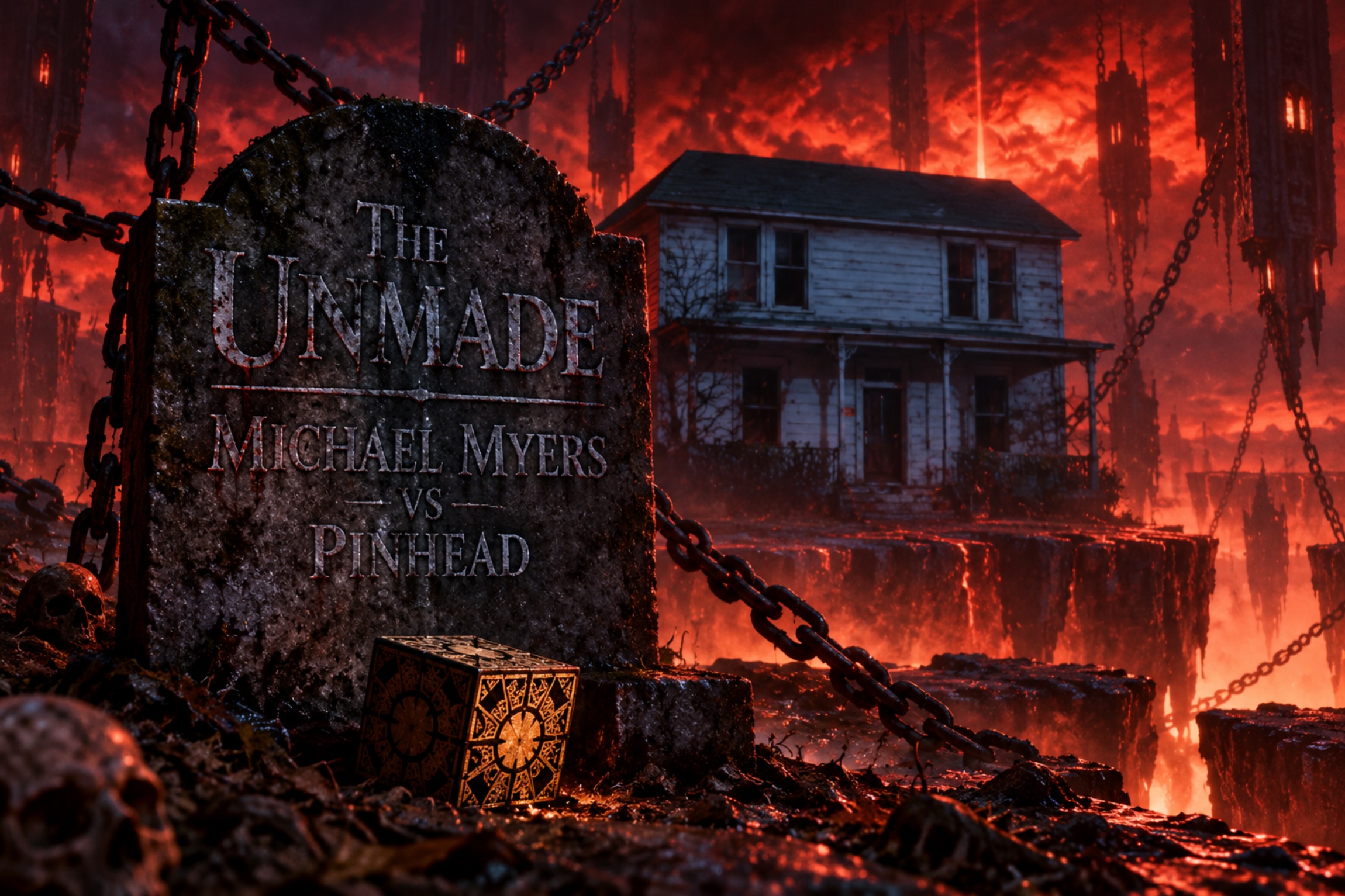
The Unmade: Michael Myers vs. Pinhead
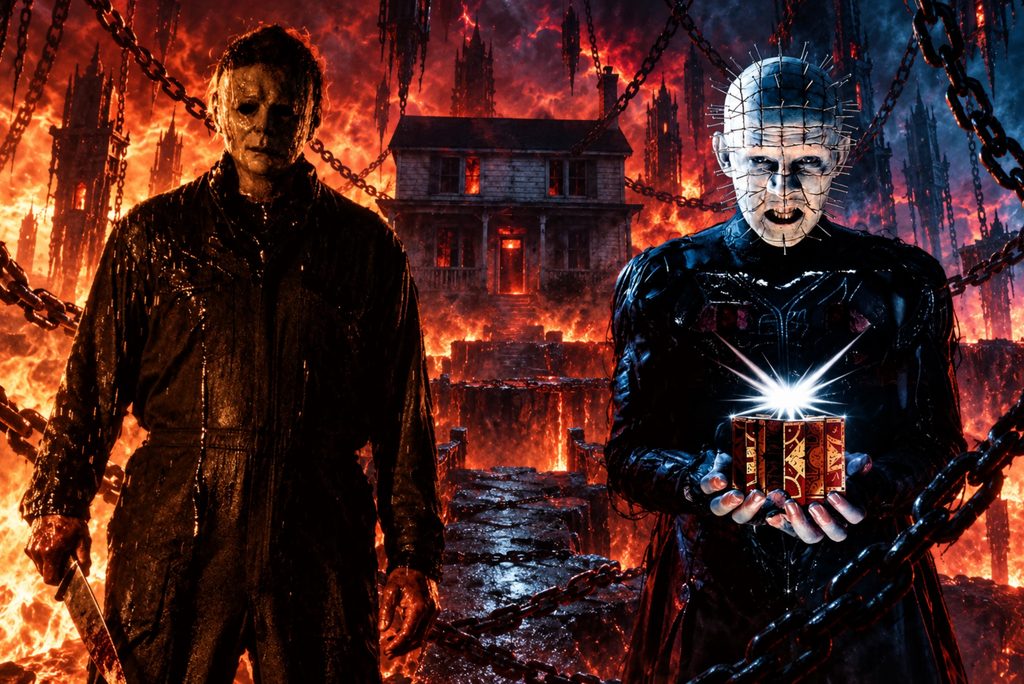
There are certain horror crossovers that sound as though they were conceived by two fans sitting in a pub after somebody made the mistake of asking who would win in a fight. Freddy Krueger versus Jason Voorhees made a strange sort of sense. Alien versus Predator had already been established in comics and video games. But Michael Myers vs. Pinhead? One is a silent murderer who spends Halloween walking very slowly after people while refusing to explain himself. The other is an articulate extradimensional sadomasochist capable of summoning chains from Hell. Finding a believable reason for them to fight was going to require considerably more effort than simply putting “VS” between their names.
Yet during the early 2000s, a Halloween and Hellraiser crossover became a serious possibility. Dimension Films had both franchises under its umbrella, Freddy vs. Jason had demonstrated that audiences would pay to watch horror icons collide, and discussions eventually reached the extraordinary point where Clive Barker was invited to write the film and John Carpenter was lined up to direct it. Michael Myers and Pinhead nearly went to war, and the men who created their respective cinematic worlds might have been responsible for putting them there.
The story actually begins years before Freddy vs. Jason finally reached cinemas. Filmmaker Dave Parker, who would later direct The Dead Hate the Living and The Hills Run Red, had unsuccessfully pitched his own idea for Freddy vs. Jason around 1994 or 1995. That experience got him thinking about other horror properties that could realistically be combined, particularly franchises controlled by the same company. Dimension had both Halloween and Hellraiser, which made Michael Myers meeting Pinhead considerably more achievable than trying to negotiate half the horror section of a video shop.
Parker came up with the title Helloween and created a proof-of-concept trailer using footage from the existing films. The trailer concluded with an image combining the skull pumpkin associated with Halloween II and Pinhead’s pins, but Parker didn’t simply have a catchy title and a piece of promotional imagery. He had developed an actual story explaining why Michael Myers and the Cenobites could exist within the same mythology.
His solution was certainly ambitious. Parker’s story would return to Michael’s childhood and fundamentally rewrite the origin of The Shape. While trick-or-treating, young Michael would encounter a mysterious figure who gave him the puzzle box familiar from Hellraiser. Opening it would allow Sam Hain, described in Parker’s concept as the Lord of the Dead, to escape Hell and take possession of Michael. His apparently supernatural ability to survive everything subsequently inflicted upon him would therefore have an explanation. Michael Myers wasn’t simply an inexplicably indestructible murderer anymore. Something from Hell had been riding around inside him since childhood.
The present-day story would involve people attempting to destroy the Myers house and discovering the puzzle box hidden inside its walls. Somebody would inevitably open it, because horror cinema would be approximately twelve minutes long if people learned to leave sinister ancient objects alone. Pinhead and the Cenobites would arrive, Michael would return to his old home, and Pinhead would recognise the supernatural presence within The Shape. The resulting conflict would begin in the real world before eventually descending into Hell for the final act.
Parker also intended to incorporate existing characters from the franchises, including Hellraiser survivor Kirsty Cotton. His objective was therefore more ambitious than arranging a wrestling match between two recognisable monsters. He wanted to connect their mythologies and explain one of the oldest questions surrounding Michael Myers in the process. Whether Halloween actually needed that question answering is another matter entirely. Part of Michael’s power had always been that nobody, including Dr. Loomis, could adequately explain what he was.
Dimension didn’t proceed with Parker’s concept, and for several years Michael Myers versus Pinhead remained another strange possibility sitting on horror’s increasingly crowded shelf of abandoned projects. Then, in August 2003, Hollywood received a fairly convincing demonstration that audiences might actually pay money to watch famous monsters beat the living hell out of one another. After spending years trapped in development, Freddy vs. Jason opened at number one in America and remained there for a second weekend.
That success dramatically changed Dimension’s attitude. Doug Bradley, who played Pinhead throughout the first eight Hellraiser films, later recalled being told that Dimension had rejected two Halloween/Hellraiser scripts before Freddy vs. Jason because the studio didn’t believe the concept would work. Once Freddy and Jason proved otherwise, Dimension suddenly became considerably more enthusiastic about discovering what other monsters it could introduce to each other.
This time, however, the studio wasn’t merely looking at another crossover pitch. It approached Clive Barker and John Carpenter, the filmmakers responsible for bringing Pinhead and Michael Myers to cinema in the first place. Barker had created the Cenobites in The Hellbound Heart before writing and directing Hellraiser in 1987, while Carpenter had co-written and directed Halloween in 1978. Barker later confirmed that he was invited to write the proposed crossover, while Bradley recalled conversations with Barker and reports that Carpenter would direct.
That distinction is important because Parker’s Helloween and the later Barker and Carpenter project are frequently folded together when the story is retold. There is no solid evidence that Barker was simply going to take Parker’s Sam Hain storyline and turn it into his own screenplay. In fact, what Bradley subsequently revealed about Barker’s thinking suggests he was interested in something considerably different.
Barker Had Something Stranger in Mind
The most obvious version of Michael Myers vs. Pinhead probably ends with Michael stabbing Pinhead while Pinhead fires chains at Michael until somebody falls through an inconveniently placed portal to Hell. Barker apparently wasn’t particularly interested in making that film. Bradley later explained that Barker considered the actual “versus” element almost beside the point, not least because Michael’s refusal to speak would make him a rather disappointing conversational partner for a villain capable of turning a threat of eternal suffering into a theatrical monologue.
Instead, Barker was interested in discovering where the worlds of Halloween and Hellraiser naturally overlapped. According to Bradley’s recollections, Barker looked at Carpenter’s original Halloween almost like a classic vampire story, with Michael occupying the role of the unknowable monster and Dr. Loomis functioning as a Van Helsing figure who spends much of the film warning everyone that they don’t understand what they are dealing with. As usual, almost nobody listens to him until several people are dead and Michael has demonstrated that falling from a first-floor balcony is, at worst, a minor inconvenience.
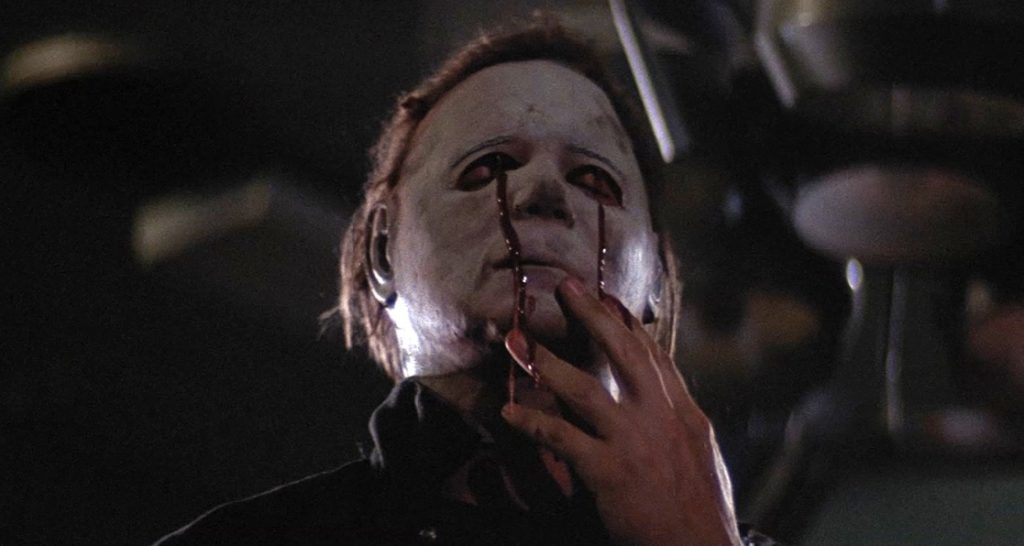
That supernatural ambiguity had been present from the beginning. Loomis repeatedly describes Michael in terms of evil rather than merely mental illness, while Halloween ends with Michael surviving six gunshots, falling from the balcony and disappearing. Carpenter then shows apparently empty locations around Haddonfield while Michael’s breathing continues over them. He is simultaneously an escaped psychiatric patient and something considerably harder to define.
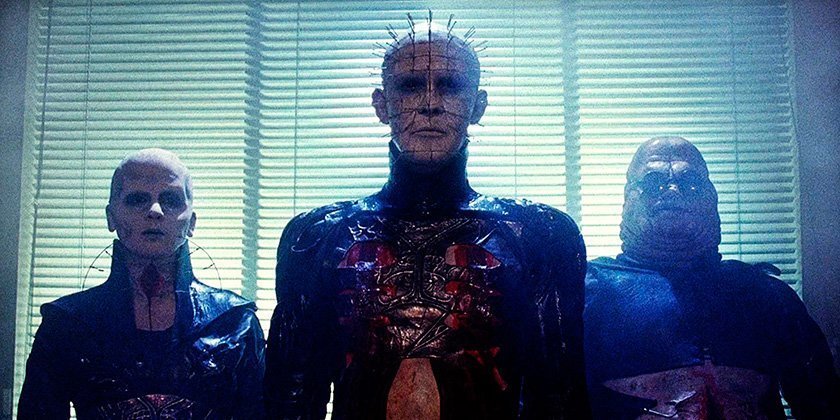
Barker apparently saw that uncertainty as the route into Hellraiser. Bradley recalled that Barker viewed Michael as a sadomasochistic sexual killer whose behaviour would be enough to attract Pinhead’s interest. Rather than giving Michael an elaborate new supernatural biography, Barker seemed interested in exploring why a creature such as Pinhead might become fascinated by whatever Michael Myers actually was. That approach potentially preserved the mystery surrounding The Shape rather than explaining that a particular demon had moved into him when he was six.
It also suggests the crossover could have been far stranger than its title implied. Hellraiser isn’t fundamentally about monsters fighting each other. Barker’s original world revolves around obsession, desire, pain, pleasure and the consequences of seeking experiences beyond ordinary human limits. Michael Myers represents almost the opposite form of horror. He wants nothing that can easily be understood. He simply watches, follows and kills. Putting those two conceptions of evil together could have produced something considerably more interesting than determining whether a kitchen knife beats a hooked chain.
Unfortunately, we never got to discover exactly where Barker would have taken those ideas. There is no known completed Barker screenplay for the project, so elaborate plot summaries sometimes attributed to his version should be treated cautiously. What can be established is that Barker was invited to write it, Carpenter was associated with directing, Bradley was discussing the project with Barker, and Dimension was sufficiently interested for talk to emerge of getting the crossover into cinemas for Halloween 2004.
An official online poll was also conducted to measure fan interest in seeing Michael Myers and Pinhead together, and the response wasn’t particularly encouraging. More importantly, there was resistance from the people controlling the Halloween side of the equation. Barker later said that the owners of the Halloween movie rights didn’t want to proceed, while Bradley recalled being told that the Akkad side opposed the crossover.
Longtime Halloween producer Moustapha Akkad had maintained substantial control over Michael Myers and the direction of the franchise. That presented Dimension with a fairly decisive obstacle. The studio could have Barker interested in writing, Carpenter linked with directing and Bradley ready to put the pins back into his head, but a Michael Myers versus Pinhead movie becomes noticeably more difficult when the people controlling Michael Myers don’t want Michael Myers versus Pinhead.
The project consequently disappeared before Barker’s ideas became a finished film. The negative fan reaction may not have helped its prospects, but the opposition surrounding the Halloween rights was the crucial barrier repeatedly identified by Barker and Bradley. For one brief period after Freddy vs. Jason, however, one of horror cinema’s most unlikely combinations had moved beyond somebody idly wondering what would happen if the two characters met.
Michael Myers vs. Pinhead – The Greatest Halloween Movie We Never Got?
The timing makes the whole thing even more fascinating. Halloween: Resurrection had arrived in 2002 and left Michael’s theatrical future uncertain despite the character himself surviving, while Hellraiser was increasingly becoming a direct-to-video franchise. Hellraiser: Hellseeker appeared in 2002, followed by Deader and Hellworld in 2005. Both monsters were therefore available at precisely the moment Hollywood briefly became fascinated with the commercial possibilities of smashing established horror properties together.
Had the crossover happened quickly enough, Doug Bradley was still playing Pinhead, meaning the definitive screen incarnation of the character could realistically have participated. Carpenter returning to direct Michael Myers would have been even more remarkable. He hadn’t directed a Halloween film since the 1978 original, although he had remained involved in various capacities during the franchise’s earlier years. The prospect of Carpenter returning to Michael while simultaneously directing Barker’s Cenobites would alone have made the film an extraordinary curiosity.
Then there was Barker himself. A Halloween/Hellraiser crossover written by somebody hired simply to manufacture excuses for Michael and Pinhead to attack one another could easily have become disposable early-2000s horror nonsense. A screenplay from Barker directed by Carpenter is a completely different proposition. These weren’t filmmakers being hired to imitate the people who had established the characters. They were the filmmakers who had established them.
Whether it would actually have worked is impossible to know. Michael Myers and Pinhead represent radically different kinds of horror. Michael is most effective when very little is known about him, while Pinhead emerges from a mythology filled with rules, desires, gateways and an entire supernatural order. Explain Michael too thoroughly and you risk destroying the blankness that makes The Shape frightening. Explain nothing and Pinhead might reasonably wonder why Dimension Films has dragged him all the way to Haddonfield.
Barker’s apparent solution, concentrating on where those concepts intersected rather than simply deciding who could win a fight, is precisely why the abandoned film remains fascinating. It might have been terrible, because horror history contains more than enough terrible movies made by extremely talented people. But the combination of Barker, Carpenter, Bradley, Michael Myers and Pinhead offered the possibility of something far more ambitious than the title Michael Myers vs. Pinhead initially suggests.
Instead, Halloween eventually went in a completely different direction. Rob Zombie was hired to reinvent the property, with his remake arriving in 2007 and providing its own extensive explanation of Michael’s childhood. Pinhead continued through further Hellraiser instalments, with Bradley making his final feature-film appearance in the role in Hellraiser: Hellworld before declining to return for later sequels.
The wider crossover craze continued for a while. Alien vs. Predator arrived in 2004 and received its own sequel in 2007, while numerous other combinations were discussed without reaching production. The enormous success of Freddy vs. Jason had briefly convinced Hollywood that perhaps the contents of the horror aisle could simply be tipped into one enormous bucket and shaken until a franchise emerged.
Michael Myers and Pinhead nevertheless remain one of the most tantalising pairings because of who might have been behind the camera. Hollywood had spent years producing Halloween sequels without Carpenter directing and Hellraiser sequels without Barker writing, then briefly reached a point where Barker might write Pinhead again, Carpenter might direct Michael again, Doug Bradley was still wearing the pins and both characters could appear in the same movie. Somehow, that was the film that didn’t get made.
Perhaps we were spared something dreadful. Perhaps Carpenter and Barker would have discovered that Michael Myers and Pinhead belonged together about as naturally as Laurie Strode and a romantic weekend at a secluded cabin. We will never know. What remains is one of the great oddities of early-2000s horror development, when the success of one crossover almost persuaded Dimension to send The Shape somewhere even Dr. Loomis might have struggled to follow.
Freddy got Jason. Alien got Predator. Michael Myers very nearly got Pinhead, Clive Barker and John Carpenter.
Considering the number of increasingly improbable things Michael has survived over the years, missing that particular appointment with Hell might be his greatest escape.