The Unmade: Vincent Ward’s Alien 3
When Aliens ended in 1986, Ellen Ripley had survived another encounter with the Xenomorphs, rescued Newt, escaped alongside Corporal Hicks and recovered what remained of Bishop. James Cameron had transformed Ridley Scott’s claustrophobic original into a spectacular war movie without simply repeating it, leaving whoever inherited the third film with an unenviable problem. How do you follow two science-fiction classics that had already taken essentially the same creature in completely different directions? During one of the most notoriously difficult development periods in Hollywood history, numerous writers and filmmakers attempted to answer that question. The strangest and perhaps most fascinating solution came from New Zealand filmmaker Vincent Ward, whose Alien 3 would have taken Ripley somewhere unlike anything previously seen in the series: a vast monastery floating through space.
Ward was an unusual candidate for a major Hollywood sequel. His 1988 film The Navigator: A Medieval Odyssey followed medieval villagers who journey through the Earth and emerge in twentieth-century New Zealand, combining religious imagery, history and fantasy in a manner that caught the attention of Alien producers Walter Hill and David Giler. Ward initially wasn’t interested in Alien 3. He was sent an existing screenplay by David Twohy, but disliked the story and continued resisting the job until his agent persuaded him to reconsider. Ward eventually agreed on one important condition: he wanted to develop an entirely different story. Fox allowed him to do exactly that.
A Monastery Floating Through Space
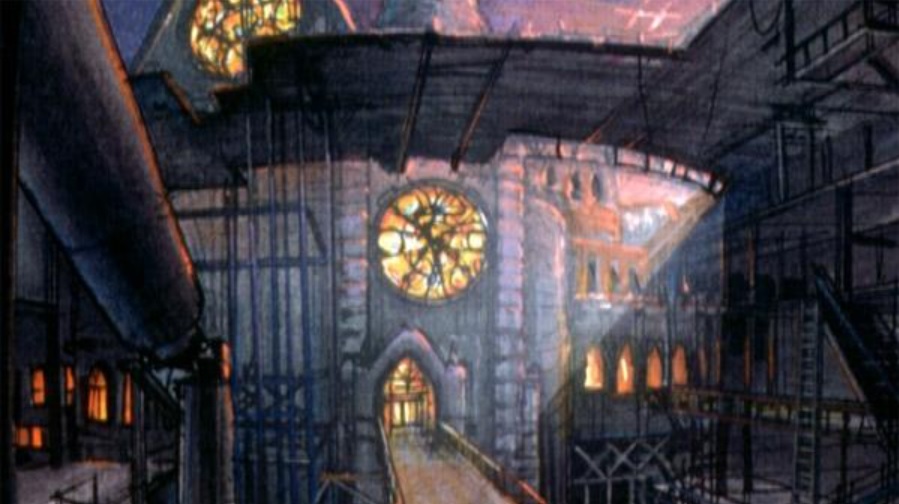
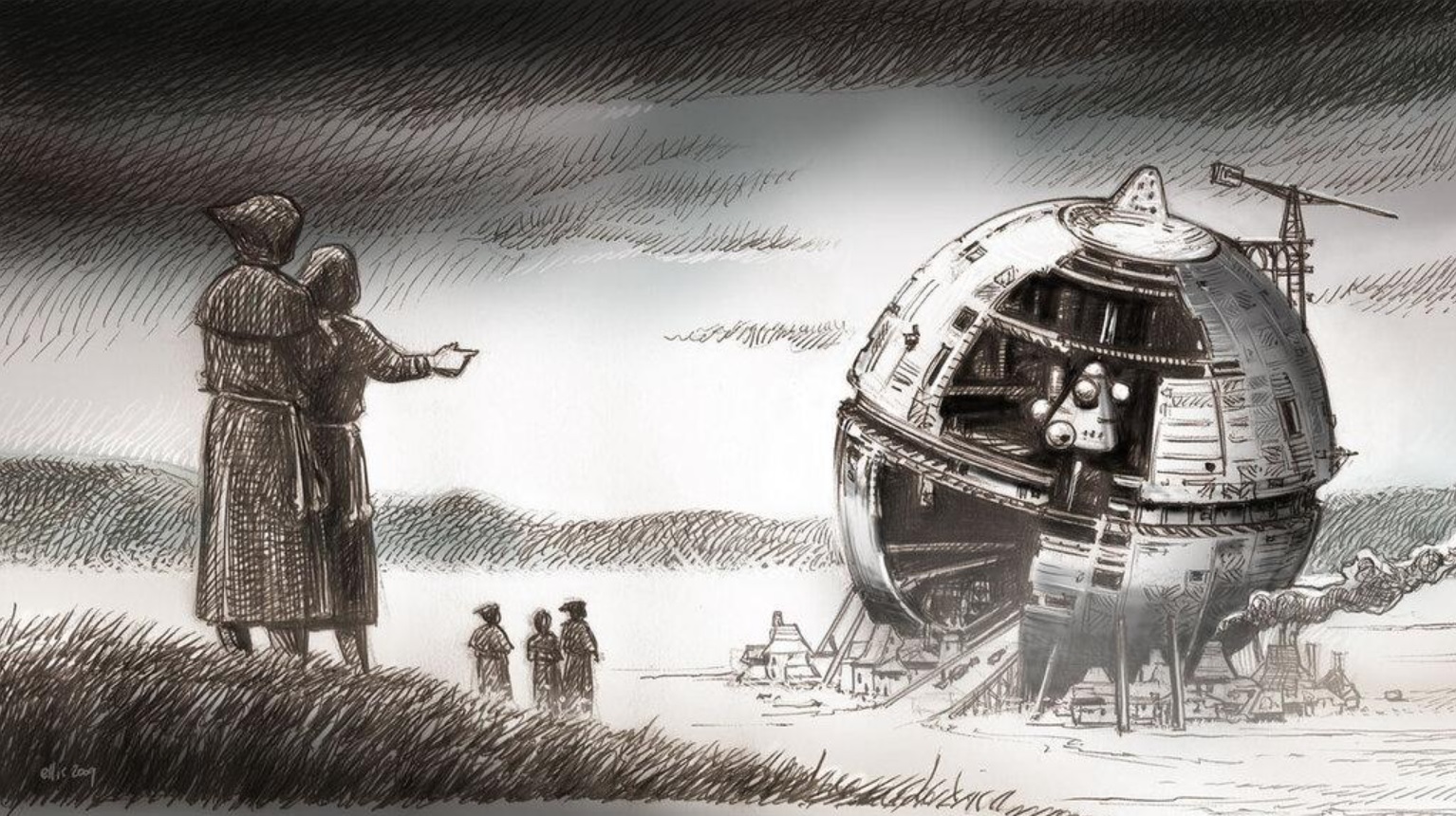
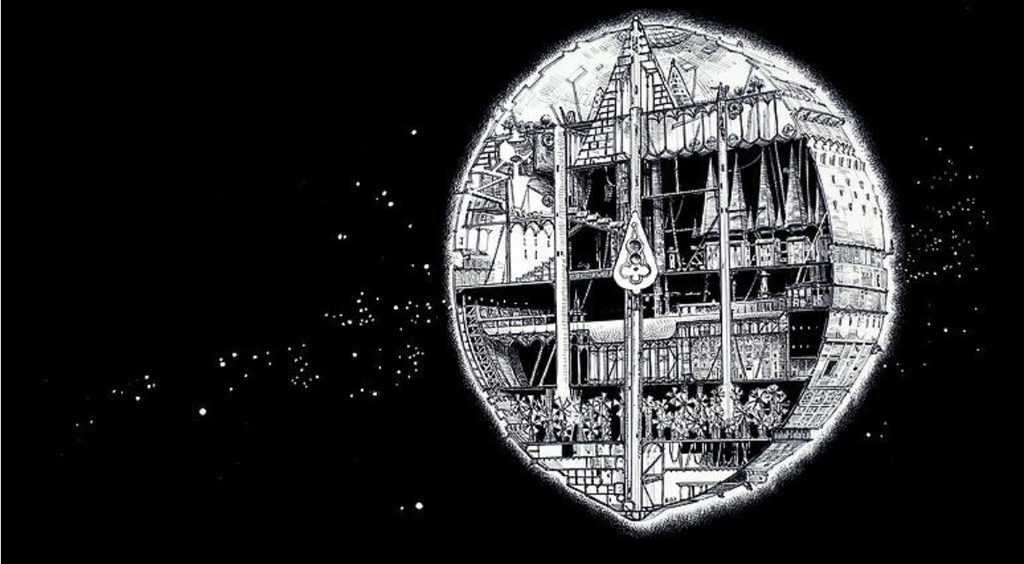
Ward’s central idea was extraordinary. Ripley would arrive aboard Arceon, an enormous artificial satellite inhabited by a religious community that had rejected modern technology. The structure was technologically advanced beneath the surface, but its inhabitants had effectively constructed a medieval world around themselves. There were wooden buildings, libraries, farms, grain fields, windmills, glassworks, animals and huge ecclesiastical spaces. The men living there dressed and behaved like monks, maintaining a society deliberately separated from the technological civilisation outside. Ward’s own description of the project and surviving development material identify Arceon as a monastery satellite constructed largely from wood, with the filmmaker drawing heavily upon medieval imagery.
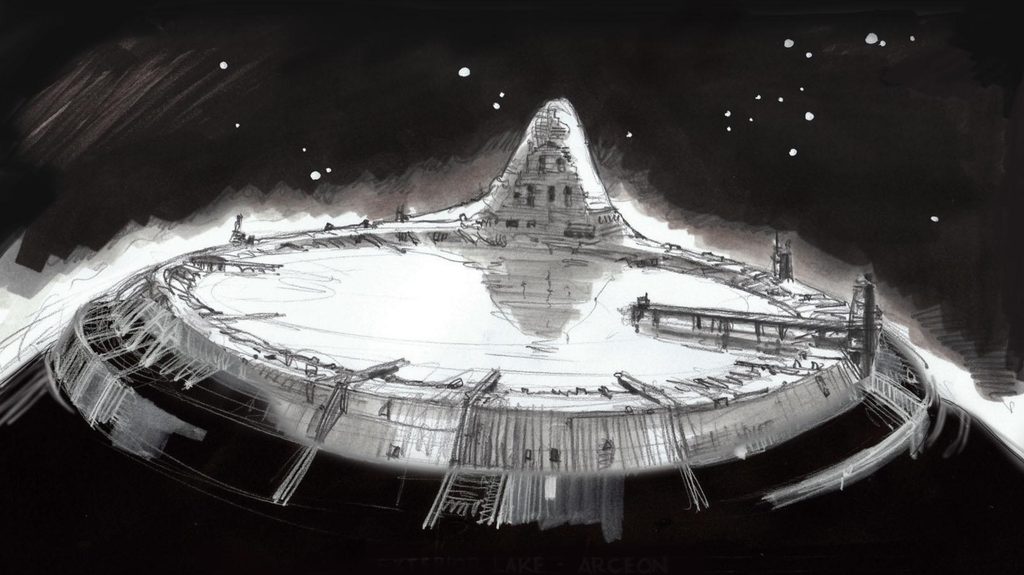
Calling it the “wooden planet” has consequently become useful shorthand, but it can also make the idea sound considerably sillier than what Ward was proposing. This wasn’t supposed to be a normal planet inexplicably made from timber. Arceon was an enormous artificial structure whose inhabitants had covered and expanded it with wood, creating the illusion of a self-contained medieval world. Screenwriter John Fasano, who worked extensively with Ward, later described the irony at the heart of the concept: the monks rejected technology while unknowingly depending upon an extremely sophisticated piece of technology to keep their society alive. Their books were physical, their lifestyle deliberately pre-industrial, yet the entire world around them could exist only because machinery continued operating beneath it.
The setting also gave the third film a thematic identity separate from its predecessors. Fasano later explained how he viewed Alien as partly concerned with corporate interests and blue-collar workers, while Aliens explored the military. Their Alien 3 would turn towards religion. Rather than merely placing another group of armed characters in front of a Xenomorph, Ward and Fasano could introduce the creature into a society whose inhabitants might interpret its existence through faith, sin and superstition. The Alien wouldn’t simply be an extraterrestrial organism to these men. Its arrival could be understood as something demonic, a punishment or a test of their beliefs.
Ripley Arrives, but Paradise Doesn’t Last
Ward and Fasano’s story went through numerous revisions, so there isn’t one single immutable version of every event. That distinction matters when discussing the unmade film because details changed during development. In one documented version, Ripley and Newt escape from the Sulaco after the ship is overrun and their craft crashes onto Arceon. Newt dies, leaving Ripley once again stripped of the family she had fought so desperately to protect. Ward explained that Newt’s death was intended to deliver another devastating emotional blow and force Ripley to question whether continuing to fight was worthwhile.
A Xenomorph also reaches Arceon, turning Ward’s beautiful medieval environment into a hunting ground. The surviving screenplay material contains some striking imagery. The creature stalks through fields of wheat, with one version giving it a chameleon-like ability to blend with the golden surroundings. Fires spread through Arceon’s agricultural areas, threatening not only the monks but the fragile ecosystem supporting their artificial world. If the vegetation dies and the fires consume the available oxygen, the entire satellite becomes a death trap. The Alien is therefore not merely killing individuals. Its presence begins dismantling the environment that allows the community to exist at all.
The creature itself was also being reconsidered. Fasano recalled the idea that a Xenomorph should take characteristics from the organism in which it gestates. That concept would survive development and become important to the finished Alien 3, whose creature moves on four legs after emerging from an animal. The exact host differs depending upon which version of the eventual film is watched, with the theatrical cut using a dog while the Assembly Cut restores an ox, but the broader idea that this Alien should physically differ from those born from humans has roots in the earlier development. Fasano specifically remembered their creature as quadrupedal and regarded its host-derived characteristics as part of the Xenomorph’s ability to adapt to whatever world it encountered.
Ripley Was Going to Lose Newt and Hicks Anyway
One of the most controversial decisions in the completed Alien 3 is the immediate removal of Newt and Hicks, effectively destroying the hopeful ending of Aliens before the third film has properly begun. That decision is sometimes associated entirely with the movie eventually directed by David Fincher, but Fasano’s recollections show that versions developed before Fincher’s arrival were already killing characters who had survived Cameron’s film.
Fasano recalled one draft in which Newt and Hicks died aboard the ship, with Ripley discovering that Newt’s body had been used to carry a Xenomorph. Bishop remained alive in damaged form, and the monks provided his surviving upper body with wooden legs. The precise treatment of the characters changed between drafts, but the important point is that Ward’s Alien 3 wasn’t necessarily going to preserve the surrogate family created at the end of Aliens. The bleakness commonly associated with the finished movie was already emerging while the project was still taking place aboard Arceon.
Ripley’s own fate was another major point of discussion. Fasano recalled Sigourney Weaver wanting Ripley to die, feeling that after defeating the creature twice, continually repeating the cycle had become difficult to justify. According to Fasano, Fox resisted an ending in which she died, leading him to develop an alternative where a monk named John attempted to save her while removing the Alien growing inside her. The ending continued evolving, but the possibility of Ripley’s death was therefore being seriously explored before Fincher eventually directed the famous conclusion in which she sacrifices herself by falling into the furnace.
This Wasn’t Just an Idea on a Piece of Paper
What makes Ward’s Alien 3 particularly fascinating for The Unmade is how far beyond an abandoned pitch it progressed. Fasano said Fox wanted a screenplay extraordinarily quickly, recalling being told that the studio needed one in around two weeks. He and Ward worked closely together, with Fasano later estimating that he wrote roughly ten drafts during their collaboration. The project moved into substantial visual development, with artists exploring how Ward’s wooden, medieval world could actually exist on screen.
Production designer Norman Reynolds was involved, while experimental architect and artist Lebbeus Woods contributed designs for Arceon’s extraordinary structures. Ward also met H.R. Giger, whose work had defined the original Xenomorph. Sets connected with Ward’s concept began being constructed at Pinewood Studios, meaning this wasn’t a movie abandoned before anyone had seriously considered how to build it. The machinery of production had started moving while the creative arguments surrounding the project continued.
Ward even considered some unexpected casting possibilities for the monks. Fasano remembered discussions involving John Cleese and Michael Palin, with certain characters intended to provide comic relief. Fasano described what he and Ward were attempting in particularly memorable terms, recalling that they were trying to make something approaching a “Monty Python version” of Alien. That shouldn’t be taken to mean Ward intended to turn the franchise into an outright comedy. Rather, it demonstrates just how far he was prepared to move away from the military machinery of Aliens and towards something stranger, more eccentric and rooted in European medieval imagery.
So Why Didn’t Vincent Ward’s Alien 3 Happen?
The same ambition that made Ward’s concept so distinctive also created enormous practical difficulties. Fox had a major franchise to protect, a schedule to meet and increasingly serious concerns about the complexity and expense of bringing Arceon to life. Ward, meanwhile, had accepted the project specifically because he had been permitted to pursue an original idea. Simplifying that idea too far risked destroying the reason he had agreed to make the film in the first place.
Accounts of the breakdown describe repeated pressure to modify and simplify the setting. Ward resisted changes he believed compromised the concept, while the studio became increasingly uncomfortable with the production. Fasano later characterised the fundamental conflict as Ward wanting the film to be perfect while Fox wanted it completed to a firm schedule. Whatever interpretation is placed on the dispute, the relationship eventually became untenable and Ward left the project. Other writers continued reshaping the material, and David Fincher was ultimately hired to direct what became the 1992 Alien 3.
Yet Ward’s movie didn’t completely disappear.
The wooden monastery was gone, but the finished film still strands Ripley inside an isolated, overwhelmingly male community that has rejected much of conventional society and embraced religion. Arceon’s monks became, in a broad sense, the religious prisoners of Fiorina 161. The quadrupedal Alien survived. Newt and Hicks still died. Ripley still discovered that she was carrying a Xenomorph, and her story still ended with sacrifice beside an enormous industrial furnace. Fasano later argued that a substantial amount of the narrative DNA from his work remained in the finished film, even though he received no screenplay credit.
The Alien Film We Can Still See Inside Alien 3
There is something particularly appropriate about Vincent Ward’s Alien 3 remaining visible only in fragments. Concept artwork, screenplay drafts, interviews and Ward’s own retrospective material allow us to glimpse a film filled with wooden cathedrals, windmills, wheat fields and monks attempting to understand a creature that appears to challenge everything they believe. It sounds completely unlike Alien or Aliens, which may have been both its greatest strength and the reason a studio preparing an enormously expensive sequel became nervous.
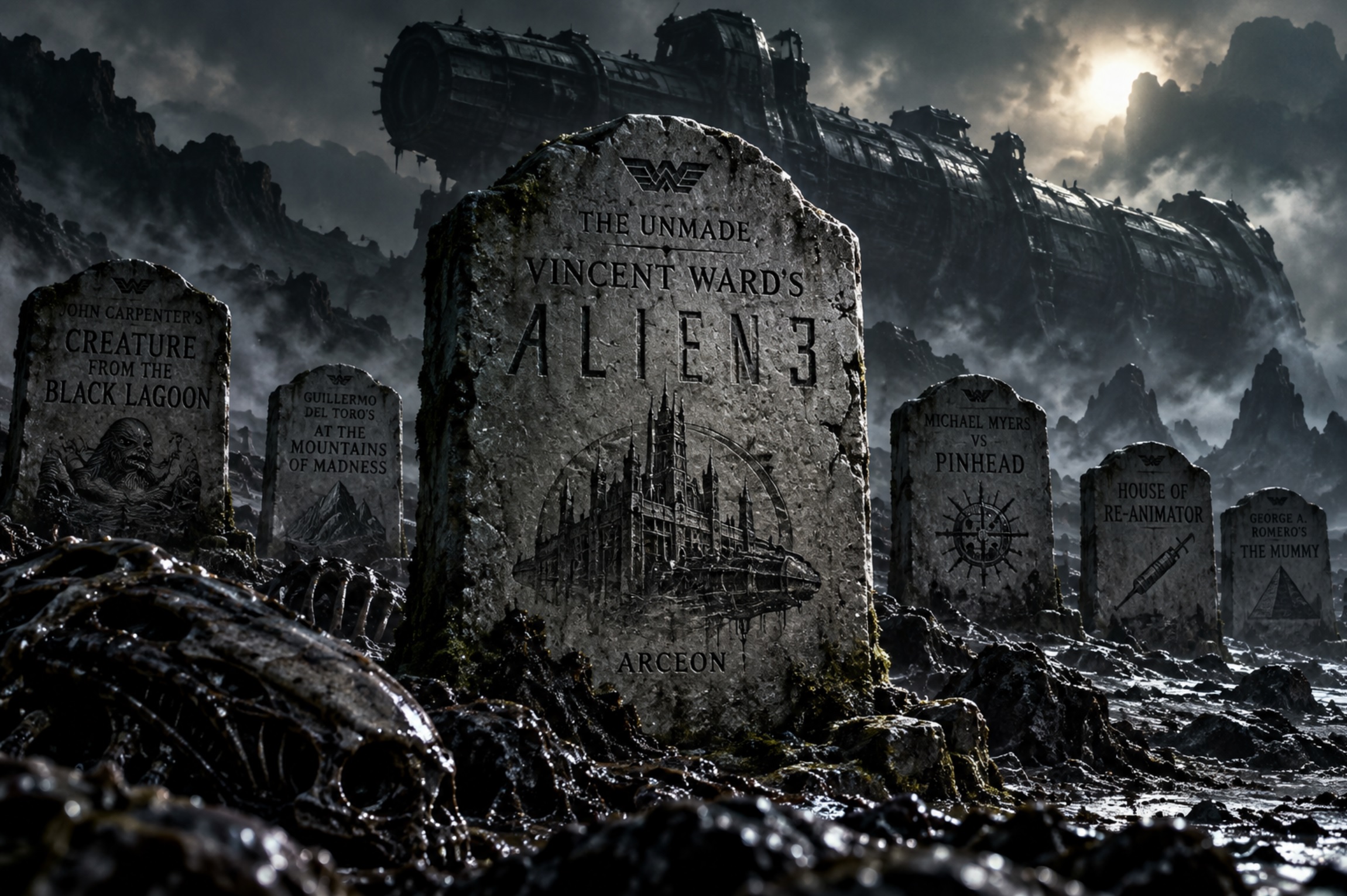
Whether it would have worked is something we can never truthfully answer. A magnificent collection of ideas doesn’t automatically produce a magnificent film, and the enormous technical challenge of creating Arceon could have overwhelmed the production. What we can say is that Ward wasn’t proposing a routine sequel. He was trying to give the third Alien film its own visual language, setting and thematic identity, just as Cameron had refused simply to recreate Scott’s original.
Instead, Ward’s wooden world was dismantled before audiences ever had the opportunity to enter it. David Fincher inherited a production already carrying years of abandoned concepts, competing scripts and studio disagreements, and the film that eventually emerged has its own complicated history. Yet beneath Fiorina 161, its religious inhabitants, its four-legged creature and Ripley’s final sacrifice, traces of another movie remain.
Somewhere underneath Alien 3 is the ghost of Vincent Ward’s wooden planet, an enormous medieval cathedral drifting silently through space, waiting for a Xenomorph that never quite arrived. If you would like to read the script, HERE IT IS